Table of Contents
Quick question: when was the last time something genuinely great happened at your company that only one person was responsible for? A product launch, a big client win, an award — these moments almost always involve multiple people behind the scenes, yet LinkedIn posts about them have traditionally credited just one.
LinkedIn just decided that’s a missed opportunity. The platform has introduced Collaborative Posts, a feature that lets creators officially co-author posts with other members or company pages — and it’s testing the idea in the highest-visibility way possible: live, on the ground, at the Cannes Lions advertising festival.
What Do You Mean By “Collaborative Posts”?
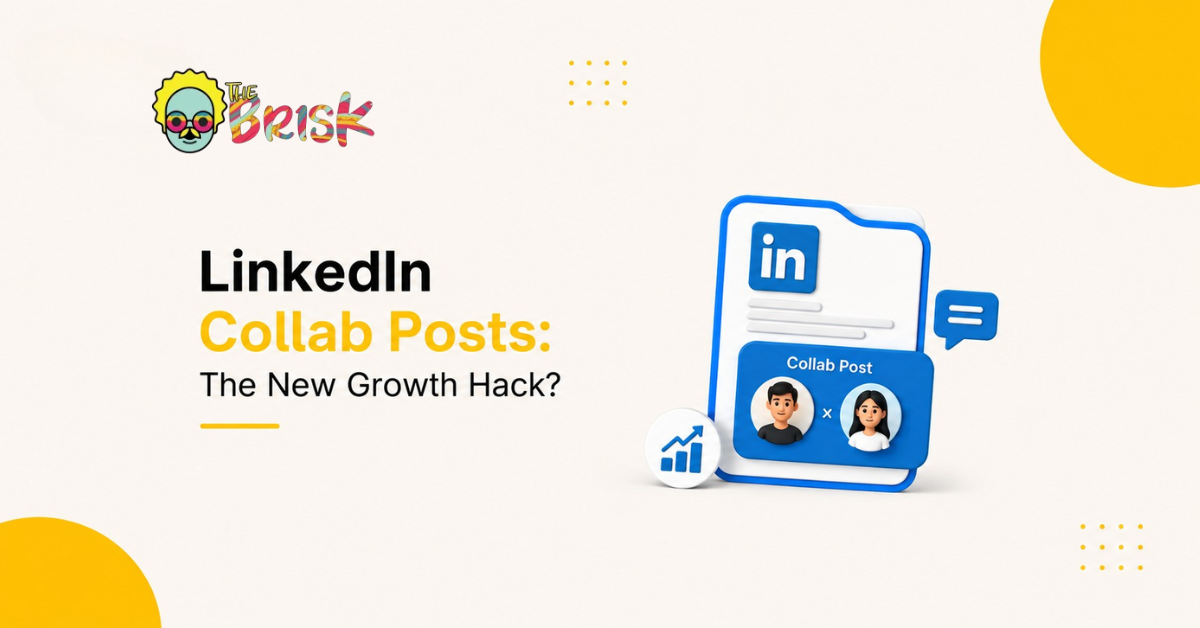
Collaborative Posts let a creator add other LinkedIn members or company pages as official co-creators on an in-stream post, through a new “Add Collaborators” option inside the post composer. Once published, all listed collaborators appear at the top of the post, and — this is the important part — the post gets pushed into each collaborator’s individual feed, not just the original author’s.
LinkedIn describes the motivation in almost sentimental terms, framing it as a way to recognize that “great ideas love company” — product launches, executive announcements, brand partnerships, and team milestones almost always involve more than one person, even if only one name has historically gotten the byline.
What Was It Earlier?
If this sounds familiar, that’s because Instagram has had a comparable “collab post” feature for a while, letting two creators co-publish content to both of their audiences simultaneously. LinkedIn is clearly borrowing the underlying mechanic, but applying it to a B2B, professional context where the format makes a different kind of sense — less “two influencers cross-promoting,” more “a founder, a customer, and a teammate all sharing credit for one announcement.”
Before this feature, LinkedIn posts had exactly one author and one feed of origin. If five people worked on a launch, only one of them could post about it natively and reach their own network; everyone else had to either write a separate post or simply comment and reshare, both of which dilute reach and split engagement.
This launch also doesn’t exist in isolation on LinkedIn’s roadmap. It’s the latest in a steady run of creator-monetization features: LinkedIn launched its own Creator Marketplace earlier in June 2026 to connect brands with relevant creators for paid promotions, on top of its existing BrandLink offering, which lets advertisers run influencer content as ads, and the platform’s long-standing ability for brands to sponsor organic posts.
What’s Changing Now?
LinkedIn is currently testing Collaborative Posts with a select group of creators and brands on the ground at Cannes Lions 2026, with plans to expand the rollout to more users over the following months. The mechanics, per LinkedIn, are straightforward: members and pages will be able to share posts together, with all collaborators visibly credited at the top, and the post distributing into multiple feeds rather than one.
Why Does The Timing Matter?
Launching at Cannes Lions — the advertising and marketing industry’s biggest annual stage — is not a coincidence. It puts the feature directly in front of the brand marketers, agency leaders, and creators who are most likely to actually use it and talk about it. It’s a calculated move to position Collaborative Posts as a marketing-industry feature first, before it trickles down to the broader LinkedIn user base.
It also lands at a moment when LinkedIn is visibly trying to deepen its creator economy — Creator Marketplace, BrandLink, sponsored organic posts, and now this. Each of these features chips away at the same problem: giving people more reasons to keep posting, and brands more ways to participate in and pay for that activity.
What’s The Future Impact Of LinkedIn Collaborative Posts?
The most consequential detail buried in this announcement is almost a throwaway line: collaborative posts give brands another way to tap into the reach of member networks, which generally outperform company page posts.
That’s not a new insight — individual employee posts have long out-reached brand pages on LinkedIn — but Collaborative Posts formalizes and multiplies that effect. A single announcement, co-authored by three or four people, could now organically land in all of their networks simultaneously, for free, without needing separate posts or paid amplification.
That has real implications for how companies plan content. Product launches, executive thought leadership, partnership announcements, and team wins are all natural candidates for multi-author treatment — and the brands that build this into their workflow early stand to meaningfully outperform those still treating LinkedIn as a single-author broadcast channel.
What Should We Do As Marketers?
- Identify your natural co-authors now. Who inside your company — beyond the usual social media handle — has a strong personal network and a real stake in upcoming announcements? Founders, product leads, sales reps closing big deals, and customer champions are all good candidates.
- Rethink your launch playbook. Instead of one company-page post and a request for employees to “like and share,” plan key announcements as genuinely co-authored content from the start.
- Treat this as an employee advocacy lever, not just a creator feature. The framing around creators and brand partnerships is real, but the bigger opportunity for most B2B companies is internal: getting the right employees credited and distributing through their networks.
- Watch how the feature gets misused before you lean in too hard. Early test phases often surface edge cases — spammy collaboration requests, mismatched brand tone across collaborators — worth understanding before scaling usage.
What Should We Keep An Eye On?
- The pace of rollout beyond the initial Cannes test group, and whether there’s a way to request early access.
- Whether collaborators can be added after a post is already published, or only at creation time.
- What analytics, if any, LinkedIn provides for collaborative posts — does each collaborator see combined reach, or only their own audience’s engagement?
- How company pages, specifically, get treated as collaborators, including any brand-safety or approval controls for that relationship.
LinkedIn rarely launches features without a clear monetization thread running underneath, and Collaborative Posts is no exception — more reasons to post, more people incentivized to post often, more inventory for LinkedIn to eventually wrap ads and promotion around. For marketers, though, the near-term opportunity is simpler: more reach, for free, if you’re willing to share the byline.
The Bottom Line
The brands that win this feature won’t be the ones who wait for a press release announcing full rollout — they’ll be the ones who already have a co-authoring habit built before everyone else catches on. Pick your next big announcement, name two or three real co-authors today, and request early access if LinkedIn offers it. This good rarely stays free for long.
Sources referenced: Social Media Today, LinkedIn’s official announcement.




No Comments