Table of Contents
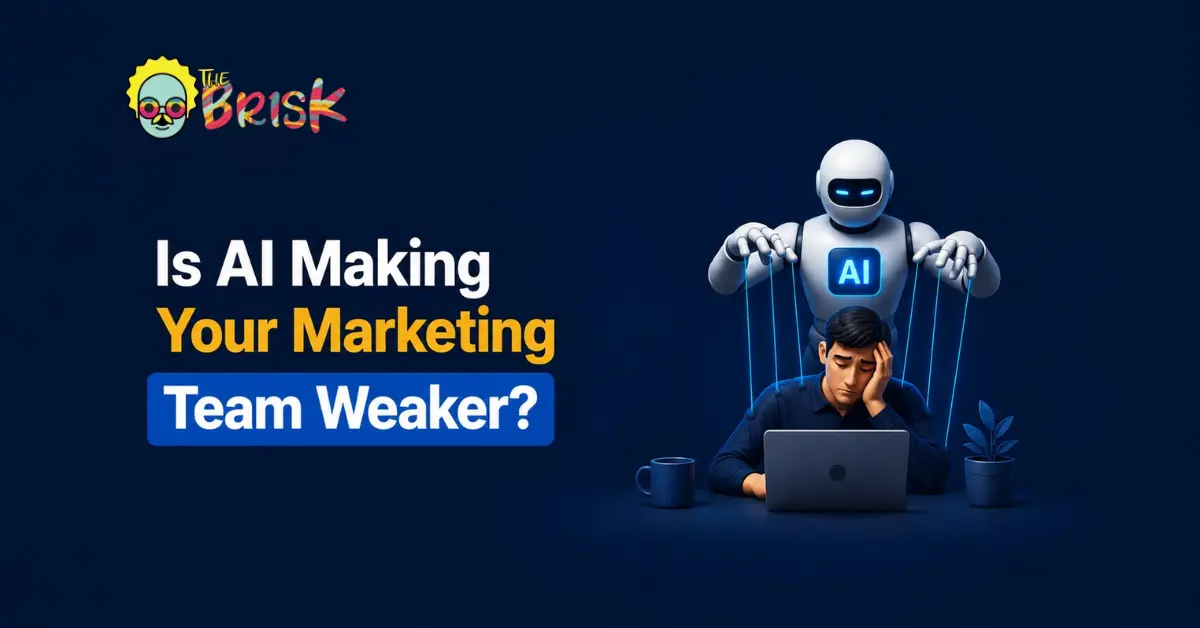
How automating the wrong tasks is quietly destroying the talent pipeline, and why most organizations won’t notice until it’s already too late.
There is a logic to AI adoption that feels almost self-evidently correct.
You look at your team. You identify the tasks that are repetitive, time-consuming, and formulaic. You ask: could a machine do this faster and cheaper? When the answer is yes, you automate. You redeploy human effort toward higher-value work. You run leaner. You report the efficiency gains upward. Everyone nods.
This is how most organisations are thinking about AI right now. And on the surface, it is hard to argue with. The productivity gains are real. The cost savings are documented. The case studies are everywhere.
But here is the problem: the logic is incomplete. It optimises for the present while quietly cannibalising the future. And nowhere is this more visible — or more consequential — than in marketing, SEO, and the content disciplines that have become the frontline of AI adoption.
The tasks being automated away are not just tasks. For many of the people doing them, they are the curriculum. They are how expertise gets built. And when you remove them from the workflow, you do not just eliminate inefficiency. You eliminate the training ground.
This is what I call the deskilling trap. And the data suggests we are already well inside it.
What the research actually shows
Before we get into what this means for teams and hiring, it is worth spending some time with the numbers — because the picture is more complicated than most coverage suggests.
The productivity argument is real
Anthropic’s Economic Index report, published in January 2026, found that AI can help users complete tasks that would typically require a college education up to 12 times faster than they could unaided. For tasks requiring roughly a high-school level of knowledge, the speed-up is still significant at nine times faster.
These are not trivial gains. If a senior strategist can now complete a competitive landscape analysis in an hour that previously took a day, that is genuinely significant. It is not hype.
But that same report contains a data point that tends to get much less attention: across all task types, AI currently achieves a success rate of between 66% and 70%. Which means somewhere between 30% and 34% of AI outputs are wrong, incomplete, or unsuitable for use — requiring human intervention, correction, or outright rejection.
One in three. Approximately.
That number becomes more alarming when you consider what type of human is best placed to catch those failures. The answer, unsurprisingly, is an experienced one. Someone who can look at a keyword cluster and feel that something is off about the intent mapping.
Someone who can read a content brief and recognise that the recommended angle has already been covered to death. Someone who knows, from years of doing this, that the client’s market does not behave the way the data says it should.
You cannot develop that kind of judgment by reading about it. You develop it by doing the work — including, and especially, the routine parts of it.
The code problem and what it tells us about marketing
A useful parallel comes from software development, where AI adoption is arguably more advanced and the consequences of errors are easier to measure.
Research from CodeRabbit, published in 2025, found that AI-generated code produces roughly 1.7 times more issues than human-written code. These are not just stylistic problems. They include logic errors, readability failures, and — most concerning — security vulnerabilities.
Experienced developers can catch these. They treat AI output as a rough prototype, not a finished product. They know what good looks like because they have written a lot of code the slow way.
Junior developers, increasingly, have not had that chance. They are being handed AI tools before they have built the foundational knowledge required to evaluate what those tools produce. The result is code that looks functional on the surface, ships into production, and surfaces problems downstream.
The same dynamic is playing out in marketing. A junior content strategist handed an AI brief generator has no reliable frame of reference for what a good brief looks like.
An entry-level SEO using AI keyword tools may not understand why certain clusters are misleading, or why the search intent mapping feels plausible but is actually wrong for this specific client. They are using sophisticated tools without the underlying literacy to audit their output.
The job market is already reshaping
The hiring data makes the structural shift visible in a way that is hard to ignore.
Entry-level job postings have declined approximately 35% across the US economy since January 2023, with AI cited as a significant contributing factor (Revelio Labs, 2025).
In the technology sector specifically, hiring of new graduates with less than one year of experience has dropped by 50% since 2019, according to SignalFire’s State of Talent Report. New graduates now account for just 7% of tech hires.
Marketing is not immune. The Content Marketing Institute’s 2026 careers and salary report found that one in three companies has pulled back on entry-level marketing hiring — nearly two and a half times more than those increasing it.
At the same time, 43% of surveyed marketers reported that their organisation had laid off marketing employees in the past year, a 30% increase from 2024.
But here is the part that often gets lost: overall marketing hiring is going up. The same CMI report shows a net hiring score of +22.3 points — the percentage of organisations increasing headcount significantly outweighs those decreasing it. A Semrush analysis of SEO job postings found that 59% are for senior leadership roles, with mid-level positions accounting for just 25%. Entry-level barely registers.
What this tells us is not that organisations are shrinking their marketing functions. It is that they are trying to skip the middle. They want the experience without the years of investment it takes to build it. They want senior people who can direct, challenge, and improve AI output — and they want them now, without going through the pipeline.
The trouble is, senior people do not appear from nowhere.
What is the deskilling mechanism, and how does it actually work
To understand why this matters so much, it helps to be precise about what “deskilling” actually means in this context. It is not that AI makes people lazy or stupid. The mechanism is subtler than that.
Expertise is built through repetition with feedback
The research on skill acquisition is fairly consistent on this point. Whether you are talking about cognitive skills, physical skills, or professional judgment, expertise develops through repeated exposure to varied problems, combined with feedback on outcomes. You do something. You see what happens. You adjust your mental model. You do it again.
The 10,000-hour rule — famously associated with Malcolm Gladwell’s interpretation of Anders Ericsson’s research, though Ericsson himself was more nuanced — is not really about time. It is about deliberate practice: repeated engagement with challenging problems at the edge of your current competence, with corrective feedback.
What this means for entry-level marketing work is that the repetitive tasks are not just mechanical outputs. They are practice sessions. Each keyword research project, each content audit, each client brief is an opportunity to build a slightly more refined mental model of how this all works.
Over dozens of those projects, patterns emerge. Instincts sharpen. A junior who has done keyword research for a law firm, a SaaS startup, a regional retailer, and a global manufacturer starts to develop a feel for how commercial context shapes keyword value in ways no spreadsheet can capture.
When AI handles that work, the output gets done. But the learning does not.
The oversight gap
There is a second, more immediate problem. AI tools require skilled oversight to produce reliable output. If you do not have people with the foundational knowledge to evaluate what AI gives you, you have no reliable quality filter.
Anthropic’s own data shows that its models succeed on roughly two-thirds of tasks. That failure rate is not distributed randomly. It is concentrated in areas that require contextual judgment, tacit knowledge, and the kind of domain expertise that is hard to specify as a prompt.
In SEO specifically, the failure modes are easy to list: keyword mapping that misses local intent variations, content recommendations that ignore competitive saturation, technical advice that is correct in principle but wrong for a specific platform configuration, link building suggestions that look reasonable but would actually harm a domain.
An experienced practitioner will catch these. Someone who has only ever used AI tools and never developed the underlying knowledge will not.
This is not a criticism of AI. It is a statement about how AI should be integrated into professional workflows — as a tool that augments expert judgment, not as a substitute for it. The problem is that organisations are often making the latter choice, and not fully accounting for what they are giving up.
The qanat problem
Around 2,500 years ago, engineers in ancient Persia developed one of the most remarkable pieces of civil infrastructure in human history: the qanat.
A qanat is a precisely engineered underground channel, dug by hand by specialist workers called muqannis, using nothing but gravity to carry water from mountain aquifers across desert terrain to agricultural settlements.
Building one required deep expertise: calculating gradients with remarkable precision, identifying stable geological formations, designing shaft ventilation to prevent gas accumulation, and maintaining a constant flow across distances of sometimes 50 kilometres or more.
The results were extraordinary. The qanats made Persia bloom. They supported cities, sustained agriculture across arid landscapes, and enabled a civilisation to flourish for centuries. Eleven of these ancient systems survive today, collectively designated as a UNESCO World Heritage Site.
But here is the thing about qanats that is directly relevant to the talent pipeline question: the consequences of neglect were invisible for a long time.
A well-maintained qanat could function for centuries with minimal intervention. But if maintenance was deferred — if the shafts were not cleared, if the tunnel walls were left to erode, if groundwater extraction elsewhere lowered the water table — the flow did not stop immediately. It reduced gradually.
A strong current became a gentle trickle. A trickle became a dribble. And eventually, sometimes years or decades after the neglect began, the flow stopped entirely.
By then, the muqannis who knew how to repair it were often gone. The knowledge had not been passed on. The damage was done.
The talent pipeline works exactly this way.
Today’s entry-level hires are tomorrow’s senior practitioners. The junior SEO doing keyword research in 2025 is the head of organic strategy in 2032. The content executive learning to build briefs and manage client feedback today is the content director fielding difficult conversations in seven years’ time.
That pipeline does not produce results immediately. It is slow, invisible infrastructure. And when you stop investing in it, the consequences do not show up for years.
What this means for SEO specifically
SEO is a particularly instructive case study because it is both one of the most AI-exposed disciplines in marketing and one of the most experience-dependent.
According to Anthropic’s Labour Market Impacts of AI report, marketing specialists rank fifth among the ten occupations with the greatest potential exposure to AI disruption, at 64.8%. But the same report also found no systematic increase in unemployment for highly exposed workers — suggesting that exposure does not automatically translate to replacement, at least not yet.
What it does translate to, in SEO, is a bifurcation of the job market. Routine execution — the kind of work that builds foundational expertise — is being compressed or eliminated. Strategic oversight — the kind of work that requires foundational expertise — is in high demand.
The problem is that you cannot hire for the second without first investing in the first.
The tasks that look automatable but are not
Let us be specific about which tasks this applies to, because this is where the practical implications lie.
Keyword research is the clearest example. An AI tool can generate a keyword list, cluster by intent, filter by difficulty, and map to funnel stages faster than any human. The output looks professional and comprehensive.
But doing keyword research manually — across many clients, many verticals, many audience types — is how someone learns to read a market. They learn why informational queries cluster in ways that do not always predict commercial intent.
They learn how geography affects search behaviour in ways that aggregated data smooths over. They learn to recognise when a keyword looks valuable on paper but is effectively owned by a competitor whose domain authority is impossible to challenge without a significant and sustained investment.
They learn, in short, to trust their judgment — and to know when their judgment is wrong. That only happens through doing the work. Not reading about doing it. Not watching AI do it. Doing it.
Content auditing is another. Running an audit with a tool is fast. Understanding what the audit is telling you about a site’s topical authority, crawl efficiency, or content cannibalisation problems — that requires pattern recognition developed over dozens of manual audits. Someone who has only ever used automated audit tools cannot answer the follow-up questions, and the follow-up questions are where the real value lies.
Client-facing interpretation work — taking data and turning it into recommendations, then defending those recommendations under scrutiny — is perhaps the most important. This is entirely non-automatable.
It requires contextual judgment, commercial awareness, communication skill, and the confidence that comes from having been right (and wrong) enough times to know the difference. It is also the work that defines whether a client stays or leaves.
None of these skills can be shortcut. They require investment in people who are given the time and space to develop them.
The compound cost of getting this wrong
There is a financial argument here that tends to be underdiscussed.
The standard efficiency calculation for AI adoption looks at the cost of human time against the cost of the tool. It often shows a significant saving, especially for high-volume, low-complexity tasks. That saving is real.
What the calculation typically omits is the cost of talent degradation over time.
When senior practitioners leave or retire, organisations need replacements. If the pipeline has been thin for five years — if entry-level hiring was cut, if junior development was deprioritised, if the repetitive tasks that build expertise were automated away — then those replacements do not exist internally.
They have to be hired externally, in competition with every other organisation that made the same decisions and is now facing the same shortage.
What happens to salaries in that scenario? They go up. Significantly. The CMI’s 2026 data already shows a market tilted toward senior hires with salary expectations to match. Demand is increasing while supply is not keeping pace.
The organisations that will be best positioned in 2030 are not the ones that eliminated the most entry-level roles in 2024. They are the ones that kept hiring juniors, gave them meaningful work, invested in their development, and are now sitting on a bench of practitioners who are three to five years into building genuine expertise.
That is a much more defensible competitive position than trying to poach experienced talent in a market where everyone is trying to do the same thing.
How to think about what to automate and what to protect
The question is not simply “can AI do this?” Almost everything is automatable in some form. The question is “does doing this develop understanding?” That is the filter that matters.
Tasks worth automating freely are those that generate no meaningful learning and carry no contextual complexity. Downloading and formatting data exports. Generating first-draft metadata at scale with a clear brief. Aggregating performance data from multiple platforms into a single view.
Sending templated reports. These are genuinely mechanical. They are not scales. They are not the learning to read music. Automating them costs nothing developmentally.
Tasks worth protecting — or at minimum, ensuring that humans remain genuinely engaged in, not just nominally overseeing — are those where the act of doing them builds the mental models that enable expertise. Keyword research. Content briefs. Competitive analysis. Client-facing interpretation of data. Technical problem diagnosis. These are the scales. These are the practice sessions.
This does not mean junior team members should never use AI tools. It means they should use them the way a musician uses a metronome rather than a backing track: as a support for developing their own judgment, not as a substitute for developing it.
The workflow that produces capable people is one where they do the foundational work themselves first, use AI to stress-test and accelerate their output, and are expected to explain and defend their recommendations.
The workflow that produces dependent, skill-shallow practitioners is one where they prompt a tool, check the output looks plausible, and move on.
The structural response
There are practical decisions here that marketing and SEO leaders can make right now.
- Audit your task allocation before automating. Before delegating any task to AI, ask whether that task builds understanding in the person currently doing it. If yes, be cautious. If the task is purely mechanical, automate freely.
- Hire juniors deliberately, not reluctantly. If your team is skewing heavily senior, that is a short-term optimization that creates long-term fragility. Bring in juniors with a genuine development plan. Assign them the foundational work. Accept that they will be slower and less polished. That is the point.
- Create explicit learning infrastructure. Do not just assign tasks — structure them as learning exercises. A junior doing keyword research should be expected to present their findings, defend their cluster choices, and receive feedback on their reasoning. The output is almost secondary. The thinking process is the product.
- Do not let AI be the quality gate. If AI produces a brief or a keyword list and no human with sufficient expertise reviews it substantively, you do not have a quality filter. You have a plausible-looking document that may or may not reflect reality. Someone has to own the judgment call.
- Think in pipeline terms, not headcount terms. The question is not how many people you need today. It is what your team looks like in five years, and whether the people you need then exist inside your organization or have to be competed for externally.
The music metaphor, and why it matters more than it seems
There is a reason music keeps appearing as an analogy in conversations about this.
Learning to play an instrument is a genuinely extended, tedious, and non-automatable process. There is no shortcut to the hours of scales, the repetitive exercises, the grinding work of muscle memory formation. AI can generate music. It cannot make you a musician.
What the music analogy captures that the productivity debate often misses is the cultural dimension. An industry without a continuous flow of new talent entering at the bottom is not just economically fragile. It is culturally stagnant.
The thinking that comes from people who learned the discipline the hard way — who failed at it, who had to solve problems without tools to do it for them — is different from the thinking of people who have only ever had AI assistance.
That difference matters. Not in an abstract, nostalgic way. In a practical way. The most interesting strategic thinking in SEO and marketing tends to come from people who understand the mechanics well enough to know when the rules can be broken. You cannot know when to break the rules if you never had to learn them.
The honest conclusion
AI is not going to stop. Nor should it. The productivity gains are real, the tools are genuinely impressive, and used well, they represent a significant capability expansion for marketing teams.
But the adoption logic that says “automate everything you can, hire only experienced people, skip the pipeline” is not a long-term strategy. It is a short-term optimisation with a deferred cost that most organisations have not yet fully reckoned with.
The cost is expertise. The cost is the pipeline. The cost is the capacity of the industry to reproduce itself.
If enough organisations make the same decisions simultaneously — cutting entry-level hiring, automating the foundational tasks, concentrating demand at the senior end — the aggregate effect is a talent pool that shrinks faster than it grows. Individual organisations face that consequence as higher salaries, longer recruitment timelines, and a declining ability to find the experienced people they need.
There is no easy answer to this. It requires organisations to hold two things in tension: the genuine efficiency gains of AI on one hand, and the genuine developmental value of human-led practice on the other. That is a harder calculation than a simple cost-efficiency analysis. But it is the right one.
The water is still flowing. The qanat is still working. But without new muqannis learning the craft, it will not always be.
This article was written and published by The Brisk. We are a marketing consultancy that takes the long view on strategy, talent, and growth. If you want to think through how your team is structured for the next five years, we would like to have that conversation.



No Comments