Most Adults Now Get Their News From Social Media – Reuters
Table of Contents
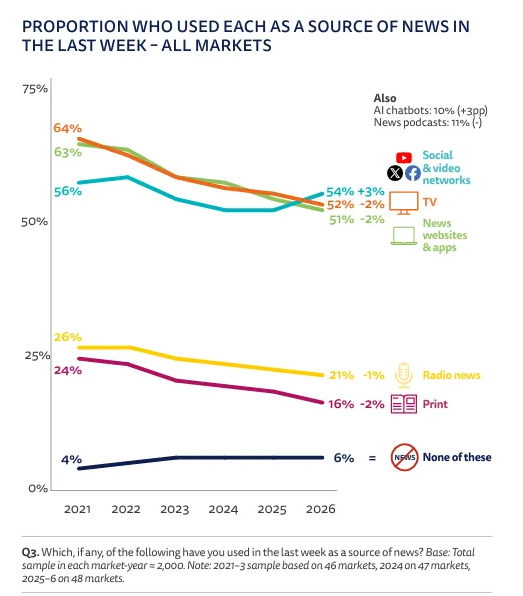
The Reuters Institute released new findings this week confirming something that’s been building for years but has now crossed a genuinely significant threshold: social media is the most common way adults get their news, ahead of television, news websites and apps, radio, and print.
Social media has overtaken television as the most common way adults get their news — and every other traditional channel declined while it grew. This isn’t a niche shift. It’s a full reordering of how information reaches people.
This isn’t a marginal lead, and it isn’t a one-off blip in a single survey wave — it’s part of a consistent trend where social media has grown while every traditional channel has declined. For anyone working in marketing, media planning, or content strategy, this data has direct implications for where attention actually lives and where your message needs to show up to reach an engaged, informed audience.
The numbers, channel by channel
Here’s the full breakdown of how adults say they get their news, according to the Reuters Institute’s latest survey:
Social Media: 54% (up 3 percentage points)
TV: 52% (down 2)
News Websites and Apps: 51% (down 2)
Radio: 21% (down 1)
Print: 16% (down 2)
None of these sources: 6%
Social media: 54% — now the single most common news source for adults.
The pattern here is unambiguous. Social media is the only channel on this list that grew. Every traditional source — television, dedicated news websites and apps, radio, print — declined, even slightly. That’s not noise. That’s a directional trend, and it’s been moving this way consistently across recent survey waves.
Where this shift is happening most
The Reuters Institute’s research highlights that while this trend is global, it’s especially pronounced in specific markets: Thailand, South Africa, Mexico, Brazil, and the United States. These are markets where the report specifically notes that creator-driven content has particularly high engagement — suggesting the shift toward social media as a news source is closely tied to the broader rise of individual creators and influencers as trusted information sources, not just institutional news brands moving their distribution online.
Which platforms are actually driving this
Knowing that social media overall is the leading news source only tells part of the story — the platform-level breakdown is where the real strategic insight is:
YouTube: 69%
Facebook: 67%
Instagram: 53%
TikTok: 37%
Usage of all four of these platforms for news consumption has increased since 2025. The only major platform that saw a decline was X/Twitter, which fell to 17% — a notable reversal for a platform that, for years, positioned itself as the default home for real-time news and breaking events.
This isn’t just a Gen Z trend
One of the more important nuances in this research is the age breakdown. It would be easy to assume this shift is being driven entirely by younger audiences who’ve never had strong habits around traditional news consumption in the first place. The data doesn’t support that assumption — the increase in social media as a news source shows up among adults both under and over the age of 35.
That detail matters a great deal for how marketers should think about this trend. It’s not a niche behavior confined to one demographic that will simply “age into” traditional media habits over time. It’s a broad, cross-generational shift in how an entire population accesses information, which makes it a much more durable trend to plan around.
Don’t treat this as “young people get news from social media.” Treat it as “people, generally, increasingly get news from social media.” The age data specifically rules out the easy generational explanation.
Why X/Twitter is the outlier in decline
While every platform in this dataset besides X grew as a news source, X’s decline to 17% stands out specifically because of its historical positioning. For years, X (and Twitter before its rebrand) was widely considered the default platform for real-time news, breaking events, and direct engagement between journalists, public figures, and audiences.
The decline suggests that whatever unique value X provided as a news platform has been eroding — whether due to changes in content moderation, shifts in user trust, algorithm changes affecting how news content surfaces, or audiences simply migrating their habits to other platforms that have actively invested in news and creator content. Whatever the specific cause, the data shows a clear loss of relative position at exactly the moment competitors gained ground.
What this means for marketers and content strategists
Your media budget should reflect where informed attention actually lives
If your goal is reaching an engaged, informed audience — the kind of audience that’s actively paying attention to current events and, by extension, likely paying attention to brand messaging that shows up in the same feeds — the data is telling you clearly where that audience spends its time: Facebook, YouTube, and Instagram, specifically.
Audiences consuming news through social feeds are accustomed to a specific content rhythm — short-form, visually driven, designed to work within a scrolling experience rather than a dedicated reading session. Brand content that’s built specifically for this consumption pattern, rather than repurposed from a different format, will naturally perform better in this environment.
Consider creator and influencer partnerships more seriously
Given that the Reuters Institute specifically ties this shift to high creator-driven engagement in several key markets, partnerships with credible creators and influencers offer a way to reach audiences through exactly the kind of voices they’re already trusting for information.
Don’t write off X entirely, but recalibrate expectations
X’s decline doesn’t mean the platform has no value, but it does suggest that if news-adjacent visibility and real-time engagement were a core part of your X strategy, that value proposition has weakened relative to other platforms. Reassess where X fits in your overall channel mix rather than assuming its historical role still applies.
Build for trust, not just reach
As more people get their information from social platforms generally, the credibility and trustworthiness of the content you publish there matters more, not less. Audiences encountering your brand in a feed alongside genuine news content will, consciously or not, hold your content to a similar bar of credibility.
The bigger picture
This data captures something bigger than a single survey result — it’s confirmation that the long-predicted shift of information consumption from traditional institutional channels to social platforms has now reached a genuine tipping point. Social media isn’t just a supplementary source anymore. For more than half of adults surveyed, it’s the primary one. Any marketing or content strategy that still implicitly treats social media as secondary to “real” media channels is working from an outdated map of where attention actually is.
Social media overtaking television as the leading news source isn’t a small statistical shift — it’s a structural change in how an entire population stays informed. The brands and marketers who treat this as the new baseline, rather than a temporary trend, will be the ones positioned correctly as this gap continues to widen.
Want your brand showing up where your audience is actually paying attention?
The Brisk Digital builds social-first media strategies designed around where real engagement and informed attention actually live.
admin
Related Posts
YouTube Ads for Clinics: The Brand Awareness + Lead Flow Combo That Actually Works




No Comments