Table of Contents
For two decades, Google has quietly decided which ads deserve to be seen and which ones don’t — using a black-box mix of relevance scores, bidding signals, and quality checks that live entirely behind the scenes. Advertisers see the outcome (their position, their cost-per-click) but never the reasoning.
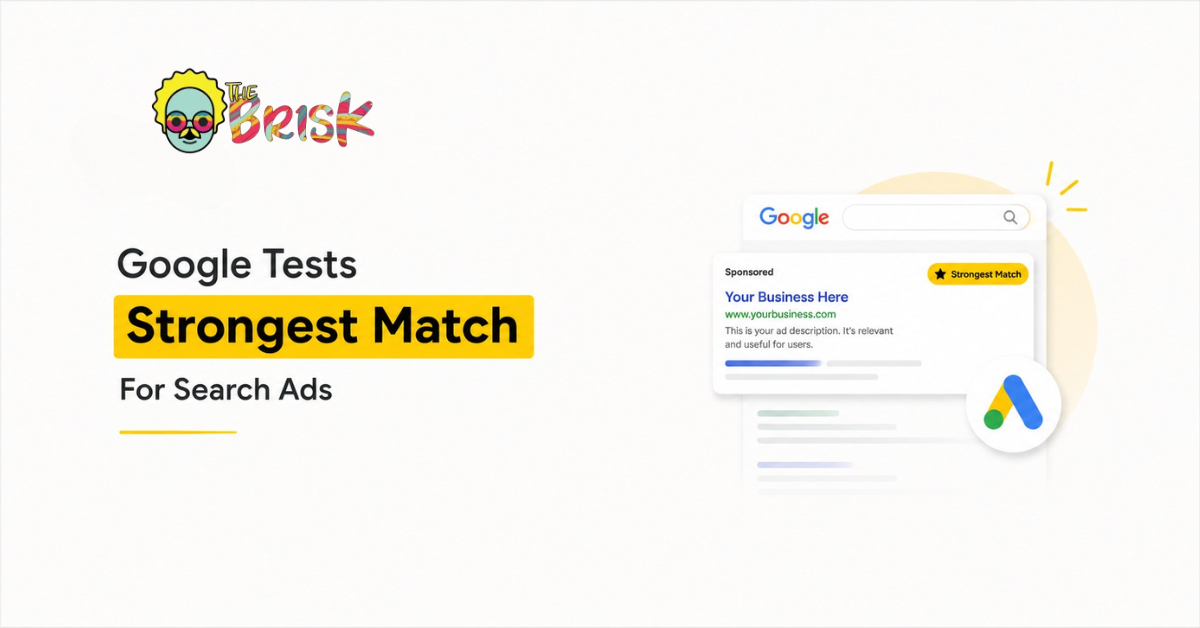
That might be starting to change. Google has begun testing a small but symbolically loaded new feature: a “Strongest Match” (and “Strong Match”) label that appears directly on select Search ads, visible to actual users.
It’s currently limited to a small slice of US searchers, and Google has shared remarkably little about how it works. Naturally, that hasn’t stopped advertisers from asking a lot of questions — and from immediately wondering whether this is the start of something much bigger.
What Do You Mean By “Strongest Match”?
In simple terms, “Strongest Match” is a visible badge Google is testing on certain Search ads to flag them as especially relevant to what a person typed into the search bar. Think of it as Google publicly vouching for an ad’s relevance, the same way “Top Pick” or “Best Seller” badges work in shopping results — except this time it’s happening inside the paid search auction itself.
The announcement came from Ginny Marvin, Google’s Ads Liaison, in a LinkedIn post describing a limited US experiment. According to Marvin, the label exists to help searchers quickly spot the most relevant result for their query, while helping advertisers connect with high-intent audiences. She also said the designation is built on quality and relevance signals Google already uses — not some entirely new evaluation system.
What Was It Earlier?
To understand why this is notable, it helps to know what’s been happening behind the curtain all along. Every Search ad auction already runs on a relevance framework most advertisers know reasonably well: Quality Score (a 1–10 diagnostic built from expected click-through rate, ad relevance, and landing page experience) feeds into Ad Rank, the real-time calculation that decides whether an ad shows and where it lands on the page.
That system has always been deliberately invisible to the person doing the searching. Users see ad position. They don’t see “this advertiser scored an 8/10 on relevance.” Google has, at various points, layered other visible signals onto ads — sitelinks, ratings, “Sponsored” labels — but none of them have directly told users “this is the most relevant ad for what you searched.”
That’s the line “Strongest Match” crosses. For the first time, part of Google’s internal relevance math is becoming a public-facing endorsement.
What’s Changing Now?
Right now, very little is locked down — which is exactly the problem advertisers have with it. Marvin confirmed the label relies on “existing ad quality and relevance signals,” but Google hasn’t clarified:
- Which specific signals determine the label
- How those signals are weighted
- Whether it’s based on the keyword, the ad, the landing page, or some blend
- Whether more than one advertiser can receive the label in the same auction
- Whether the label is tied to a specific position on the page
The reaction on LinkedIn was immediate and pointed. Commenters pressed on whether bid strength plays any role in the designation, whether the “strongest match” will always land on the top-ranked ad, and — perhaps most importantly — what happens if the label is occasionally wrong.
If an inaccurate “Strongest Match” badge effectively tells a user “trust this business,” and that business doesn’t deliver, advertisers worry Google could be lending its credibility to the wrong company.
Why Does The Timing Matter?
This test isn’t happening in a vacuum. Google Search has been steadily moving away from a simple list of ranked links toward a more conversational, AI-assisted experience — AI Overviews, AI Mode, and a growing number of AI-native ad formats are reshaping what a search results page even looks like.
In that kind of environment, a visible relevance label makes a different kind of sense. If users are increasingly trusting Google’s own summarization and curation (the same dynamic that lets AI Overviews recommend products directly), it’s a logical next step for Google to extend that “we picked this for you” framing into paid search results too.
Put simply: Google has always made relevance judgments behind the scenes. This experiment tests what happens when it starts saying those judgments out loud.
What’s The Future Impact of the Strongest Match?
If “Strongest Match” sticks around and expands, it could become more than a cosmetic label — it could become a genuine competitive advantage. Users who start to associate the badge with reliability may click those ads disproportionately more often, regardless of position, turning the label into something advertisers actively compete for rather than a passive side effect of good Quality Score practices.
That, in turn, raises a less comfortable possibility: a feature framed as helping users navigate search more efficiently could end up functioning as a new monetizable status symbol — one Google currently gives away for free, but might not always.
What Should We Do As Marketers?
There’s an important distinction here between “what might matter eventually” and “what you should do today.” Right now:
- Don’t chase the label directly — Google hasn’t given advertisers any controls, reporting, or qualification criteria to optimize toward.
- Double down on the fundamentals that already drive relevance: tight keyword-to-ad-copy alignment, fast and relevant landing pages, and strong expected click-through rate. If the label really is built on existing quality signals, these are still the levers that move it.
- Watch your own ads in search, where possible, to see if you’re getting tagged — and note any patterns in performance if you are.
- Don’t restructure campaigns around an unconfirmed feature. This is an early-stage experiment running on a small percentage of US traffic; broad rollout, if it happens, is still likely months away at minimum.
What Should We Keep An Eye On?
A few open threads will determine whether this becomes meaningful or fades into “remember when Google tested that?” territory:
- Will Google release qualification criteria or advertiser-facing reporting if the test expands?
- Does the label correlate with ad position, or can a “Strongest Match” ad appear lower on the page than a non-labeled ad?
- Can multiple advertisers receive the label within the same auction, or is it exclusive?
- How does Google plan to handle mislabeling, and will there be any accountability if a labeled ad delivers a poor experience?
For now, treat “Strongest Match” the way you’d treat any early Google experiment: interesting, worth monitoring, but not yet something to build a strategy around. The bigger story is what it signals — that Google is increasingly comfortable making its relevance judgments visible to the people actually doing the searching.
The Bottom Line
There’s no dashboard for this yet, no toggle to chase — which means the only real move right now is to make sure your fundamentals would earn the label if Google looked your way.
Run a quick relevance audit this week: check your top keywords against your ad copy and landing pages, and tighten anything that wouldn’t pass the “strongest match” test on its own merits. Then keep watching — this is one to bookmark, not ignore.
Sources referenced: Search Engine Journal, Google Ads Help Center, public LinkedIn commentary from Google Ads Liaison Ginny Marvin, and industry practitioners.




No Comments