Table of Contents
“The brands losing today mostly aren’t outbid. They’re out-briefed — because the only picture the broker ever had of them was thin.”
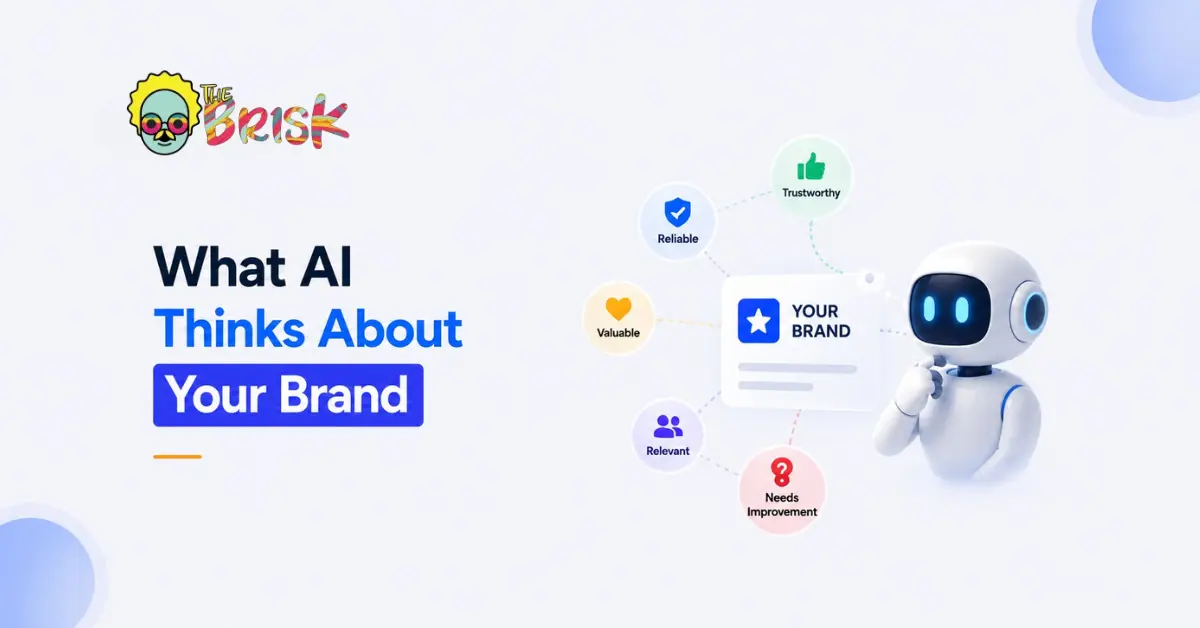
There’s a moment that happens in conversations with business owners and marketing teams that’s become increasingly common. They open ChatGPT, or Perplexity, or Google’s AI Overviews, and they ask the kind of question their ideal customer would ask.
And the recommendation that comes back is a competitor. Not a slightly less prominent competitor — sometimes a direct rival they know they’re better than in every measurable dimension.
The reaction is usually frustration. Occasionally it’s disbelief. But the question that actually matters isn’t “why is this happening?” — it’s something more specific: what does the AI know about your competitor that it doesn’t know about you?
The answer, almost always, is not that the competitor’s product is better. It’s that the competitor’s digital footprint is clearer, more complete, and more corroborated. The AI isn’t making a value judgment about quality. It’s making an inference based on available evidence — and the available evidence about your brand is thinner than you think.
This article breaks down the framework for understanding how AI engines form their opinions of your brand, what they need to see to recommend you, and the five specific content streams that most brands are either not harvesting or not publishing in a way that AI systems can read and trust.
The Three Questions Every AI Engine Is Answering About Your Brand
When an AI engine encounters your brand — through your website, your content, your reviews, your mentions across the web — it’s implicitly working through three questions. These three questions collectively determine whether your brand gets recommended, ignored, or misrepresented.
1. Understandability: Does AI Actually Know What You Do?
This seems like a low bar, but it’s one that many brands fail in subtle ways. Understandability isn’t just about having an about page and product descriptions. It’s about the AI being able to answer: who is this brand for, what specific problem does it solve, and under what circumstances would it be the right recommendation?
The gap that most businesses miss is operational detail — the granular description of what actually happens once a client engages you. Your product page might say “we provide enterprise cybersecurity solutions.”
But AI needs to understand what a typical engagement looks like, what types of organisations are the best fit, what problems you’re specifically equipped to solve that others aren’t. A thin product description tells AI a product exists. An exhaustive one tells it when and to whom to recommend that product.
2. Credibility: Does AI Believe You’re Good at It?
This maps to what Google calls E-E-A-T — Experience, Expertise, Authoritativeness, Trustworthiness — extended by the NEEAT-T framework (adding Notability and Transparency). Credibility isn’t what you say about yourself. It’s what the evidence shows about you.
Most brands understand this in principle but underinvest in it in practice. Case studies, credentials, and testimonials are the obvious credibility signals, and most businesses have some version of these. What they almost never have is the operational evidence of credibility — the specific detail from client interactions that makes a claim real rather than asserted.
3. Deliverability: Does AI Have Enough to Match You to the Right Person?
Deliverability is about specificity of fit. AI doesn’t just need to know you exist and are credible — it needs enough content about your audience, your use cases, and your specific solutions to match you accurately to a user’s particular situation at their particular moment of need.
This is the hardest to get right because it requires understanding not just who your ideal customer is, but what they’re looking for at each stage of their decision-making — what the framework calls “cohort-to-intent combinations.” AI has to know whose problem you solve, which specific version of the problem, and at which decision-making moment.
Think of Understandability, Credibility, and Deliverability (UCD) as the three gates an AI engine passes through before recommending you. Most brands clear the first gate reasonably well. The second and third are where recommendations are won or lost.
The 5 Content Streams That Feed Your Digital Footprint
The UCD framework tells you what AI needs. The five content streams tell you where to find the raw material — and critically, which streams almost every brand is currently leaving untapped.
Stream 1: Products and Services — What You Sell (You Already Do This)
This is the foundation: what you offer, at what price, under what conditions, with consistent naming and identifiers. Most businesses have this. The gap isn’t whether it exists — it’s whether it’s deep enough.
A thin product page tells AI a product exists. An exhaustive one — describing who it’s for, what problem it solves, what it costs, what it doesn’t do, and how it differs from similar alternatives — gives AI the detail it needs to recommend the right product to the right person. Price inconsistencies, naming variations, and incomplete descriptions across pages all create uncertainty in AI’s model of your offerings.
Stream 2: Authority Content — Your Published Expertise (Nearly Everyone Does This)
This is your blog, your guides, your videos, your data studies, your thought leadership. Almost every brand with any content marketing investment has this. It contributes to deliverability — it tells AI which topic territory you operate in and what audience you’re trying to reach.
The limitation is that everyone does it, which makes it the least differentiating of the five streams when used alone. Authority content earns its weight only when it’s tied to the other streams — when the expertise claimed in a blog post is also proven by operational evidence, client testimonials, and third-party corroboration. Assertion without corroboration is a signal AI reads with appropriate scepticism.
Stream 3: Brand Narrative and Voice — Who You Are and Why You’re the Best Fit
This is more than your about page and mission statement. It’s the complete, consistent communication of your ICP (ideal customer profile) paired with their specific intent at each stage, your credibility evidence, and the explicit statement of why a customer should choose you.
Most brands communicate their ICP reasonably well. They less often pair it with intent — not just “we serve mid-market SaaS companies” but “we serve mid-market SaaS companies that are scaling past 50 employees and need their first structured content strategy.” That specificity is what gives AI the ability to make the right match.
Voice deserves separate mention. Narrative is what you say. Voice is how you say it. When voice drifts across channels, teams, and time periods — which it almost always does in larger organisations — AI reads the same brand as multiple inconsistent entities and reduces its confidence in all of them. Consistency of voice is a credibility signal. Inconsistency is a tax that accumulates invisibly.
Stream 4: OPID Business Operations — The Stream Almost Nobody Harvests
This is the most powerful of the five and the one most comprehensively ignored. OPID stands for the full lifecycle of client operations: Onboarding, Performance, Integration, and Devotion — everything your business generates by actually doing what it does.
Think about what this includes:
- Support tickets describing exactly what problems clients bring to you, in their own words
- Onboarding documentation that shows precisely what happens when a new client starts working with you
- Churn-exit interviews where clients describe what was and wasn’t working — honest, specific, unvarnished
- Sales call transcripts where prospects describe their situation before they became clients
- Case studies with real before-and-after numbers rather than generic outcome claims
- FAQs built from actual questions asked by actual clients, not questions you wish they’d ask
- SOPs and playbooks that demonstrate methodological depth
- Webinar and podcast transcripts that capture your expertise in spoken, conversational form
Almost none of this makes it online. It lives in CRMs, intranets, helpdesk systems, and inboxes — places AI can’t see. Publishing it, in appropriate form, moves it from invisible to visible without making it up or exaggerating it. It’s simply surfacing what’s true.
The reason it’s so powerful is that it serves all three UCD dimensions simultaneously. A client review that describes in specific terms what they got from you tells AI exactly what you do (understandability), that you do it well (credibility), and for whom (deliverability). And it does all of this more convincingly than anything you’d write about yourself, because you didn’t write it.
Stream 5: Bringing the Offline Online — The Stream Almost Nobody Runs
This stream covers all the ways your brand creates value and credibility in the physical world that AI can’t see: the conferences where you speak, the communities you support, the panels you participate in, the industry events where you’re recognised, the press coverage you generate in local or trade publications.
The solution is self-reporting, done consistently: publish recaps of talks and panels you participate in, link to social posts and coverage others create about you, and create the content that makes your offline credibility visible online.
The reverse also applies: whatever you publish online should be consistent with what you say in person. When the story a client hears from you at a conference differs from what AI would tell someone researching your brand, the gap creates doubt — in the human audience and in the AI’s confidence about who you are.
Three-Tier Publishing Architecture: First-Party, Second-Party, Third-Party
Once you’ve identified the content from your five streams, where and how you publish it determines how much AI trusts it. The rule is counterintuitive but consistent: the less of you in the publication, the more it’s trusted.
First-Party: You Claim
You publish on your own properties, in your own voice. Your website. Your blog. Your product pages. This is baseline — necessary but, on its own, proving nothing. It’s pure assertion. You wrote it; you published it; AI weights it accordingly.
Second-Party: You Corroborate
You’re still involved, but the footprint is wider or the voice is partially someone else’s. Publishing across YouTube, LinkedIn, Medium, and press releases. Surfacing client reviews or testimonials on your own site. Publishing case studies that include client quotes. This is a step up because the substance isn’t solely your assertion, even if you chose to publish it.
Third-Party: They Prove You
A third party publishes about you independently — journalists, analysts, clients sharing their experiences on their own platforms, academic mentions, industry recognition. No involvement from you. This is the strongest evidence because you had no hand in creating it.
Worth noting: the same review carries different weight depending on where it appears. A client testimonial you publish on your website is second-party. The same client publishing that review unprompted on their own LinkedIn profile is third-party. Identical words, meaningfully different weight.
You can’t write the third tier. But you can earn it — by serving clients well enough that they want to publish, and by giving external writers and journalists detailed, accurate material to work with.
The Compounding Footprint
Here’s the structural advantage of getting this right: the loop compounds. You harvest your operations, codify them into a consistent source of truth, distribute them across the tiers AI reads, and clients arrive because AI recommended you. Serving those clients generates the next round of operational evidence to harvest.
Each iteration adds to a growing body of corroborated evidence that becomes progressively harder for competitors to displace. AI’s model of your brand improves with each addition; it doesn’t reset. The incumbent wins.
The implication: every month of delay is a month competitors have to build a more complete picture while yours stays thin. AI is forming opinions now that will influence recommendations for years. The brands that start briefing it clearly today will have a structural advantage that compounds, while those that wait will face an increasingly uphill task.
Conclusion: Brief the Broker or Be Invisible
The honest broker principle is the most useful mental model for understanding AI’s relationship with your brand. AI doesn’t have a stake in recommending you over your competitor. It has a stake in recommending whoever best serves the person asking.
Your job isn’t to manipulate it — it’s to give it the most complete, most corroborated, most clearly organised picture of who you are, what you do, and who you serve.
Most brands are losing ground in AI recommendations not because they’re being outspent, but because they’re being out-briefed. Their operational knowledge stays hidden. Their client voices stay unpublished. Their offline credibility stays offline. And AI, unable to see any of it, reaches for the brand that gave it something to work with.
The five streams are available to every brand. The three publishing tiers are available to every brand. The compounding advantage is available to whoever starts first. The window for building that structural lead is open now — and it won’t stay open indefinitely.
READY TO TAKE ACTION?
Want to know how AI engines currently see your brand — and what it would take to improve?
The Brisk Digital builds AI-ready digital footprints for ambitious brands: content strategy, structured data, reputation architecture, and everything in between. Let’s build the picture AI needs to recommend you.


No Comments