Table of Contents
The most significant development in healthcare advertising since the shift to mobile — and why the brands that understand it now will own it later.
Google has confirmed it is testing healthcare ads inside AI Mode — the fully conversational, AI-powered search experience that represents the most significant evolution in how Google delivers information to users since the introduction of mobile search.
This is not an incremental update to existing healthcare advertising. It is a structural expansion of where and how healthcare advertising happens — moving from a static query-and-result model into a dynamic, conversational research environment that is fundamentally different in both its intent signal quality and its user engagement depth.
For healthcare marketers — clinic operators, hospital systems, health D2C brands, medical device companies, and anyone whose commercial growth depends on reaching patients at the moment of healthcare decision-making — this development deserves serious strategic attention.
What Is Google AI Mode, and Why Does It Matter for Healthcare Advertising?
To understand why testing healthcare ads in AI Mode is significant, you need to understand what AI Mode is and how it differs from traditional Google Search and AI Overviews.
Traditional Google Search operates on a query-response model. A user types a query. Google returns a ranked list of results. The user evaluates and clicks. The interaction is brief, the intent signal is limited to the text of the query, and the advertising opportunity is a placement on a results page.
AI Overviews extended this by adding an AI-generated summary at the top of certain search results pages — but the fundamental interaction remained a single query with a results page response.
AI Mode is categorically different. It is a fully conversational interface where users can ask multi-part questions, receive synthesised answers that draw from Google’s entire knowledge base, ask follow-up questions that drill deeper into the topic, and maintain an ongoing research conversation that Google’s AI tracks and responds to contextually.
For healthcare specifically, this conversational capability transforms the search experience. A user who has noticed concerning symptoms doesn’t just search “headache causes” and read results.
In AI Mode, they might describe their specific pattern of symptoms, ask follow-up questions about which of several conditions it might indicate, ask what doctors specialise in this area, ask what to expect from an initial consultation, and ask which clinics in their area are recommended for this type of concern — all within a single AI Mode session.
The intent signal generated by this kind of deep, conversational health research is orders of magnitude richer than a single keyword search. And the advertising opportunity inside that intent signal is what Google’s healthcare ads test is beginning to explore.
Why Healthcare Is the Right Category for AI Mode Advertising Testing
Not every advertising category is equally suited to AI Mode placement. The conversational AI context creates specific requirements for ad relevance and appropriateness — ads that appear contextually irrelevant or tonally mismatched to a sensitive research conversation will perform poorly and potentially damage the advertiser’s brand.
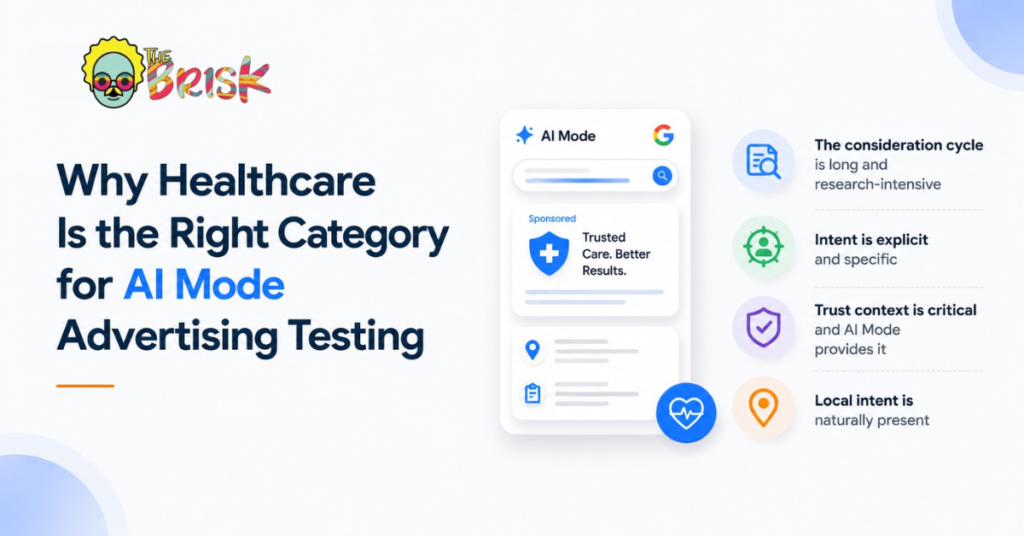
Healthcare is actually one of the best-suited categories for AI Mode advertising, for several reasons:
- The consideration cycle is long and research-intensive. Healthcare decisions — choosing a clinic, understanding treatment options, evaluating a specialist — are not impulse purchases. They involve extended research, careful evaluation, and trust-building over multiple sessions. AI Mode’s conversational depth maps directly to this research process. An ad that appears within a deep healthcare research conversation is appearing at exactly the right moment in the patient journey.
- Intent is explicit and specific. A user in an AI Mode healthcare conversation has expressed their intent in detail — the specific condition they’re concerned about, the type of care they’re looking for, their geographic context. Advertising targeting based on this conversational intent context is significantly more precise than keyword-based targeting.
- Trust context is critical and AI Mode provides it. Healthcare advertising depends on trust. Patients need to trust that the provider being advertised is credible and capable before they’re willing to make contact. AI Mode’s curated, high-quality information environment creates a trust context that benefits advertisers appearing within it — provided those advertisers maintain the quality and credibility standards the environment demands.
- Local intent is naturally present. Healthcare is inherently local. AI Mode conversations about healthcare providers, clinic options, and specialist availability naturally include geographic context that makes local healthcare advertising acutely relevant.
The Regulatory and Compliance Landscape
Healthcare advertising in any format carries significant regulatory requirements that AI Mode ads will need to navigate carefully. In India, healthcare advertising is governed by ASCI guidelines, MCI regulations for medical practitioners, and various state-level healthcare marketing regulations.
Globally, HIPAA in the US and equivalent data protection frameworks impose strict requirements on how patient data can be used for advertising targeting.
The specific compliance considerations that AI Mode healthcare advertising will need to address:
- Sensitive health data handling. Conversational AI Mode sessions generate highly sensitive implicit health data — the user’s symptoms, the conditions they’re researching, their expressed concerns. Using this data to target advertising raises complex consent and data protection questions that will need explicit regulatory frameworks before the advertising format can scale.
- Medical claim standards. Healthcare ads are subject to strict standards around what medical claims can be made. AI Mode’s conversational context — where users may be asking highly specific clinical questions — creates a more demanding standard for ad relevance and accuracy than a generic search results page placement.
- Prescription and regulated product categories. Many healthcare advertising categories — prescription medications, certain medical devices, clinical procedures — have specific advertising restrictions that vary by jurisdiction. AI Mode ads will need to apply these restrictions contextually, which is more complex in a conversational environment than in traditional keyword-based targeting.
- Sensitivity targeting restrictions. Most major advertising platforms restrict or prohibit targeting based on health conditions for sensitivity reasons. AI Mode’s implicit health data creates a tension between the targeting precision the format enables and the sensitivity restrictions that protect users from exploitative health-condition-based targeting.
How Google navigates these complexities will define whether healthcare AI Mode advertising reaches its potential or remains constrained by compliance friction. The early test phase is almost certainly focused on understanding these tensions before the format scales.
What Healthcare Advertisers Should Be Doing Right Now
The healthcare AI Mode ads test is in early stages. The full format, targeting mechanics, compliance frameworks, and pricing are not yet public. But the preparation work for healthcare advertisers doesn’t require waiting for the rollout details.
Build the Content Foundation That AI Mode Rewards
Healthcare advertising in AI Mode will function differently from traditional paid search in one crucial way: the context in which ads appear will be shaped by the quality of the surrounding organic content about the advertiser.
An AI Mode response about skin conditions, for example, will draw from the web’s most authoritative content about dermatology when constructing the context in which advertising might appear.
Healthcare brands that have invested in genuine educational content — comprehensive explanations of conditions and treatments, evidence-based health information, patient journey documentation — are building the content foundation that creates the right context for AI Mode advertising.
The clinic whose website comprehensively covers the conditions it treats, in accurate and helpful detail, is the clinic that the AI Mode environment will reference when constructing responses about those conditions. Advertising within that context is advertising in a high-credibility environment.
Develop Conversion Pathways Optimised for the AI Mode User
The user who encounters a healthcare ad through AI Mode has already done significant research. They’re not at the awareness stage — they’re in consideration or even decision mode. The conversion pathway from an AI Mode ad click needs to match this user’s state.
A landing page that starts by explaining what a dermatologist does is the wrong destination for an AI Mode user who has been having an in-depth conversation about their specific skin condition.
The right destination: a page that speaks directly to the specific concern they were researching, provides the specific reassurance that their research journey was leading toward, and makes it immediately easy to take the next step toward care.
This requires more targeted, patient-journey-specific landing pages than most healthcare practices currently have — and building them now prepares for both AI Mode advertising and the broader shift toward more contextual healthcare search.
Monitor the Test Rollout and Request Early Access
Google typically works with select advertisers during test phases for new ad formats. Healthcare organisations with existing Google Ads relationships and strong account histories are the most likely candidates for early access.
Engaging proactively with Google Ads representatives about the AI Mode healthcare ads test is the most direct path to early access — which provides both commercial advantage and the opportunity to shape what the format becomes through active participation in the test.
AI Mode as the Future of Healthcare Digital Marketing
The healthcare AI Mode ads test is one data point in a broader shift that will define healthcare digital marketing for the next decade.
The patient’s information-seeking behaviour is moving from brief, keyword-driven searches toward extended, conversational research sessions. This is being driven by AI tools — ChatGPT, Perplexity, Google AI Mode — that are better at the kind of nuanced, multi-part research that healthcare decisions require than traditional search could ever be.
As this shift accelerates, the healthcare marketing channels that will generate the most commercial value will be the ones that are present in these extended research conversations — either through organic authority (being the content that AI systems draw from when constructing health information) or through paid presence (advertising that appears within AI-mediated research sessions).
Healthcare brands that are building for this environment — developing genuine content authority, preparing conversion pathways for research-mode users, and engaging early with AI Mode advertising — are making the right long-term investments.
Healthcare brands that are waiting for the landscape to stabilise before acting are watching the window for first-mover advantage close.
The Brisk Digital works with healthcare brands on digital marketing strategies built for the AI search era — from content authority building to performance campaign management to the emerging landscape of AI Mode advertising. If you want to understand what this shift means for your specific healthcare business, we’re here to think it through with you.



No Comments