
Table of Contents
- Introduction
- Brand Strategy
- Marketing Strategy
- Major Differences Between Branding and Marketing Strategy
- Additional Key Differences
- Conclusion
1. Introduction
Many people think that branding and making marketing strategies are almost similar. Indeed, there may be certain similarities, but they are not the same! Both have their benefits and value for a particular firm. Let’s know what exactly these are and why they are different from each other.
A brand strategy is a component of your company that specifies your voice, purpose, and general direction of your business and marketing efforts.
Branding enables your customers to grasp the traits, values, and attributes you represent, as well as how you compare to your opponents. A brand strategy differs from a marketing strategy as it serves as the cover under which marketing, product, sales, and customer service operate.
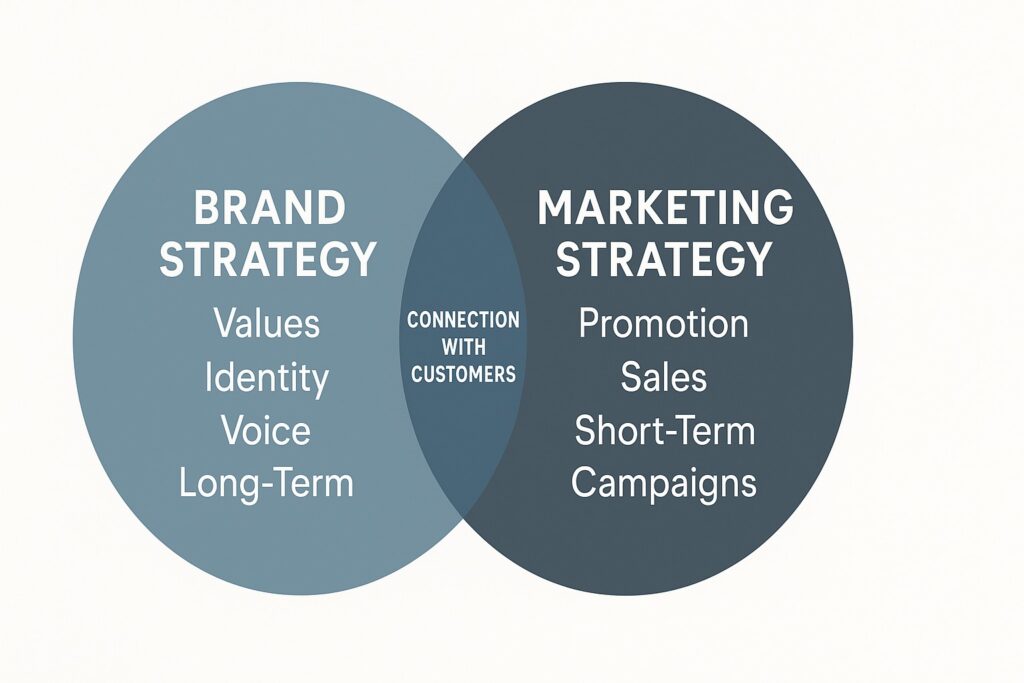
Your brand is your company’s, product’s, or service’s overall reputation. It has various components, one of which is marketing. Product, sales, and customer service are also critical components of your brand.
Each component of your brand strategy should successfully express the style and emotion associated with you and your business. This also assists your staff in making well-informed judgments on challenges, since everything should be consistent with your overarching brand strategy.
2. Brand Strategy:
It should be a large, focused picture, but it should also have a practical purpose that matches your short, mid, and long-term company objectives.
You begin to achieve your company plan when you get more specific with your business and plunge into more tactical and personal business objectives. Down here, you will get more specific knowledge about the brand and marketing strategy.
The business plan is enabled, expressed, and brought to life by the brand strategy and by building brand identity. As a result, branding is the expression of an organization’s, product’s, or service’s core.
Branding conveys the traits, values, and qualities that an organization or product represents, how it differs from rivals, and why a buyer would purchase it.
A brand strategy defines a brand’s distinct features, values, and qualities. It consists of the brand positioning – the distinctive, relevant, credible, and sustainable market position that it has – as well as the brand narrative, values, personality, and tone of voice.
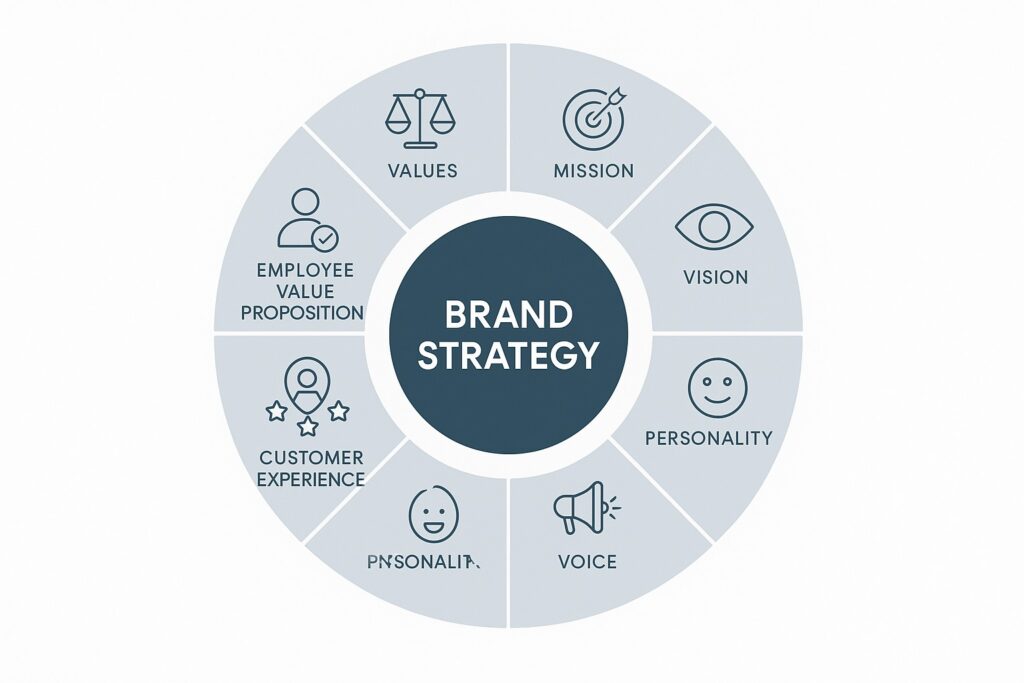
It should also incorporate your brand’s employee value proposition (EVP). If there are several brands, a brand architectural framework and brand portfolio strategy may be included. In addition, if the company has various target markets, the brand strategy may incorporate customer value propositions (CVPs).
Branding is the material that holds your company together. It includes your company’s principles, differentiating features, target audience, and general-purpose statement.
Because your branding strategy influences your audience’s whole experience with your organisation, it must be carefully studied from the start of the company, product, or service.
Having a well-defined branding strategy implies that consumers understand what your business offers, not only in terms of product, but also in terms of value, culture, and position.
3. Marketing Strategy:
After an organization has approved its brand strategy, it must develop a marketing strategy and a marketing plan.
Business strategy and brand strategy both influence marketing strategy. Branding is more strategic, while marketing is more tactical. Marketing is the active promotion and sales of a product or service.
It all comes down to putting the right product/service in the right location, at the right price, and at the right time. It finds and activates buyers. Marketing is a push strategy.
The brand essence should be reinforced and supported by all marketing activities and campaigns. Marketing is described as the collection of tools, procedures, and strategies used to aggressively market a product, service, or organization.
Consider marketing to be the steps you take to interact with your consumers and persuade them to purchase your goods or services.
So, now that we’ve established what they are, let’s discuss the fundamental distinctions between marketing and branding:
4. What Is The Major Difference Between Marketing And Branding Strategy?
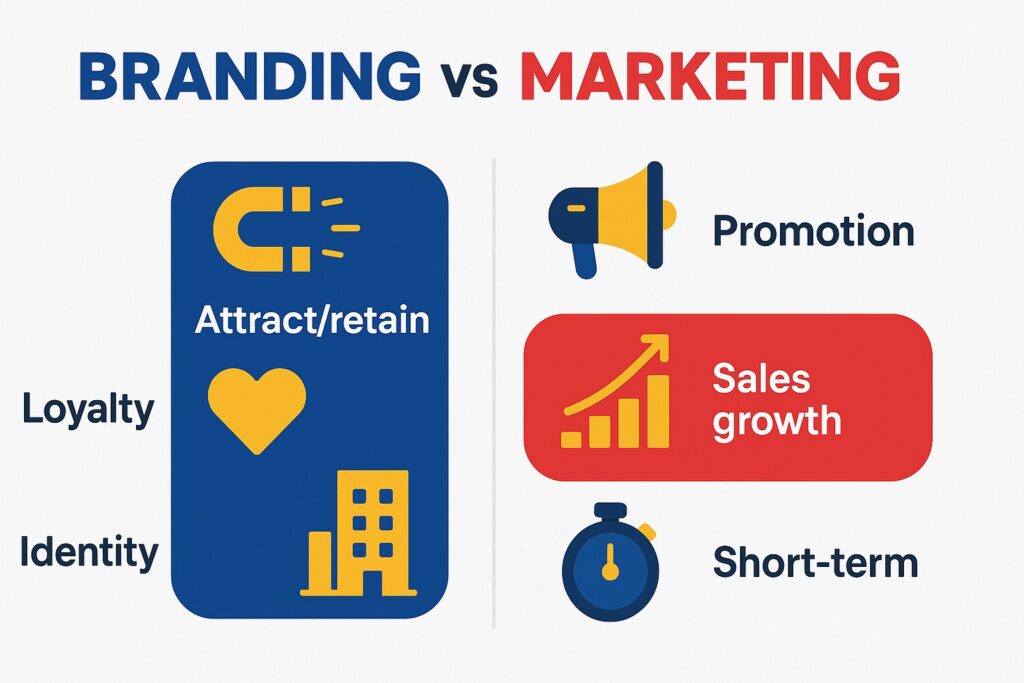
- So, if branding is what your audience consumes, marketing is the vehicle via which you distribute the commodities. It is concerned with how you connect with your audience and how you convey your message to consumers. Simply said, marketing is the active promotion of your brand. It is goal-oriented, requiring the selection of target audiences, price, distribution, media and public relations, and campaign execution.
- Another significant distinction between branding strategy and marketing strategy is the distinction between long-term and short-term commitment. Branding is a long-term commitment to your audience, and it should be consistent across all media and activities. Marketing strategy is more pliable and may be changed by the time of year, major news items, or societal movements.
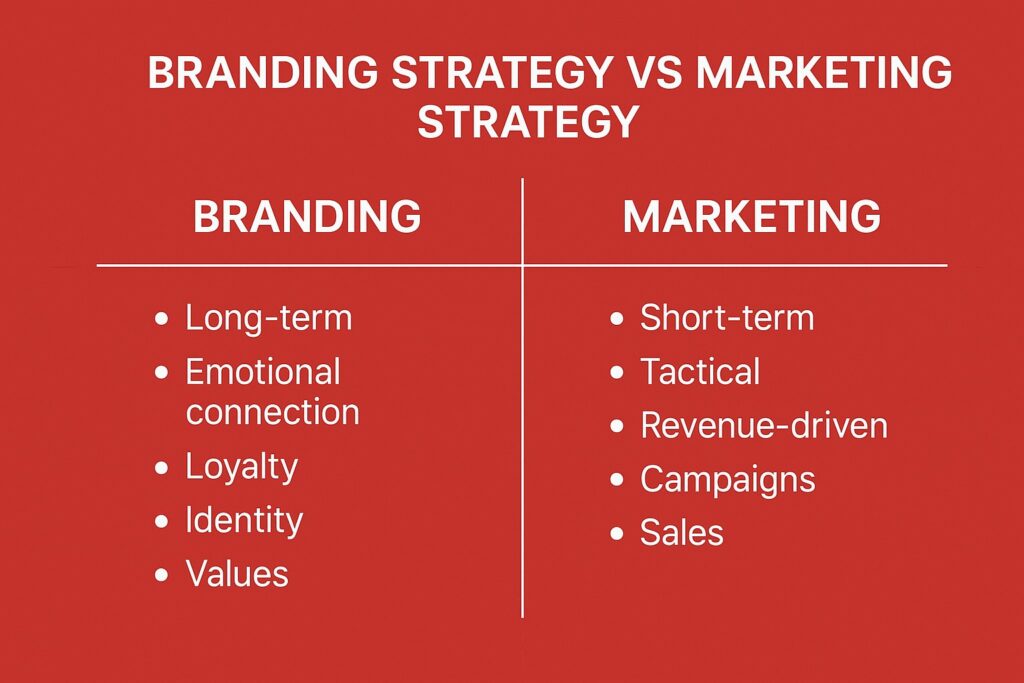
- Branding comes first, followed by marketing. In the great scheme of things, branding always comes before marketing. With excellent cause! You can’t exactly advertise a brand that you haven’t yet developed.
- Marketing generates revenue, whereas branding generates awareness and loyalty. At their foundation, most marketing methods are intended to create outcomes—and, more often than not, those results are sales-related.
- Marketing is an excellent approach to get a customer’s attention, but branding is an excellent way to maintain it. Chances are, no matter what business you’re in, you’re only one firm in a sea of competitors. And, if you want to make a difference and get your clients’ attention, marketing is necessary.
5. Additional Key Differences
Some more differences are:
- While marketing promotes your product or service, branding actively shapes your brand and who you are. Both need techniques, and they have distinct aims and outcomes.
- Marketing draws a customer’s attention; branding keeps their interest.
- Branding generates awareness and loyalty, while marketing drives sales.
- Marketing methods come and go, but branding remains.
- Branding influences your employees just as much as it does your consumers.
6. Conclusion
Therefore, it is clear that without the other, the first one can’t create an impact in the current business scenario.
For a company to be successful, it must give equal attention to both strategy, including business strategy like The Brisk.
You must decide that without all three components, you cannot create a business that runs for the long term.

No Comments