Table of Contents
Gaining more visibility and connecting with current and future clients are two of the most important factors in expanding one’s business.
But what use are a flashy website and a flurry of online activity without a well-developed plan? Without a current and thorough analysis, it is impossible to formulate an effective strategy.
It’s not a simple task to get relevant visitors to your website. Businesses of all sizes and in all sectors are always on the lookout for ways to increase traffic and retention. Web analytics provides insight into these types of concerns.
So, how can we include a more all-encompassing strategy in our deliberations and choices?
We start by developing a framework for good decision-making by defining the factors that go into it. After that, we use this paradigm in our analysis of potential options.
We have developed a framework—the “critical thinking framework”—that lends itself particularly well to such an integrative strategy.
What is Web Analytics?
Analyzing the behaviour of people who visit a website is known as Web Analytics. This process includes collecting data from websites and then processing, reporting, and analyzing. All of this forms an online strategy to improve the website experience.
Using web analytics, a company may keep current customers, draw in new ones, and raise the amount of money each customer spends.
Using Critical Thinking Framework
The analysis is essential for web analytics. You can’t make educated decisions based solely on the raw data that your analytics tool provides. A deeper understanding of website visitors is gained by carefully examining analytical data.
The success of any website’s online strategy hinges on a deep familiarity with the people who will be visiting it.
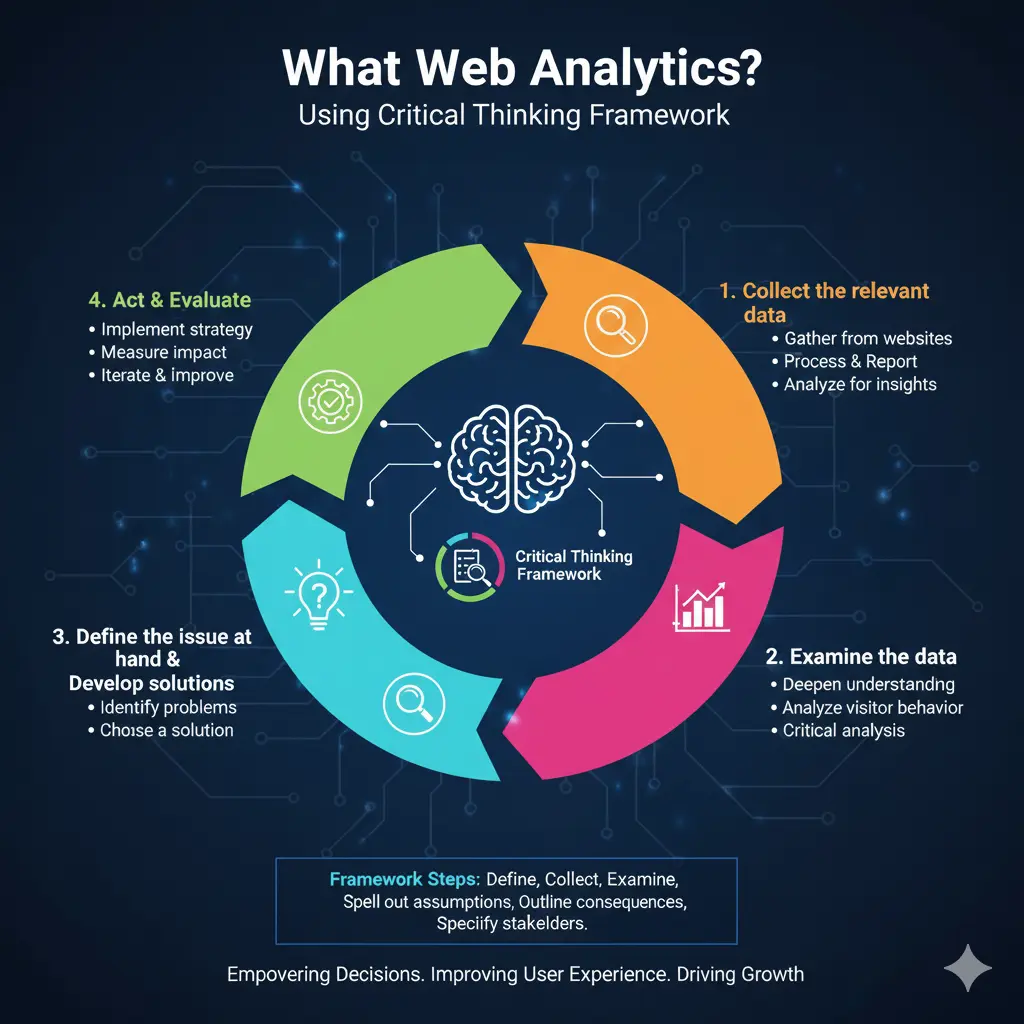
Therefore, a critical thinking framework is essential for web analysis. Here is how to use them:
- Define the issue at hand
- Collect the relevant data
- Examine the data
- Develop alternate options, settle for one
- Spell out the presumptions that were used
- Outline the possible consequences of your choice or solution in detail
- Specify the stakeholder(s) whose input was taken into account in reaching the final answer or conclusion
While each part of the framework is numbered, the steps do not need to be performed in sequential form. Moreover, we are likely to switch back and forth between elements as we solve the problem at hand. We must check off every element of the framework and make sure we’ve covered everything.
Pillars of Web Analytics
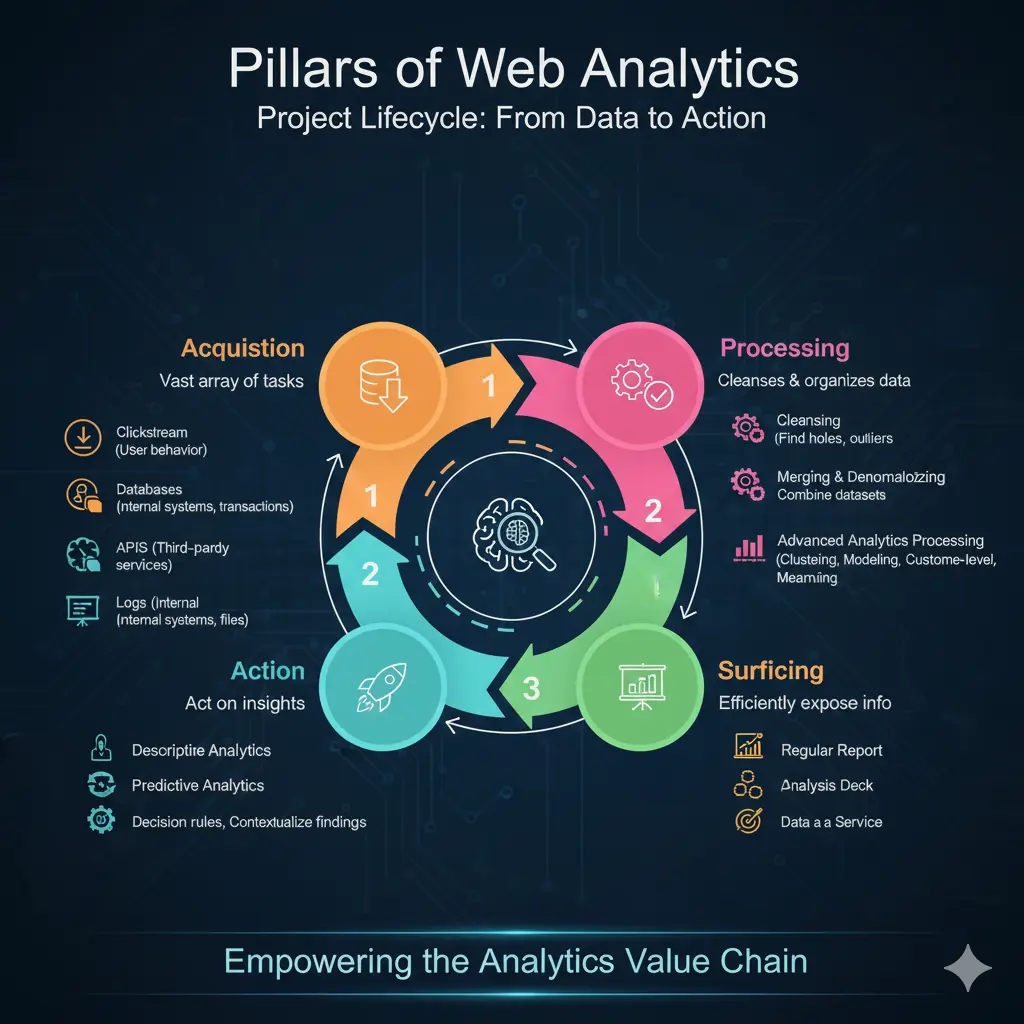
Data collecting, processing, surfacing, and taking action on the data are all aspects of the analytics project lifecycle that are ruled by the pillars of Web analytics. Individually, each of the web analytics pillars makes a considerable impact on the analytics value chain as a whole. Mainly, there are four pillars of web analytics:
- Acquisition
The data acquisition pillar encompasses a vast array of tasks, processes, and technological expertise for effective data collection. What is needed from an analytics expert varies greatly depending on the field.
Data acquisition comes in four categories:
- Clickstream –
The purpose of clickstream data is to provide insight into user behaviour on the website or apps that we operate.
- Databases –
Data from internal systems that must be stored typically comes from databases. This data typically includes profiles, transaction details, object relationships, and more.
- APIs –
When interacting with third-party services, API calls are the standard method of gathering information.
- Logs –
Data can also be gathered through logs, which are often stored and analysed within an organization’s internal systems.
They each come with their own set of difficulties and methods for managing data collection.
2. Processing
The data processing pillar is in charge of cleaning and organising data to make it useful. Cleaning, merging, and arranging datasets, handling aggregation, and applying extra advanced analytics processing are all parts of the process.
- Cleansing
Every analyst needs to clean their data at some point in their career. You’ll need to do some serious digging in the data to find any holes or outliers, and then try to organise the information so that it can solve most of the issues you’re facing.
- Merging and Denormalizing
The merging and denormalisation of datasets is yet another component of data processing. Researchers are considering ways to merge existing data sets to create more useful, queryable information.
- Aggregation
Depending on the task at hand, various degrees of aggregation may be required.
- Temporary processing consists mostly of materialised subqueries that can be utilised to effectively supply more data further down the line.
- Full dataset extracts, you need for analysis and reporting, with all the critical metrics.
- Customer-level aggregations are helpful for analysis and processing since they may be utilised to build a profile of a customer for modelling or other uses.
Advanced Analytics Processing
Different advanced analytics and machine learning approaches can be used on top of the generated aggregates. This ranges from clustering methods to propensity modelling employing methods such as random forests or others.
3. Surfacing
There must be an efficient means of exposing relevant information for it to be useful. Data can be surfaced in a variety of ways, such as a dashboard, a regular report, an analysis deck, an online analytical processing cube, or simply by making the data available as a service.
4. Action
Descriptive analytics, predictive analytics, and prescriptive analytics are three distinct areas within the broader analytics field. Ideally, analytics would be prescriptive, but it might also make use of other types of analytical methods, such as descriptive or predictive statistical or modelling approaches.
To provide a churn propensity, for example, without placing it inside the context of a decision rule that acts on this information is to provide research rather than analytics.
Summary
Web analytics can shed light on how visitors engage with your site, but they can’t tell you everything there is to know about your visitors’ habits and motivations. Internet analytics can reveal actions taken by users but not their motivations.
If the purpose of analytics is to make breakthroughs in insights, analytics must be allowed to transcend conventional thought to address unusual and elusive problems. The brisk can help you understand the pillars of web analytics and frameworks of critical thinking.




No Comments