Table of Contents
In 2025, marketing is no longer a creative playground — it’s a data-powered battlefield. Founders today are expected to make measurable marketing decisions, not just intuitive ones.
The difference between a startup that scales and one that stalls often lies in its marketing stack — the ecosystem of tools, technologies, and workflows that drive performance, creativity, and automation.
But here’s the truth: you don’t need 100 tools. You need the right 10 that talk to each other seamlessly.
Whether you’re a D2C founder, healthcare entrepreneur, or SaaS visionary, your marketing stack is your silent growth engine. In this in-depth guide, we’ll help you understand how to build, layer, and scale a marketing stack in 2025 — balancing efficiency, affordability, and intelligence.
Why Every Founder Needs a Defined Marketing Stack
A marketing stack is not just a list of tools — it’s the digital nervous system of your business.
It integrates your brand visibility (top funnel), engagement (middle funnel), and conversion (bottom funnel) through connected platforms that share data in real-time.
Without a stack, your marketing team operates in silos:
- Ads run, but no one tracks conversions.
- Leads come, but nurturing is manual.
- Campaigns launch, but insights are fragmented.
A smart stack gives founders control, visibility, and speed — the three elements that define high-growth execution.
Understanding the 2025 Marketing Stack Framework
Think of your marketing stack as a five-layer ecosystem, not a shopping list of tools:
| Layer | Function | Core Outcome |
| 1. Data & Analytics | Collect, track & measure behavior | Visibility |
| 2. Performance & Acquisition | Drive paid traffic & leads | Growth |
| 3. Creative & Content | Build brand identity & engagement | Storytelling |
| 4. Automation & CRM | Nurture leads & personalize communication | Efficiency |
| 5. Collaboration & Productivity | Align teams, assets, and timelines | Execution |
Let’s dive deep into each layer — and the best tools (and combinations) to use in 2025.
Layer 1: Data & Analytics – The Control Tower
This is your foundation layer. Every click, impression, and form fill must feed into one single source of truth.
Core Functions
- Measure performance across platforms.
- Attribute leads to correct campaigns (multi-touch attribution).
- Analyze audience behavior and engagement.
- Predict trends through AI-driven analytics.
Recommended Stack (2025)
| Use Case | Recommended Tools | Why It Matters |
| Web + App Analytics | GA4, Matomo, Mixpanel | GA4 integrates deeply with Ads & Search Console. Mixpanel adds behavioral depth. |
| Tag Management | Google Tag Manager (GTM) | Centralized tracking for all ad pixels, conversions, events. |
| Dashboarding | Google Looker Studio, Databox, Klipfolio | Converts data into visual, founder-friendly dashboards. |
| Session Tracking | Hotjar, Microsoft Clarity | Heatmaps and recordings reveal UX friction. |
| Attribution | Segment, Hyros, Triple Whale (for D2C) | Solves data loss due to cookie restrictions. |
2025 Founder Tip: Integrate server-side tagging in GTM to future-proof against third-party cookie depreciation.
Layer 2: Stack for Performance Marketing
The performance layer drives acquisition — but the key in 2025 is signal quality. AI-driven ad platforms depend on accurate event feedback.
Key Channels to Cover
- Google Ads Ecosystem – Search, Display, YouTube, Discovery, Performance Max.
- Meta Suite – Facebook, Instagram, WhatsApp Ads.
- Programmatic Ads – Display & video via DV360, StackAdapt, or The Trade Desk.
- Emerging Platforms – Quora, Reddit, Spotify, and OTT ads.
- Local Platforms (India/Asia) – ShareChat, Josh, Chingari for vernacular reach.
Recommended Stack (2025)
| Function | Tool | Why It’s Relevant |
| Ad Creation & Management | Google Ads, Meta Ads Manager, TikTok Business Center | Unified campaign control and retargeting. |
| Budget Optimization | Revealbot, Madgicx, TrueClicks | Automates scaling, pausing, and budget shifts based on performance. |
| Keyword + Trend Insights | Ahrefs, SEMrush, Exploding Topics, AnswerThePublic | Detects user intent early for high-performing content & ad copy. |
| Competitor Benchmarking | SpyFu, Adbeat, Moat | Monitors competitor creatives and spend trends. |
| Cross-Channel Tracking | WhatConverts, LeadsBridge | Tracks calls, forms, WhatsApp inquiries under one view. |
Founder Insight: Use offline conversion tracking (OCT) to close the loop between leads and actual sales. This is a game-changer for clinics, real estate, and service-based brands.
Layer 3: Creative + Content Stack
Even the best targeting fails without thumb-stopping creativity. In 2025, content intelligence drives conversion. Founders need creative systems that blend art, science, and speed.
Creative Categories
| Type | Purpose | Tools |
| Design & Branding | Build consistent visual identity | Canva Pro, Figma, Adobe Express |
| Video Production | Campaign videos, testimonials, reels | CapCut Pro, Descript, Adobe Premiere Rush, Runway ML |
| AI Copywriting | Ad copies, hooks, blog drafts | ChatGPT (custom GPTs), Jasper, Copy.ai |
| Creative Asset Management | Store + share content safely | Notion, Airtable, Bynder, Frame.io |
| Collaboration | Feedback + approval | Monday.com, Trello, Slack Integrations |
2025 Creative Intelligence Add-ons
- Predictive AI Creative Testing (Marpipe, Pencil) → Test multiple versions before launch.
- Voice & Video Cloning (Synthesia, ElevenLabs) → Create doctor explainer videos without repeated shoots.
- Dynamic Creative Optimization (DCO) → Auto-adjust ad creatives based on audience demographics and performance.
Founder Tip: Maintain a brand creative bible on Notion or Figma that defines tone, typography, filters, and emotional positioning. This keeps freelancers and agencies aligned.
Layer 4: Automation, CRM & Personalization
The goal here is simple — turn cold leads into conversations, and conversations into conversions.
Manual nurturing is outdated. In 2025, automation defines growth efficiency.
Core Use Cases
- Capture leads from multiple channels (forms, WhatsApp, calls).
- Auto-assign leads to sales/telecallers.
- Trigger follow-ups via email, SMS, or WhatsApp.
- Score leads based on behavior and priority.
- Segment and personalize future campaigns.
Recommended Tools
| Function | Tools | Strength |
| CRM | HubSpot, Zoho, Pipedrive, GoHighLevel | HubSpot for scalability, Zoho for affordability. |
| Email + Drip Automation | ActiveCampaign, Klaviyo, MailerLite | Visual workflow builders with deep segmentation. |
| WhatsApp Automation | WATI, Twilio, Interakt, Gupshup | Integrates with CRMs to trigger automated replies. |
| Workflow Automation | Zapier, Make (Integromat) | Connects any two tools in your stack effortlessly. |
| Customer Data Platform (CDP) | Segment, Ortto, Lytics | Unified profile of every user across touchpoints. |
Real-World Example:
A skin clinic uses Facebook Lead Ads → Zapier → Zoho CRM → WhatsApp Automation → MailerLite Drip
→ The lead receives appointment reminders, educational videos, and clinic reviews automatically — all without manual input.
Layer 5: Collaboration, Project & Knowledge Management
Marketing success is not only about tools — it’s about how teams use them together.
When agencies, in-house teams, and founders collaborate asynchronously, structured platforms prevent chaos.
Recommended Tools
| Function | Tools | Benefits |
| Task + Project Management | Asana, ClickUp, Monday.com | Real-time campaign timelines & accountability. |
| Communication | Slack, Discord, Loom | Central hub for daily updates and video briefs. |
| Document Repository | Notion, Confluence, Google Workspace | Centralized campaign learning and templates. |
| File Storage | Google Drive, Dropbox, Frame.io | Easy asset sharing between designers and media teams. |
Founder Tip: Create a “Marketing HQ” Notion workspace — one space where analytics dashboards, campaign calendars, briefs, and learnings live together.
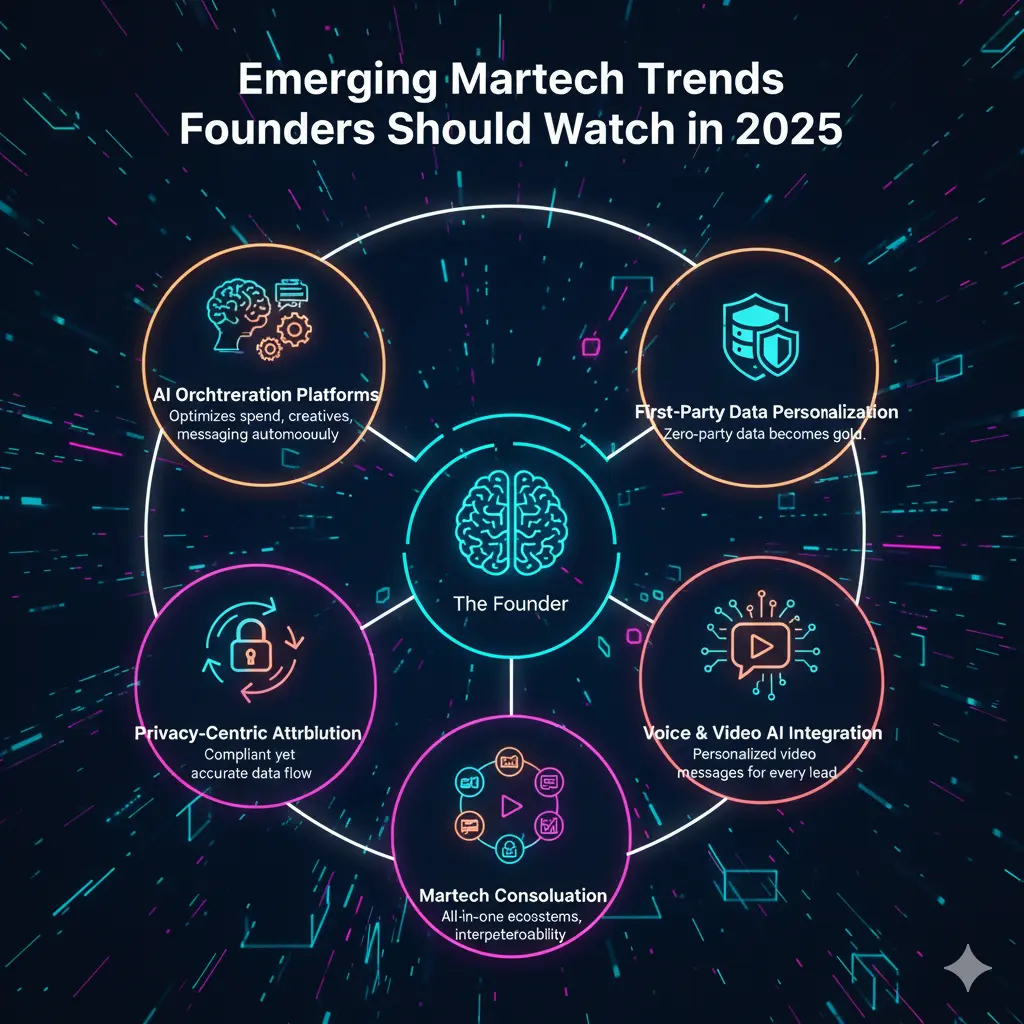
Emerging Martech Trends Founders Should Watch in 2025
- AI Orchestration Platforms
Tools like Autopilot AI or HubSpot GPT Extensions unify marketing decisions — optimizing spend, creatives, and messaging autonomously. - First-Party Data Personalization
With third-party cookies dying, zero-party data (surveys, form inputs, behavior-based signals) becomes gold. - Voice & Video AI Integration
Imagine your CRM automatically generating a personalized video message for every lead based on their concern — that’s already possible with Synthesia + HubSpot. - Privacy-Centric Attribution
Tools like Stape.io and ServerSide GTM are becoming essential for compliant yet accurate data flow. - Martech Consolidation
Expect larger players (like HubSpot and Zoho) to absorb niche tools into all-in-one ecosystems — founders should bet on interoperability, not variety.
How to Assemble & Audit Your Marketing Stack
- Start With Your Goals, Not Tools.
Ask: “What do I need to measure, automate, and scale?” Then map tools accordingly. - Document Workflows Before Buying Software.
Create flow diagrams showing data flow: Ad → Lead → CRM → Automation → Analytics. - Check Tool Integrations Before Subscription.
Use Zapier or native APIs as connectors. Avoid manual data export-import setups. - Review Your Stack Every Quarter.
Eliminate redundancies and identify tools that overlap in features. - Empower Your Team With Training.
A sophisticated stack is useless if your team doesn’t know how to use it efficiently.
Final Thoughts
A founder’s job in 2025 is not to run campaigns, but to design the system that runs them.
Your marketing stack is that system — the infrastructure that lets creative, analytical, and automation layers coexist harmoniously.
When done right, it doesn’t just save money. It compounds your marketing intelligence — turning every campaign into a learning engine.
So whether you’re spending ₹10,000 or ₹10 lakh, remember:
A smart stack doesn’t cost more. It performs more.

No Comments