Table of Contents
Picture this.
You’ve got a killer email sequence — crafted by the best copywriter you know.
Your subject lines pop. The design is pixel-perfect. The offer? Irresistible.
You hit send to 50,000 subscribers.
And then… nothing.
Open rates collapse. Sales flatline. You blame content, timing, or maybe the economy.
But what if the real culprit isn’t your message — it’s your deliverability?
Because here’s the brutal truth:
The most persuasive email means nothing if it never reaches the inbox.
In 2025, email deliverability has become the silent killer of marketing ROI — especially for founders who treat “delivered” as “seen.”
The Difference Between Delivered and Deliverability
Let’s clear a common misconception.
- Delivered just means your ESP (like Mailchimp or HubSpot) handed off your email to the recipient’s mail server.
- Deliverability is whether that email actually reached the inbox, not spam, promotions, or quarantine.
So yes — your campaign can show 100% “delivered,” and yet, 60% of those emails might be buried in folders no human ever opens.
Deliverability is not a feature.
It’s a discipline — the bridge between your message and your money.
Why Deliverability Is Revenue — Not Just Reputation
When your inbox rate drops, you don’t just lose “visibility.”
You lose trust, engagement, and long-term revenue velocity.
Here’s what the math looks like:
| Metric | Scenario A (Healthy) | Scenario B (Poor Deliverability) |
| Emails Sent | 100,000 | 100,000 |
| Inbox Placement | 95% | 75% |
| Open Rate | 30% | 18% |
| CTR | 3.5% | 1.2% |
| Sales | ₹5,00,000 | ₹1,80,000 |
That’s over ₹3 lakh lost — not because your product failed, but because Gmail decided you were less trustworthy than a weekend sale spammer.
Deliverability defines your visibility velocity — how fast and how often your brand can enter a customer’s attention zone.
The Anatomy of Deliverability
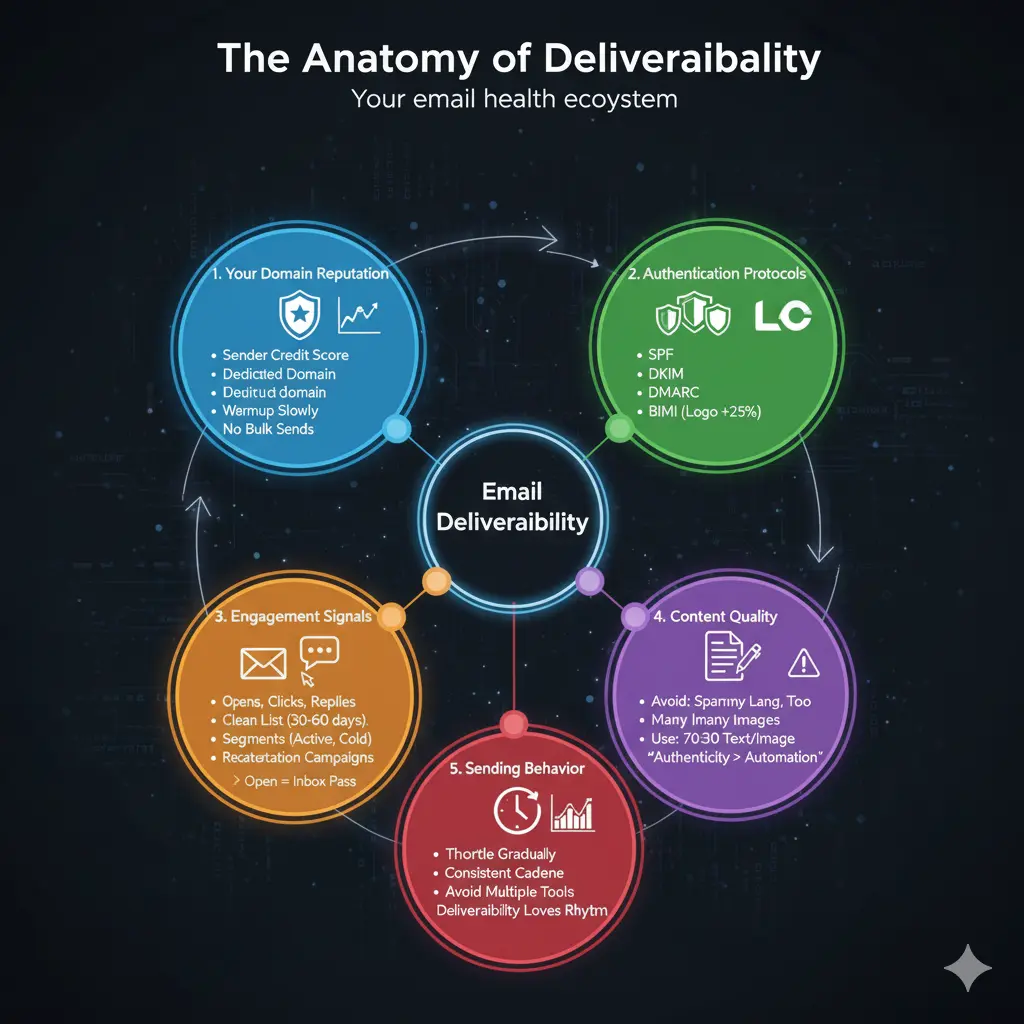
Deliverability lives and dies on five interconnected factors. Think of it like your email health ecosystem.
1. Your Domain Reputation
It’s your sender credit score.
Bad habits like spamming, inconsistent sends, or using bought lists destroy it.
📈 Fix:
- Use a dedicated sending domain (like mail.yourbrand.com).
- Warm it up slowly using tools like Mailreach or Folderly.
- Never send bulk emails from your main website domain.
2. Authentication Protocols
If you don’t verify yourself, Gmail and Outlook will verify you by suspicion.
🧩 Fix:
Set up these three DNS records:
- SPF: Authorizes your server to send emails.
- DKIM: Adds a digital signature proving the message wasn’t tampered with.
- DMARC: Tells mail servers what to do if SPF/DKIM fails.
✨ Pro move: Add BIMI (so your logo appears beside your emails). It boosts open trust rates by up to 25%.
3. Engagement Signals
Gmail doesn’t “read” your email — it reads your audience’s behavior.
Do people open? Click? Reply? Or ignore?
🧠 Fix:
- Clean your list every 30–60 days using ZeroBounce or NeverBounce.
- Create engagement-based segments (active, warm, cold).
- Send reactivation campaigns like “Still want these updates?”
💬 Every open tells Gmail: “Hey, people want this.”
That’s your pass to the inbox.
4. Content Quality
Your words can make or break deliverability.
⚠️ Avoid:
- Spammy language: “FREE!!!”, “Guaranteed!”, “Act Now!”
- Too many images, too few words
- Shortened URLs or link redirects
✅ Use:
- A text-to-image ratio of roughly 70:30
- Plain-text versions of your email
- Conversational tone (“Hey Raj, here’s something you might like…”)
Remember: authenticity > automation.
5. Sending Behavior
Even great content fails if your sending patterns scream “bot.”
🕒 Fix:
- Don’t batch-send 100k emails at once — throttle them gradually.
- Maintain consistent cadence (weekly, bi-weekly).
- Avoid sending from multiple tools using the same domain simultaneously.
Deliverability loves rhythm. Chaos confuses filters.
The “Deliverability Debt” No One Talks About
Just like technical debt in product, there’s deliverability debt in email.
It builds quietly — each bad send adds friction.
You ignore your bounce rate →
Your domain reputation dips →
You start hitting promotions →
Then spam →
Then blocklists →
Then your growth pipeline dies, silently.
Recovering from deliverability debt takes weeks — rebuilding your sender reputation, warming up IPs, cleaning lists, rewriting content.
That’s why prevention is your cheapest insurance.
The 2025 Deliverability Stack
If you’re serious about scaling email as a revenue channel, build this stack early.
| Layer | Tools | Purpose |
| Monitoring | Google Postmaster, GlockApps | Inbox tracking, domain reputation |
| Authentication | EasyDMARC, MxToolbox | SPF/DKIM/DMARC management |
| Warmup | Mailreach, Lemwarm | Gradual domain warming |
| Verification | ZeroBounce, Bouncer | Cleans your list |
| Sending | Postmark, Klaviyo, ConvertKit | ESPs with good IP hygiene |
| Analytics | Looker Studio, HubSpot Reports | ROI + inbox placement visualization |
The Fix Blueprint
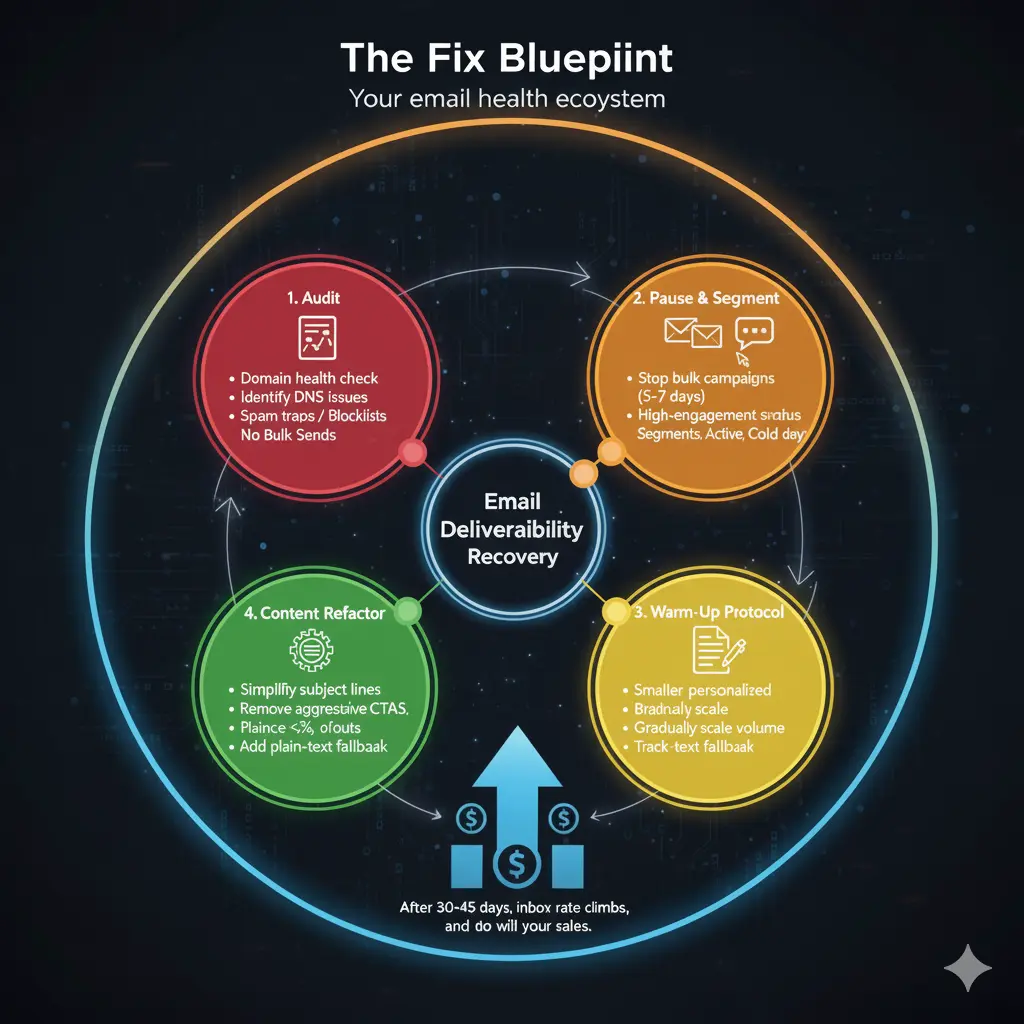
When deliverability tanks, here’s your battle-tested recovery framework:
Step 1: Audit
- Run a domain health check (MxToolbox + Postmaster).
- Identify DNS issues, spam traps, or blocklists.
Step 2: Pause & Segment
- Stop all bulk campaigns for 5–7 days.
- Resume sending only to high-engagement segments.
Step 3: Warm-Up Protocol
- Send smaller batches with personalized content.
- Gradually scale volume.
- Track inbox placement daily.
Step 4: Content Refactor
- Simplify subject lines.
- Remove aggressive CTAs.
- Add plain-text fallback.
Step 5: Rebuild Trust
- Maintain consistent frequency.
- Keep bounces <2%, complaints <0.1%.
- Continue using warmup and monitoring tools weekly.
After 30–45 days, your inbox rate begins to climb again — and so will your sales.
Deliverability Benchmarks (2025 Standard)
| Metric | Ideal Benchmark | Notes |
| Inbox Placement | 90–95% | Below 85% = problem |
| Spam Complaint Rate | <0.1% | Higher = blacklisting risk |
| Hard Bounce Rate | <2% | Clean lists often |
| Open Rate | 25–45% | Segment-based variation |
| Click Rate | 2–5% | Depends on offer & design |
The Founder’s Take: Deliverability Is a Profit Lever
Founders obsess over CAC, CTR, and CPC — but none of that matters if your retention engine (email) fails to deliver.
Think of deliverability as your invisible profit margin.
It doesn’t cost money to fix, but it saves — and multiplies — revenue that’s already yours.
The fastest way to scale your ROI in 2025 isn’t a new funnel or another ad channel.
It’s ensuring the messages you’ve already written actually reach your audience.
Final Thought
You can’t build a high-performing business on invisible communication.
If your emails aren’t landing, neither is your growth.
So before you write your next campaign, ask yourself —
“Can my customer even see this?”
Because if not… your revenue might already be stuck in spam.

No Comments