Table of Contents
Companies have used traditional marketing for many years to encourage customers to buy something. They invest a significant amount of money in ads to reach more customers. However, it is not always guaranteed that companies reach their target audience.
Behaviour Targeting and behavioural advertising help marketers gain insights into customer behaviour and create content that delivers more relevant and effective messages.
This approach allows marketers and publishers to target customers based on their internet browsing patterns and purchase history.
Read further for brief information on behavioural targeting benefits, types, challenges, and promises.
What is Behaviour Targeting?
Behaviour targeting is a marketing strategy that utilises information about web users to boost advertising campaigns. A more specific plan gives better engagement and returns on investment (ROI) in your marketing efforts.
However, this method differs marginally from conventional contextual marketing, which displays advertisements based on product similarity.
It involves collecting information from several sources on the web browsing and purchasing habits of potential customers. Its primary objective is to send advertising messages to the behavioural target populations with the most interest in them.
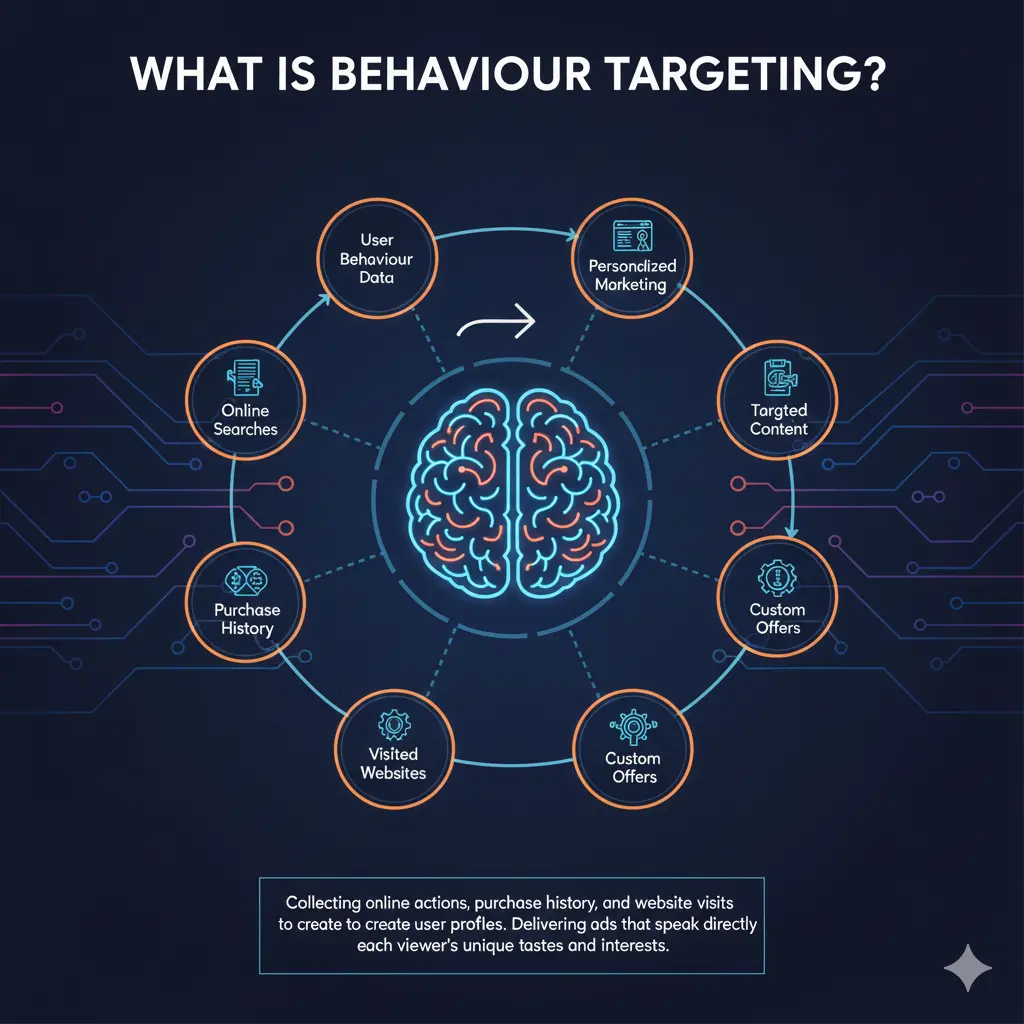
This method compiles online searches, purchase history, frequently visited websites, and other data to generate a comprehensive user profile. Which reveals what your audience wants, avoids, and buys.
By compiling this data, companies may create advertisements that speak directly to each viewer by catering to their unique tastes and interests.
How Does It Work?
As you know, behavioural targeting involves data collection about visitors and delivering the right ads to match their profile. A data management platform is used to collect behavioural data about visitors. DMPs collect, store, and sort data for advertisers.
The data for behaviour targeting can come from diverse sources, which include:
- User login information
- IP address and geolocation
- Duration of visit
- Recent visits
- Clicks
- Demographics
- Content read
- Regularly visited sections of the page
- Searches within the website
- Visited websites
Furthermore, advertisers and publishers can gather onsite data on their website visitors. Learning how to use the information achieved through specific marketing goals is important for effective behaviour targeting. Utilizing the approach is a simple way to increase conversion rates.
The Challenge of Behaviour Targeting
Web analytics has always been challenging due to issues of scale, data, and diversity. They are aggressively working to thwart its capacity to respond quickly.
Here is how to do it: Scale, Data, and Diversity.
- Every time, thousands of people keep visiting your website, and the number of people is still increasing. This increase in scale restricts the accurate analysis of your website.
- Also, some visitors keep going back and forth on your website, which produces huge data that is impossible for a human or even a tool to calculate.
- Furthermore, most website owners are unable to understand the reason behind the people visiting their website. Sometimes people visit your website for reasons that you did not intend or create. This unknown cause and calculations complicate your data.
You can overcome the scale, data, and diversity problem by using the right tool for behavioural targeting. Understand your visitors as they interact with your web presence and show them the most appropriate content.
Benefits of Behaviour Targeting for Business
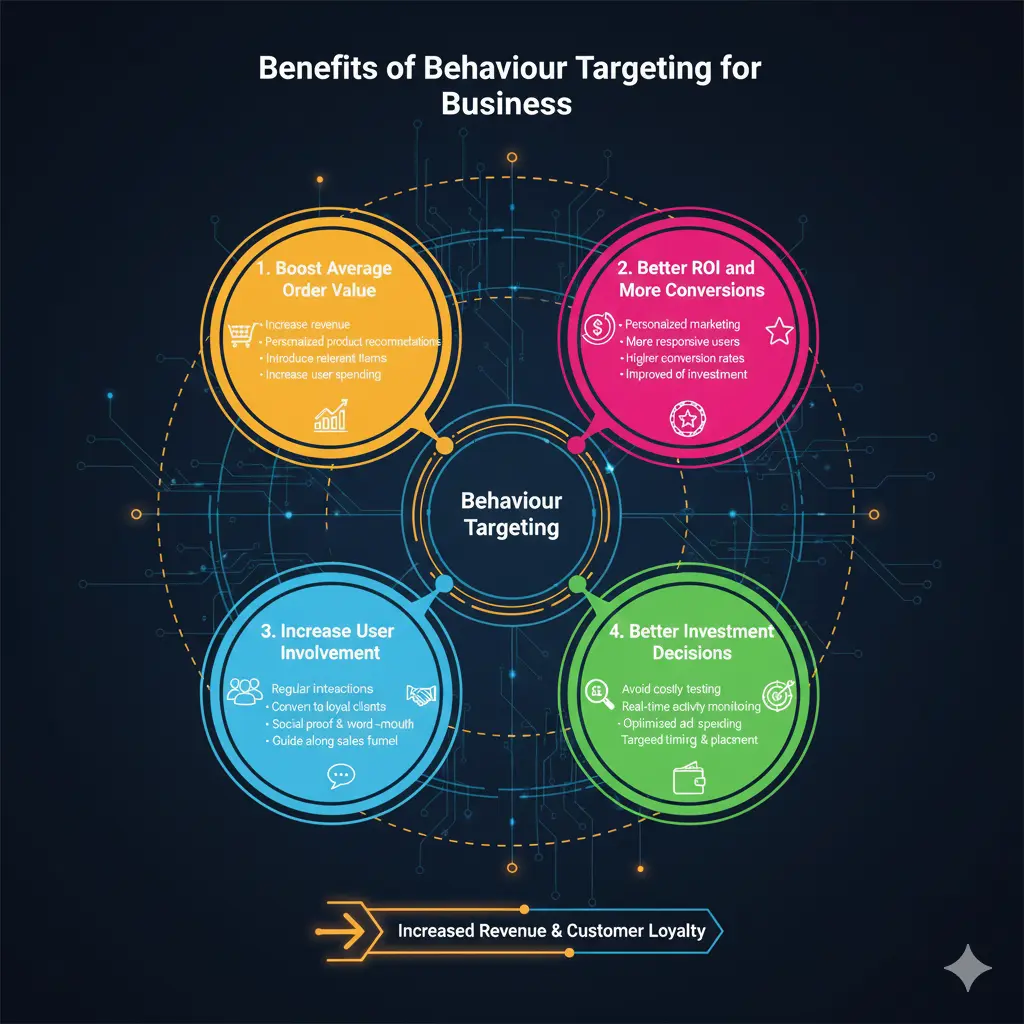
There are four direct benefits of marketing to users, depending on their activities on your company’s objectives.
1. Boost Average Order Value
One way to increase your revenue is to boost your average order value. Several e-commerce sites evaluate a customer’s browsing or purchasing history using algorithms.
This form of machine learning assists your company in introducing consumers to items and services that may be of interest to them, hence increasing user spending.
2. Better ROI and More Conversions
Personalised marketing generates better outcomes. Unlike in the past, users nowadays are more responsive to marketing communications. Therefore, your advertising initiatives must resonate with them.
Using the behaviours of prospective users to create a personalized experience increases your conversion rate and improves your return on investment.
3. Increase User Involvement
It’s essential to your company’s survival that your users actively participate. Regular contacts have a higher probability of converting into loyal clients.
They’ll also be more inclined to spread the word about your business. It will help you build up a solid social proof foundation for your brand.
You may guide potential consumers along the sales funnel by monitoring their actions on your website and displaying material personalized to their interests.
4. Better Investment Decisions
Obtaining additional information on the behaviours of your target audience can help you avoid costly testing across channels. Instead, you may gain a deeper understanding of their online behaviour by monitoring their activity in real-time and reacting accordingly.
Spending is optimised because adverts are shown to potential buyers at the time and place where they are most likely to make a purchase.
Types of Behavioural Targeting
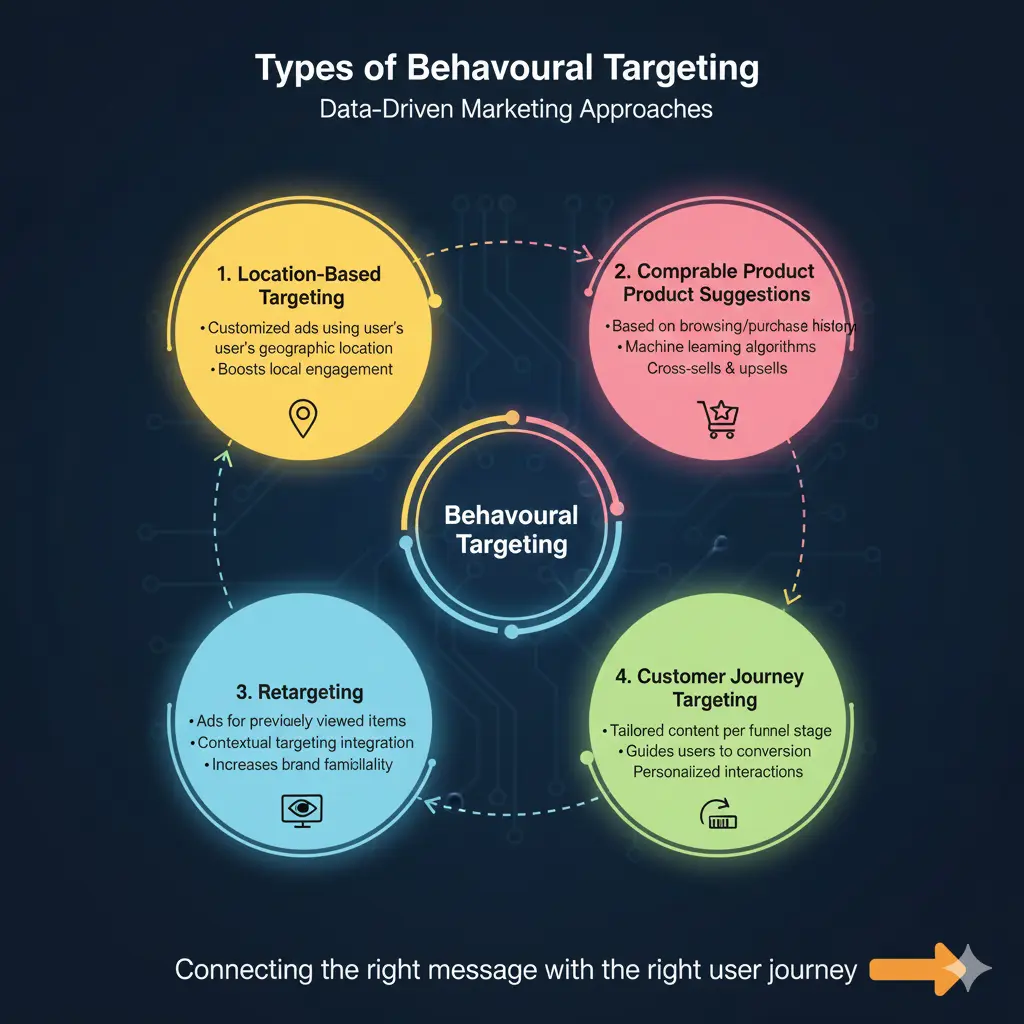
1. Location-Based Targeting
Location-based targeting is an emerging approach to reaching clients through behavioural marketing. This method sends customised and relevant advertisements to boost engagement by using a user’s exact geographic location and behaviour habits.
2. Comparable Product Suggestions
If you shop online or watch shows, you are likely aware of the notion of comparable product recommendations.
Some refer to this method as “recommended selling” because both companies provide recommendations on what to watch or purchase next.
This method involves proposing a complementary or comparable product or service for purchase.
3. Retargeting
Retargeting introduces a user to advertisements for items or services they have previously viewed. Furthermore, it may be used with contextual targeting to offer a tailored advertising experience for users.
Users devote a considerable amount of time to Internet connectivity. Consequently, your company has more options than ever to reach its target audience with the proper message at the right moment. Continuous exposure generates brand familiarity, which builds confidence and increases conversions.
The Promise of Behaviour Targeting
Behaviour targeting has been in existence for quite some time. What has changed, though, is that these methods are now more widely available.
Furthermore, they are also becoming less expensive. The promise is alluring, and if you put in the effort, you may accomplish a great deal.
You can get more information on behavioural targeting at the brisk. It can give you more detailed information on how this method works.




No Comments