Most B2B marketing is built on an assumption that turns out to be wrong more often than anyone wants to admit: that buyers are primarily weighing your product against a competitor’s, comparing features, pricing, and capabilities, and choosing the best option on the merits.
New research from LinkedIn and Bain & Company, published on June 11, 2026 under the title “The Principles of Buyability,” makes a different case entirely. The dominant force shaping B2B purchase decisions isn’t a rational features-and-pricing comparison. It’s fear — specifically, the fear of making a decision that can’t be defended later if something goes wrong.
“The number-one driver of decision making was this idea of fear of messing up. Buyers are centered on that — the number-one thing they’re thinking is: can I defend this decision in a post-mortem two years from now?” — Jamie Cleghorn, Senior Partner, Bain & Company
This article unpacks what the research actually found, why the psychology behind B2B buying is so different from what most marketing strategies assume, and what “being buyable” actually requires from a brand that wants to win more of these decisions.
Meet FOMU: the fear that beats FOMO
Marketing has spent years leaning on FOMO — Fear of Missing Out — as a core psychological lever. Create urgency, demonstrate competitive momentum, show buyers what they’ll lose by not acting, and decisions accelerate.
The LinkedIn and Bain research argues that logic doesn’t hold up in complex B2B environments. The research, authored by Mimi Turner, Head of Marketplace Innovation at LinkedIn, in collaboration with Bain, identifies FOMU — Fear of Messing Up — as the dominant psychological barrier behind stalled deals, and argues it consistently outweighs FOMO in B2B contexts.
The distinction matters enormously. A buyer driven by FOMO is asking “what am I missing out on if I don’t act?” A buyer driven by FOMU is asking something much more personal and much higher-stakes: “if this goes wrong, will I be the one blamed for it?”
40% of B2B deals stall because buying groups can’t reach agreement.
The post-mortem question
Jamie Cleghorn, Senior Partner at Bain & Company, frames the core insight in a way that’s hard to forget once you’ve heard it: buyers aren’t primarily asking whether a solution does the job. They’re asking whether they could defend choosing it in a hypothetical post-mortem conversation two years down the line, if things didn’t go as planned.
That’s a fundamentally different psychological test than “is this the best product.” It’s closer to “if my boss, or my boss’s boss, asked me why I chose this vendor after a rocky implementation, would my answer hold up?” Professional reputations and career security are tied to these decisions in B2B in a way that’s rarely true for individual consumer purchases, and that changes what buyers are actually optimizing for.
Why deals actually stall
The research found that 40% of B2B deals stall specifically because the buying group can’t reach agreement — not because of a competitor winning, and often not because the product was deemed insufficient. It’s indecision among the people who need to collectively sign off, not active rejection.
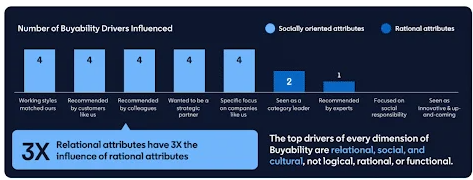
Three of the top five drivers behind purchase decisions, according to the research, revolve around group dynamics — relational and cultural factors — rather than product features. That’s a striking ratio. The features comparison that most marketing content is built around is, by this data, a minority factor in whether a deal actually closes.
The hidden buyers nobody is marketing to
One of the most actionable findings in this research is the concept of “hidden buyers” — people inside the buying organization who rarely appear on a marketing team’s radar but who hold real influence, often described as roughly half the decision-making power in major purchases.
These are typically people in finance, legal, procurement, or other process-owner and fiduciary roles. They’re not the champion pushing the deal forward internally — they’re the guardians whose job is explicitly to catch risk before it becomes a problem. Cleghorn’s research distinguishes these hidden buyers clearly from the “target buyers” that most B2B marketing strategies are built to reach.
Target buyers, according to the research, are more willing to take some risk in exchange for innovation — which tracks with why so much B2B marketing leans on bold creative and forward-looking positioning. But that messaging is aimed at only half the actual influence in the room. Hidden buyers respond to a completely different set of signals: peace of mind, reliability, and demonstrated trustworthiness, not innovation or boldness.
“If we really want to break through in B2B, we have to fully understand what drives target and hidden buyers. This is where marketing efforts usually stop, because our current efforts fundamentally ignore the needs of hidden buyers.” — Jamie Cleghorn, Bain & Company
Social proof beats almost everything else
The research includes a statistic that should reshape how most B2B marketing budgets get allocated: buyers are three times more likely to purchase something that’s heavily recommended by someone they know, compared to other influence channels.
This lines up directly with the FOMU framework. A recommendation from a trusted peer doesn’t just suggest a product is good — it provides social cover. If something goes wrong later, “several people I trust recommended this” is a far more defensible position than “I chose this based on a vendor’s own marketing materials.” Peer recommendation isn’t just a discovery channel; it’s a risk-mitigation tool for the buyer’s own career security.
What “buyability” actually means
LinkedIn defines buyability as a strategic model for B2B marketing and sales that treats the buying group — not the individual buyer — as the real unit of decision-making. Being “buyable,” in this framework, means a brand has made it easy for an entire buying committee to arrive at collective confidence, not just convinced one enthusiastic champion.
Mimi Turner describes this as the “safety effect” — in a world where, as the old saying goes, no one gets fired for buying the safe, established option, emotional security remains one of the most powerful drivers of B2B confidence. Being considered as an option isn’t enough. Being buyable means a buyer who’s close to saying yes can find the reassurance they need from people like them — making relatability and validation some of the strongest purchase triggers available.
What this means for your B2B marketing strategy
Build content specifically for hidden buyers, not just champions
If half of your buying group’s influence sits with finance, legal, and procurement-type roles, you need content that speaks directly to their priorities — risk mitigation, compliance, implementation reliability, total cost of ownership — separate from the innovation-forward messaging aimed at your champion.
Invest more deliberately in customer advocacy and peer proof
Given that peer recommendation triples purchase likelihood, customer advocacy programs, case studies featuring named and verifiable customers, and genuine peer-to-peer referral mechanisms deserve a bigger seat at the budget table relative to outbound prospecting or pure brand awareness spend.
Help your champion build their internal case, not just their initial interest
Since most deals stall on group agreement rather than the champion’s own conviction, the most valuable content you can produce might be the material that helps your champion defend the decision internally — comparison frameworks, implementation risk mitigation details, and proof points designed to be shared inside the buying committee, not just consumed by one person early in the funnel.
Make defensibility a explicit part of your messaging
Address the post-mortem question directly. Case studies and proof points that specifically demonstrate reliability over time — not just initial results — give buyers the kind of evidence they can point to later if their decision is ever questioned.
Why this matters now
B2B buying committees have generally grown larger and more cautious over the past several years, which means the psychological dynamics this research describes are intensifying, not fading. A marketing strategy built entirely around convincing a single enthusiastic buyer, without addressing the fear-driven caution of the rest of the committee, is increasingly likely to produce exactly the kind of stalled, indecisive outcome this research describes.
Price and features still matter in B2B. But if 40% of deals are stalling on group indecision driven by fear rather than active rejection, the marketing strategy that wins is the one that makes the whole buying committee feel safe saying yes — not just the one that makes the strongest feature comparison.
Struggling with B2B deals that stall in committee instead of closing?
The Brisk Digital builds B2B marketing strategies designed around how buying groups actually make decisions — not just how individual buyers discover you.
admin
Related Posts
Most Adults Now Get Their News From Social Media – Reuters



No Comments