Table of Contents
Google has given advertisers five extra months to migrate Dynamic Search Ads into AI Max. That’s a genuine relief for teams that were scrambling — but it’s also exactly the kind of extension that quietly turns into a missed deadline if you don’t plan around it now.
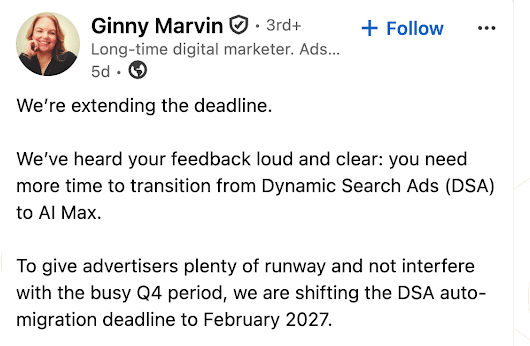
If you’ve been running Dynamic Search Ads and dreading the migration into AI Max, you just got some breathing room. Google has officially extended the deadline for moving existing DSA campaigns into AI Max, pushing it from September 2026 to February 2027.
That’s a meaningful extension — roughly five additional months — and for advertisers who were staring down a tight migration window, it’s a welcome change. But extensions like this come with a quiet risk: the additional time makes it easier to deprioritize the migration entirely, right up until the deadline arrives anyway. This piece covers what’s actually changing, why the extension matters, and how to use the extra time productively instead of just delaying the inevitable.
Why this migration is happening at all – A Quick Recap
Google has been moving advertisers away from standalone Dynamic Search Ads campaigns and toward AI Max, its more automated, AI-driven approach to matching ads with relevant search queries. The original timeline required all existing DSA campaigns to be migrated before September 2026, after which point Google indicated it would begin migrating remaining campaigns automatically on advertisers’ behalf.
That basic structure hasn’t changed with this announcement — what’s changed is the date. Advertisers now have until February 2027 before Google takes over the migration process for any campaigns that haven’t been manually transitioned.
What actually changed
- The hard deadline for manual migration has moved from September 2026 to February 2027.
- Manual transition tools remain available right now — there’s no need to wait for the new deadline to approach before starting.
- If you take no action by February 2027, Google will migrate your remaining DSA campaigns automatically.
New DSA-to-AI-Max migration deadline: February 2027
Why “Google will do it for you” is not a comforting backup plan
It’s worth being direct about why the automatic migration path is worth avoiding if you have any ability to do this manually instead. When a platform migrates a campaign automatically on your behalf, it’s making structural decisions based on its own defaults and its interpretation of your existing setup — not based on your specific knowledge of what’s actually working, what budget allocation makes sense for your business, or which elements of your current campaign structure you’d want preserved versus rebuilt.
A manual migration, on the other hand, gives you full control over how your new AI Max campaigns are structured from day one. You decide how budgets carry over, how targeting and asset groups are organized, and how to handle any edge cases specific to your account. That level of control essentially disappears once Google’s automatic migration kicks in.
Treat “Google will migrate it for you” as a worst-case fallback, not a plan. The advertisers who get the best results from this transition are the ones who migrate deliberately, on their own terms, well before any deadline forces their hand.
The Final URL Expansion reporting improvements
Alongside the deadline extension, Google also announced a set of reporting improvements specifically for Final URL Expansion (FUE), the feature that allows AI Max and similar automated campaign types to dynamically select landing pages based on a query’s relevance, rather than relying solely on a fixed final URL.
The improvements Google has described include:
- Account-level Final URL Expansion reporting, giving advertisers a consolidated view across their entire account rather than having to review FUE performance campaign by campaign
- Additional performance metrics specifically for FUE assets, which should make it easier to evaluate whether the dynamically selected URLs are actually performing well
- Bulk asset removal capabilities directly from reporting tables, which would let advertisers clean up underperforming or irrelevant FUE assets more efficiently than handling them one at a time
Google has not yet shared a specific launch date for these reporting improvements, so it’s worth keeping an eye out for that announcement as your migration planning progresses — better account-level visibility into FUE performance is exactly the kind of tool that makes a confident migration decision easier.
How to use the extra time productively
Don’t wait until late 2026 to start
The most common mistake with any extended deadline is treating the extension as permission to delay rather than as additional planning time. Five months sounds like a lot until you’re three weeks from the new deadline with a complex account still unmigrated. Start now, even if you take it in stages.
Audit your current DSA campaigns first
Before migrating anything, get a clear picture of what’s actually working in your existing DSA setup — which page groups are driving the most conversions, which targeting rules are producing the best match quality, and which elements of your account structure you’d want to deliberately preserve in the new AI Max structure.
Use the manual transition tools now, even just to explore
Since the manual tools are already available, there’s real value in starting the process early on a smaller account or campaign segment first. This lets you understand how the transition tool behaves, what decisions it asks you to make, and where your specific account might hit edge cases — all before you’re under deadline pressure.
Build in time for a post-migration review
Don’t treat migration as a single event. Plan for a review period after migrating each campaign to confirm performance is tracking in line with expectations, and budget time to make adjustments. A migration done in a rush, right at the deadline, doesn’t leave room for this kind of validation.
Watch for the FUE reporting launch
Since Google hasn’t given a specific date for the Final URL Expansion reporting improvements, check in periodically on Google Ads’ release notes or your account notifications. If those tools land before you’ve completed your migration, they could meaningfully improve your ability to evaluate AI Max performance once you’re set up.
A simple migration timeline to consider
- Now through late summer 2026: Audit existing DSA campaigns and document what’s working.
- Late summer through fall 2026: Begin manual migration on a portion of your account, starting with lower-risk or smaller campaigns.
- Fall through end of 2026: Expand migration to your core campaigns, incorporating lessons learned from the earlier phase.
- Early 2027, well before February: Complete migration of any remaining campaigns, leaving buffer time for review and adjustment before the deadline.
Why this matters beyond just one feature transition
This deadline extension is a small example of a much bigger pattern across Google Ads: a steady, ongoing shift toward AI-driven, automated campaign types replacing more manually structured ones. Dynamic Search Ads is just one of several legacy campaign formats that has been folded into broader automated systems over the past couple of years. Advertisers who build a disciplined, deliberate approach to these transitions — rather than waiting for deadlines to force action — tend to come out the other side with a better-performing, better-understood account than those who let the platform make the decisions for them by default.
An extended deadline is a gift only if you actually use the extra time. Start your migration now, on your own terms, and the February 2027 date will be a formality rather than a deadline you’re racing against.
Still running Dynamic Search Ads and not sure where to start with AI Max?
The Brisk Digital handles full campaign migrations — structured, tested, and built around what’s actually working in your account, not Google’s default settings.




No Comments