Table of Contents
The purchase funnel just got a new owner. Here's what Google's AI-powered Universal Cart means for brands, performance marketers, and everyone selling online.
For years, the e-commerce industry has operated on a reasonably clear mental model of how online purchase decisions unfold. A customer has a need. They search for a solution — on Google, on Amazon, sometimes on social media. They land on a product page, evaluate, add to cart, and check out. The funnel is linear.
The touchpoints are trackable, the strategy is predictable.
Google’s Universal Cart, announced at Google I/O 2026, breaks that model.
Not gradually. Not at the margins. It breaks it structurally, by inserting Google itself as the persistent layer through which shopping happens — across Search, Gemini, YouTube, Gmail, and participating merchants — with AI handling the price monitoring, the deal-hunting, the stock alerts, and the loyalty integrations.
This is not a feature update. It’s a declaration of intent about where Google believes commercial activity on the internet should live.
What the Universal Cart Actually Does
Let’s start with the mechanics, because the details matter more than the headline.
The Universal Cart is an AI-powered shopping layer that operates across Google’s entire product ecosystem. When a user finds a product they’re interested in — whether through a Search result, a Gemini recommendation, a YouTube video, or a promotional email in Gmail — they can add it to a single, persistent cart that travels with them across all of these surfaces.
The AI component isn’t passive. Once an item is in the cart, Google’s system actively works on behalf of the shopper:
- Price monitoring: The system scans the internet for better deals, price drops, or promotional offers — and alerts the user when prices change. It also provides pricing history, so shoppers can evaluate whether a current price represents genuine value.
- Stock alerts: Items that are out of stock are tracked, and users are notified when inventory becomes available.
- Loyalty integration: Google Wallet is natively integrated, meaning shoppers can apply loyalty programs, merchant offers, and rewards without leaving the Google ecosystem or losing the benefits they’ve accumulated elsewhere.
- Cross-surface continuity: The cart persists across sessions, devices, and contexts. A user can discover a product in a YouTube review, add it to the cart on their phone, and complete the purchase on their laptop later — with all the AI-driven price intelligence intact.
Currently, the Universal Cart is live with a select group of major retailers: Nike, Sephora, Target, Ulta Beauty, Walmart, and Wayfair. Shopify merchants will be integrated later this summer, which is the detail that expands this from a large retailer story to an every-brand story.
Why This Is a Bigger Deal Than It Looks
The initial reaction from many marketers has been measured — a new Google shopping feature, interesting but not earth-shattering. That reaction underestimates what’s actually happening here.
The Universal Cart represents Google’s most serious attempt yet to own the commercial layer of the internet end-to-end. Not just the discovery phase (where Google has always been dominant), but the consideration phase, the decision phase, and increasingly the transaction phase as well.
To understand why this matters, consider what Google is doing for the shopper. Instead of making the purchase decision themselves — evaluating prices across multiple sites, managing wishlist items in different tabs, tracking whether a sold-out item has come back into stock, applying promo codes from emails — the AI agent does all of that. The shopper’s cognitive load drops dramatically. The friction of purchase drops with it.
Friction reduction in e-commerce is one of the most reliable drivers of conversion. Every time a barrier between intent and purchase is removed, conversion rates improve. Google is removing a significant number of those barriers simultaneously.
For brands, the implication is dual-edged.
On one hand, being in the Universal Cart ecosystem means your products are visible inside a high-intent, AI-assisted purchase environment where Google is actively working to match your inventory with interested buyers. That’s a meaningful commercial opportunity, and the brands currently integrated — Nike, Target, Walmart — aren’t there by accident.
On the other hand, the Universal Cart also introduces a layer of AI-mediated price comparison into every purchase decision. If a user adds your product to their cart and Google immediately surfaces a competitor’s lower price, your brand has just been placed in direct, transparent price competition in real time. The customer doesn’t have to do the research — Google does it for them.
The Attribution Problem This Creates
Performance marketers are going to feel this acutely, and it’s worth addressing directly.
The existing attribution ecosystem for e-commerce is already complicated — last-click models, multi-touch models, view-through attribution, incrementality testing — but it’s built on an assumption that the key interactions happen on identifiable surfaces that can be tracked. A click from a search ad. A click from a social ad. A direct visit. An email click-through.
The Universal Cart complicates this because the journey becomes genuinely multi-surface in a way that existing attribution tools aren’t designed to handle.
A user discovers your product in a YouTube video (a content interaction). They add it to their Universal Cart (a Google ecosystem interaction). Google sends them a price drop alert three days later (a push notification interaction). They complete the purchase (a transaction).
Which of those moments drove the conversion? Traditional models will struggle to answer that question accurately. Google’s own attribution tools will likely surface an answer, but that answer will naturally credit Google touchpoints, which creates obvious conflicts of interest in interpreting the data.
For brands, this means investing more seriously in incrementality testing and multi-touch attribution methods that can handle cross-surface journeys—not as a future consideration, but as an immediate capability need.
What This Means for Different Types of Brands
The Universal Cart doesn’t affect every brand the same way. The strategic implications vary significantly depending on where you sit in the market.
- Large established retailers already integrated into the system are in the strongest position. Their products are visible in a high-intent purchase environment, their loyalty programs are natively surfaced to customers, and they have data partnerships with Google that smaller brands don’t. The gap between large and small retailers in this ecosystem is not trivial.
- Mid-market brands on Shopify face the most interesting moment. When Shopify integration arrives this summer, it represents access to a distribution channel that was previously available only to brands that could negotiate direct integrations with Google. The question is whether Shopify brands are ready to participate — which means having accurate inventory data, competitive pricing, active Google Merchant Center accounts, and structured product data that Google’s AI can read and surface confidently.
- Premium and luxury brands face a specific tension. The price comparison functionality that makes the Universal Cart valuable to price-sensitive shoppers is, in many cases, actively undesirable for premium brands. Being placed in a real-time price comparison environment undermines the brand positioning that premium pricing depends on. The strategic choice for premium brands — whether to participate in the Universal Cart ecosystem at all, and on what terms — is not obvious, and deserves careful consideration.
- DTC brands with strong direct-to-consumer positioning face a channel conflict question. If a customer’s purchase journey increasingly runs through Google’s ecosystem, the direct relationship that DTC brands have worked hard to build — email lists, loyalty programs, first-party data collection — gets mediated by a third party. Google’s loyalty integration helps partially, but the fundamental tension between DTC philosophy and Google’s universal platform ambitions remains.
The Price War Risk Nobody Is Discussing
One of the underexplored consequences of AI-powered price monitoring at scale is what it does to price competition across categories.
When price comparison is manual — when a shopper has to open multiple tabs, visit multiple websites, and do the work of finding the best deal themselves — many shoppers don’t bother. They pay a slight premium for the convenience of buying from a trusted site, or they simply accept the first reasonable price they see. This price tolerance creates margin room for brands that aren’t price-leaders.
When price comparison is automated and invisible — when Google’s AI simply tells a shopper that the same item is $12 cheaper elsewhere, without the shopper having to do anything — the market dynamic changes. Price tolerance erodes. The cognitive friction of comparison shopping disappears. And the margin room that existed because comparison shopping was effortful starts to compress.
At a category level, this is deflationary for many types of products. For brands competing primarily on price, it sharpens an already thin battlefield. For brands competing on something other than price — quality, brand experience, values, service — it makes differentiation more important, not less.
The Universal Cart is, in a very direct sense, an AI-powered mechanism for making markets more efficient. More efficient markets are good for price-sensitive consumers. They are harder for brands that rely on information asymmetry to maintain margin.
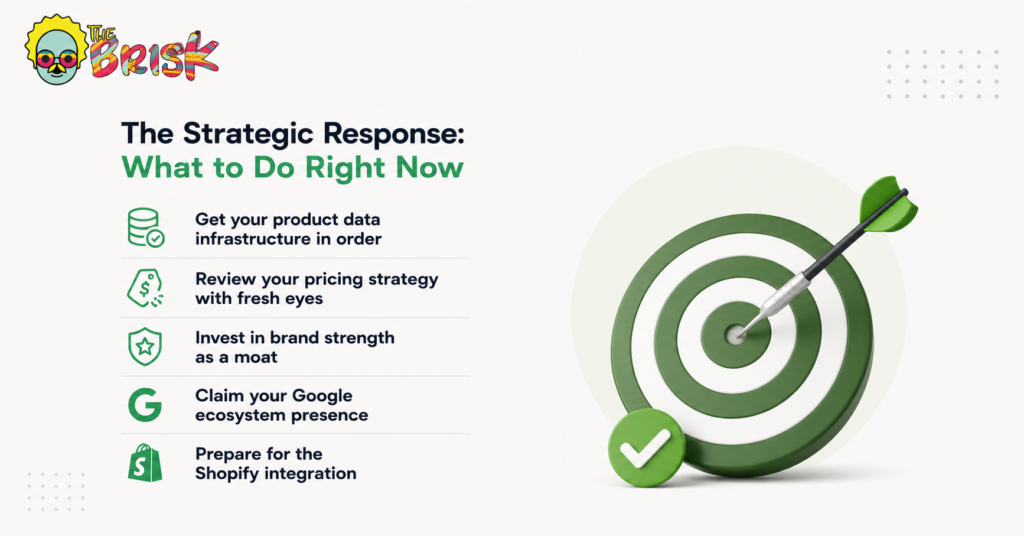
The Strategic Response: What to Do Right Now
Given all of this, what should brands actually do? Here’s a framework built around the realities of where the Universal Cart is today and where it’s heading.
- Get your product data infrastructure in order. The Universal Cart runs on structured product data — accurate inventory, clean pricing information, high-quality images, detailed specifications. If your Google Merchant Center feed is incomplete, outdated, or poorly structured, you’re invisible to the system before you even compete on price or positioning. This is not glamorous work, but it’s foundational.
- Review your pricing strategy with fresh eyes. Not to race to the bottom — that’s almost always the wrong response — but to understand where your pricing sits relative to competitors in a world where AI is doing real-time comparisons on your customers’ behalf. Where you’re genuinely competitive, that needs to be clear in your product data. Where you’re not competing on price, your brand differentiation needs to be strong enough that price isn’t the deciding factor.
- Invest in brand strength as a moat. The Universal Cart commoditises price. It cannot commoditise brand experience, customer trust, product quality, or the emotional dimension of purchasing from a brand a customer loves. Investments in brand — in content, in community, in customer experience — are investments in the one dimension of competition the Universal Cart cannot flatten.
- Claim your Google ecosystem presence. Google Business Profile, Google Merchant Center, shopping campaigns, YouTube product integrations — the Universal Cart is an ecosystem play, and brands that have a strong presence across Google’s surfaces are better positioned to benefit from the interconnected nature of the system.
- Prepare for the Shopify integration. If you’re a Shopify merchant, treat the summer integration as a product launch. Have your inventory data clean, your product imagery optimised, your pricing reviewed, and your Google Merchant Center account in good standing before it goes live. The brands that are ready at launch get early visibility advantages.
The Bigger Picture: Google’s Commercial Ambitions
It’s worth stepping back from the tactical details to consider what the Universal Cart reveals about Google’s broader commercial strategy.
Google’s business model is, fundamentally, a commercial intermediary. It connects people who want things with the providers of those things. Search advertising has been the primary mechanism for this intermediation for two decades.
But advertising is a relatively indirect mechanism — it creates visibility, which creates intent, which creates a click, which creates a visit, which eventually creates a transaction.
The Universal Cart is a more direct mechanism. Google is inserting itself into the transaction layer, not just the visibility layer. It’s building an AI-powered shopping experience that keeps users inside Google’s ecosystem through the entire commercial journey.
This is the same play Amazon made with Prime and the integrated marketplace — building a commerce ecosystem sticky enough that users default to it for purchase decisions. Google is making a serious bid to bring that model to the open web.
For brands, this means understanding Google not just as an advertising platform, but as a commercial infrastructure provider — one whose terms and capabilities will increasingly shape the economics of selling online.
Early Positioning Is Everything
The Universal Cart is live today with select retailers and expanding to Shopify merchants this summer. The window to get ahead of this — to have your product data clean, your pricing strategy reviewed, your Google ecosystem presence established — is short.
The brands that are well-positioned inside the Universal Cart ecosystem when it reaches broader scale will have a structural advantage over those still catching up. The opportunity isn’t in the feature itself. It’s in being ready for it before your competitors are.
The Brisk Digital works with brands at exactly these inflection points — when platform changes create genuine strategic choices that have real commercial consequences. If you’re thinking through how Google’s evolving shopping ecosystem affects your brand, we’d be glad to have that conversation.




No Comments