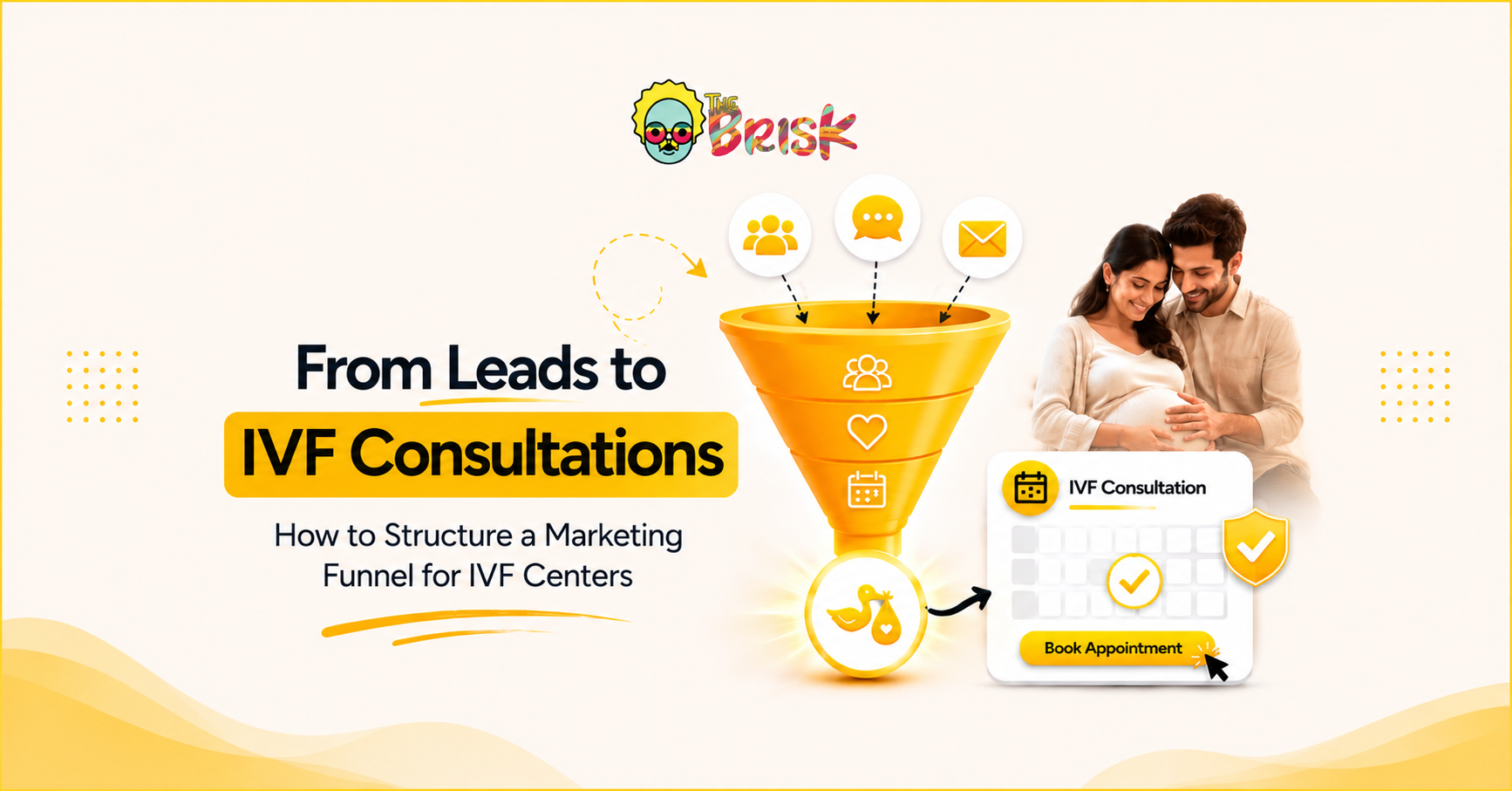
Marketing a fertility clinic is not like marketing a product. The person on the other side of your ad is not making an impulse purchase or comparison shopping for a commodity. They are in one of the most emotionally raw, privately painful, and financially significant decision periods of their adult life. They are scared, hopeful, exhausted from trying, and deeply sceptical of clinics that do not understand what they are going through.
Getting IVF marketing wrong does not just waste budget. It damages the trust of prospective patients at the moment they need to feel safe. Getting it right — meaning building a funnel that meets people where they are emotionally and informationally at each stage of their consideration journey — does not just generate consultations. It creates relationships that convert because they are built on demonstrated understanding.
This guide provides a complete, stage-by-stage blueprint for building an IVF marketing funnel that is both ethical and effective, with specific messaging frameworks, creative approaches, and nurture sequences for each funnel stage.
| ⚠️ The Emotional Context That Changes Everything IVF patients are not average healthcare consumers. They have typically been trying to conceive for 1 to 3 years before seeking IVF. They have often experienced miscarriage or failed fertility treatments. They are under significant relationship pressure and financial strain. Every piece of marketing content, every ad, every email, every landing page must be built with this emotional context in the room. Content that feels pushy, insensitive, or transactional will not just fail to convert — it will actively harm the perception of your clinic. |
Understanding the IVF Patient Journey: The Full Decision Arc
Before building a funnel, you must understand the actual patient journey — which is longer, more research-intensive, and more emotionally complex than most healthcare marketing funnels assume.
| Stage | Where They Are Emotionally | What They Need from You |
| Awareness | First acknowledging they may need help; fear and shame common | Educational content that normalises seeking help; no selling |
| Consideration | Actively researching IVF options; comparing clinics | Transparent information about success rates, costs, and process |
| Evaluation | Shortlisting 2–3 clinics; trust-building phase | Doctor profiles, patient stories, clear consultation process |
| Intent | Ready to book a consultation; final hesitation points | Friction-free booking, risk reversal, clear what-happens-next |
| Nurture (Post-Consult) | Post-consultation; deciding whether to proceed | Warmth, ongoing education, answer to lingering doubts |
| Advocacy | Successful patients; grateful and potentially vocal | Referral pathways, community, celebratory content participation |
Funnel Stages Breakdown: What to Run at Each Stage
Stage 1: Top of Funnel — Awareness and Education
At the top of the funnel, the couple (because IVF is almost always a couple’s decision) has not yet decided to pursue IVF. They are at the stage of acknowledging that natural conception is not happening as expected and beginning to ask questions. The primary emotion is a mix of confusion, shame, and hope.
Your content at this stage should not mention IVF prominently. It should answer the questions they are already asking:
- How long does it take to get pregnant normally?
- What are the signs of a fertility problem in men and women?
- When should we see a doctor about not getting pregnant?
- What is the difference between IUI and IVF?
- Does stress affect fertility?
Content formats that work at TOF: Educational blog posts (highest organic search volume here), short educational Reels answering specific fertility questions, Google search ads targeting informational queries (not ‘book IVF’ but ‘signs of low AMH in women’), YouTube explainer videos, and Facebook/Instagram carousel posts on fertility topics.
The critical rule: TOF content establishes you as a trusted educational resource. The implicit message is ‘this clinic understands what we are going through and is not just trying to sell us a procedure.’ The explicit message is purely educational. This distinction is what separates IVF marketing that builds equity from IVF marketing that burns it.
Stage 2: Middle of Funnel — Consideration and Trust Building
At MOF, the couple has accepted they need professional help and is actively evaluating options. They are comparing clinics on: success rates, technology and protocols offered, doctor credentials and communication style, patient experience and reviews, and total cost and financing options.
Your job at MOF is to differentiate your clinic on the dimensions that matter most to this audience, while building the emotional trust that ultimately drives the consultation booking decision.
MOF content and ad formats: Doctor introduction videos (personality, empathy, expertise), detailed patient success stories (with specific details: diagnosis, protocol, outcome), transparent cost breakdown content (one of the highest-engagement formats in IVF marketing), clinic tour videos, lab and technology explainers, and FAQ content that addresses the questions couples are most afraid to ask.
| 💡 The Transparency Advantage Most IVF clinics are opaque about pricing. Publishing a clear, honest cost breakdown — including medication costs, diagnostic costs, and what is and is not included — is counterintuitive to most clinic marketers but is one of the highest-converting content pieces in IVF marketing. It demonstrates respect for the couple’s financial situation, removes the uncertainty that creates inaction, and positions your clinic as honest in a category known for hidden costs. Transparency here is a competitive advantage, not a vulnerability. |
Stage 3: Bottom of Funnel — Consultation Conversion
At BOF, the couple is ready to book. The barriers are: uncertainty about what happens at the consultation, lingering financial concern, and the emotional vulnerability of making the call. Your job is to make booking feel safe, simple, and supported.
- Landing page must confirm the consultation is no-obligation and free
- Include a clear ‘what happens at your first consultation’ step-by-step to eliminate the fear of the unknown
- Feature a doctor introduction video — the couple is choosing a doctor, not just a clinic
- Provide multiple booking channels: online form, WhatsApp, phone. Match the preferred communication channel of your audience
- Post-booking confirmation should be warm, not clinical: ‘We understand the courage this takes. You are in the right place.’
Messaging & Offers: What to Say at Each Stage
IVF marketing messaging must navigate the tension between hope (which motivates action) and honesty (which builds trust). Overpromising in an emotionally vulnerable category is not just ethically wrong — it produces patients who feel deceived when outcomes do not match expectations, which destroys long-term clinic reputation.
Messaging Principles for IVF Marketing
- Lead with empathy before expertise: Open every piece of content by acknowledging the emotional weight of the journey. Then demonstrate your expertise. Expertise without empathy is cold. Empathy without expertise is insufficient. Both together build the trust that leads to consultation bookings.
- Use real success rates, not vague language: ‘High success rates’ means nothing. ‘50 percent clinical pregnancy rate per embryo transfer in women under 35’ is meaningful and differentiating. Clinics that can share verified, ICMR-standard success rate data have a significant credibility advantage.
- Normalise the process, not just the outcome: Content that walks couples through the IVF process in non-clinical, human language (‘what the first week of injections actually feels like’) reduces fear and increases consultation intent.
- Always include a couple’s perspective, not just a medical one: Patient voice in content — real patient testimonials, user-generated social media posts (with permission), patient blog contributions — is more persuasive than doctor credentials for the MOF audience.
Offer Framework for IVF Clinics
| Offer Type | When to Use It |
| Free initial fertility consultation (30 mins) | BOF primary conversion offer — the central call-to-action across all campaigns |
| Free AMH/hormonal assessment with consultation | Increases perceived value of consultation booking; reduces financial barrier |
| Fertility health webinar (monthly, free) | TOF and MOF engagement; builds database and positions clinic as educator |
| Second opinion consultation | Targets couples who have seen another clinic and are not satisfied |
| EMI / financing information session | Addresses the single biggest barrier for many couples — financial accessibility |
What High-Converting IVF Content Looks Like (Creative Example)
Creative Example 1: TOF Educational Reel (30 seconds)
Hook (0–3s): ‘If you’ve been trying for more than 12 months, this is important.’
Body (3–25s): ‘One in six couples in India faces fertility challenges. Most wait 2 to 3 years before seeking help. The earlier you understand what’s happening, the more options you have. Our team at [Clinic Name] has helped over 2,000 couples through this journey.’
CTA (25–30s): ‘Download our free guide: Understanding Your Fertility Test Results. Link in bio.’
This creative drives TOF engagement through education, collects leads via a lead magnet (the guide), and seeds the clinic name without a sales pitch.
Creative Example 2: MOF Patient Story (60–90 seconds)
Format: Authentic video, handheld camera or simple production. Patient speaking directly to camera.
Script structure: ‘We tried for two and a half years. I was 34, and I remember sitting with my husband feeling like our window was closing. We’d heard mixed things about IVF. But at [Clinic Name], Dr. [Name] spent 45 minutes with us on the first call just listening. Not selling. Just listening. [pause] Our daughter is 8 months old today.’
Why this works: specific timeline (2.5 years), specific age (34, the AMH conversation is subtext), specific emotion (the window closing), specific differentiator (doctor listened vs sold), specific outcome (8 months old). Every element is specific.
Creative Example 3: BOF Remarketing Ad (Static Image)
Visual: A warm, natural image of a doctor in consultation with a couple (not a sterile medical photo). Overlay text: ‘Still thinking it over? That’s completely okay.’
Body copy: ‘We know this is one of the biggest decisions you’ll make. Our first consultation is free, completely confidential, and has absolutely no pressure to commit. Just answers, clarity, and a plan.’
CTA button: ‘Book My Free Consultation’
Why this works: it addresses the hesitation directly rather than re-selling the service. It validates the couple’s slow decision-making rather than pressuring them. The risk reversal (‘no pressure to commit’) removes the final conversion barrier.
Nurture Strategy: What Happens After the Consultation
In IVF, many couples attend a consultation and do not proceed immediately. Financial planning, second opinions, emotional processing, and further research are all normal parts of the decision timeline. A nurture sequence that stays present, warm, and informative through this period — without becoming pushy — is often what converts a consultation into a treatment cycle months later.
Post-Consultation Email Sequence (Example Structure)
- Day 1 — Immediate: Thank you email from the doctor (personalised salutation). Summary of what was discussed. No selling. Offer to answer any follow-up questions via WhatsApp or email.
- Day 3: Educational content on the specific diagnosis or topic relevant to the couple (e.g., if low AMH was discussed, send the AMH explainer guide). This demonstrates you listened and remember their specific situation.
- Day 7: A real patient story relevant to their situation (same diagnosis, similar age demographic). No sales CTA — just a story.
- Day 14: Transparent cost and financing guide. Address the financial question proactively.
- Day 21: Invitation to monthly fertility Q&A webinar. Low-commitment re-engagement.
- Monthly thereafter: One valuable educational email per month. Keep the relationship warm without sales pressure. Many couples return after 3 to 6 months.
Frequently Asked Questions
Q: Is paid advertising appropriate for IVF clinics?
A: Yes, with the right approach. Google search ads targeting specific fertility query keywords (high intent, researching audiences) and Meta awareness campaigns with educational content are both effective and ethical. The distinction is that advertising that exploits emotional vulnerability for immediate conversion is both ethically problematic and strategically counterproductive in this category. Educational, empathetic paid content that provides value before asking for anything is both the right approach and the higher-performing one.
Q: How long is the typical IVF patient decision cycle?
A: From first digital touchpoint (searching a fertility question) to booking a consultation, the average decision cycle in India is 2 to 4 months. From consultation to treatment cycle decision is typically 1 to 3 months additionally. This means a patient who first engaged with your content today may not book for 3 to 6 months. A nurture strategy that sustains presence through this period is essential.
Q: What is the most important platform for IVF clinic marketing in India in 2026?
A: Google Search for intent-based lead capture (high-intent queries like ‘best IVF clinic in [city]’), Meta (Facebook and Instagram) for awareness and remarketing to research-phase audiences, and YouTube for longer-form educational and testimonial content. WhatsApp is increasingly important for nurture and direct consultation booking. Instagram Reels and YouTube Shorts are effective for reaching the 28 to 38 female demographic at scale.


No Comments