Table of Contents
Overview
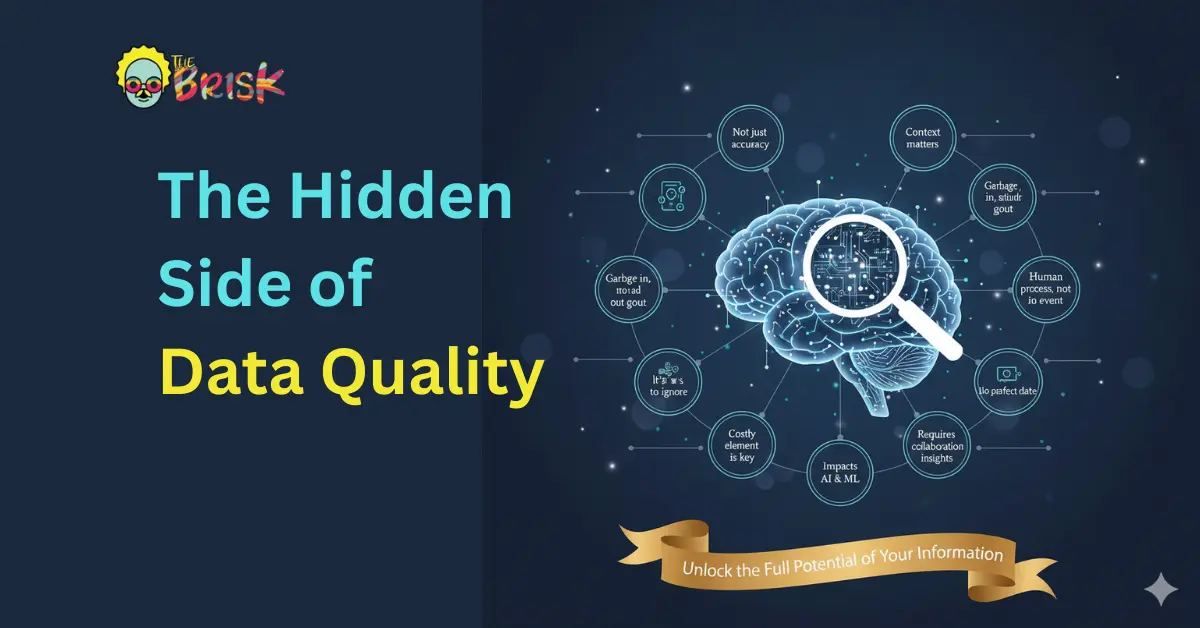
How well-versed are you in data quality? Let’s suppose that, like most people, you are aware that it is something significant that must be controlled, but aside from that, you make every effort to avoid it.
Data administration is typically disregarded and brushed off as “not my duty” because it is frequently linked with tedious, manual, and endless labor.
However, you are doing yourself and your business a disservice if you are unaware of the effects of insufficient data in your CRM or Marketing Automation System.
In addition, the customer-centric environment of today places greater demands on your company than ever before, including the requirement to predict client wants.
10 Best Practices For Successful Data Quality
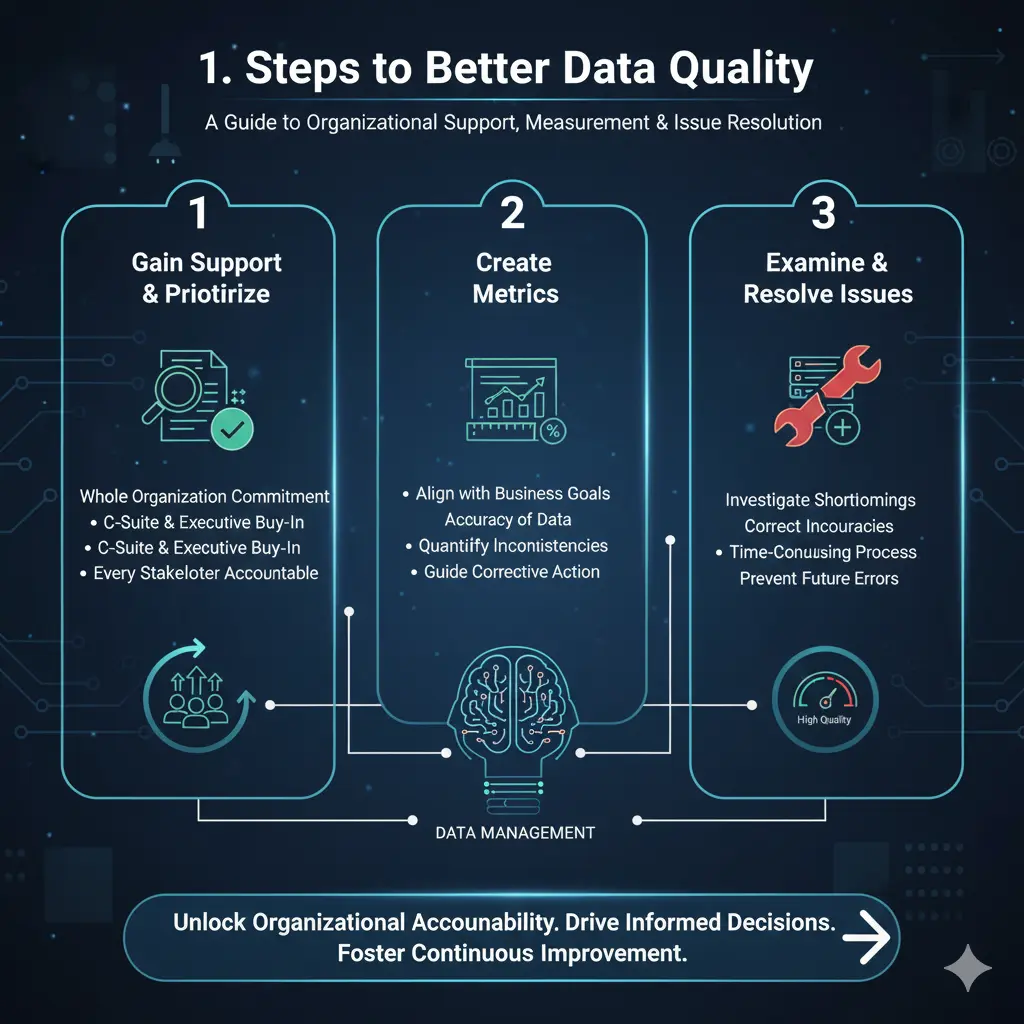
1. Gain Support And Make Data Quality A Top Priority Across the Whole Organization.
You can only expect data quality to be better than 50% if only half of the firm is committed to guaranteeing it. Every stakeholder must be aware of and accountable for data quality.
Data quality needs to be supported and promoted at every level of management, including the C-suite, to gain corporate buy-in. Data managers won’t prioritize data and excellent data quality if executives and business leaders don’t.
2. Create Metrics
By creating metrics that are relevant to the objectives and business aims you’re trying to achieve with your data, you need a technique to gauge the quality of your data. Data quality measurement is crucial for
- Giving management advice on how to improve data quality to get their support
- Knowing the accuracy of your data
- Quantifying inconsistent, insufficient, or missing data
- Taking corrective action to enhance the quality of the data
3. Examine Data Quality Issues.
Errors will presumably continue to arise if data quality shortcomings aren’t looked into. Correcting data inaccuracies can be a challenging and time-consuming operation. It is tempting to think of the process as finished once the data has been adjusted.
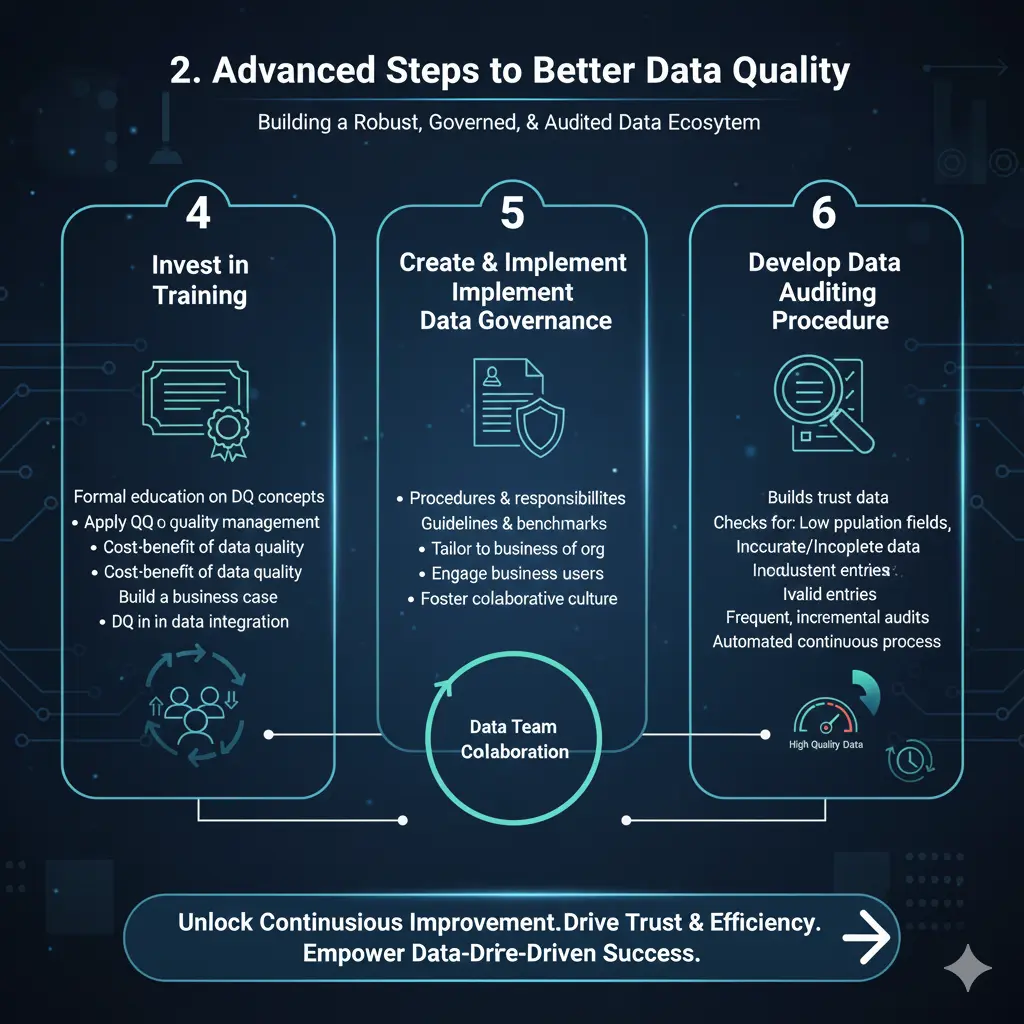
4. Make Internal Training Investments
Achieving high data quality is a challenging endeavor. It necessitates a thorough understanding of data quality concepts, procedures, and tools. The greatest way to learn this information is through formal education.
Encourage data quality personnel to obtain the certification so they are more knowledgeable about:
- Basic quality management ideas, rules, and procedures
- How to apply data to quality management concepts
- How to consider the advantages of high-quality data as well as the expenses of low-quality data
- How to present a business case for data quality and sell it
- The fundamental ideas for creating data quality organizations
- Fundamental ideas, rules, and procedures of a data stewardship program
- The difficulties with data quality that come with data integration
5. Create And Put Into Effect Data Governance Policies
Rules and data protection are only a small part of data governance. Data governance is a group of procedures, responsibilities, guidelines, benchmarks, and measurements that guarantee the effective and efficient use of data in assisting an organization in achieving its objectives.
Every organization needs to create a set of data governance policies that are tailored to its particular processes, use cases, and organizational structure.
Engaging business users in best practices and as members of the data team, however, is the most effective approach to adopting these data governance rules throughout a company.
Organizations can more effectively foster a culture of data quality by implementing a collaborative approach to ensure data governance while running reports and using data-driven information.
6. Create A Procedure For Data Auditing
The greatest way to establish trust in the data is through audits of the information stored in data repositories. The auditing of data should look for any instances of poor data quality, including but not restricted to:
- Fields with little population
- Inaccurate and incomplete data
- An inconsistent format
- Redundant entries
- Invalid entries
The acceptance and success of the data audit process depend on how frequently audits are conducted. Errors might not be discovered for a year if you audit once a year.
Finding, fixing, and looking into a whole year’s worth of mistakes would likewise take a lot of time. An automated, continuous auditing component with recurrent incremental audits is ideal.
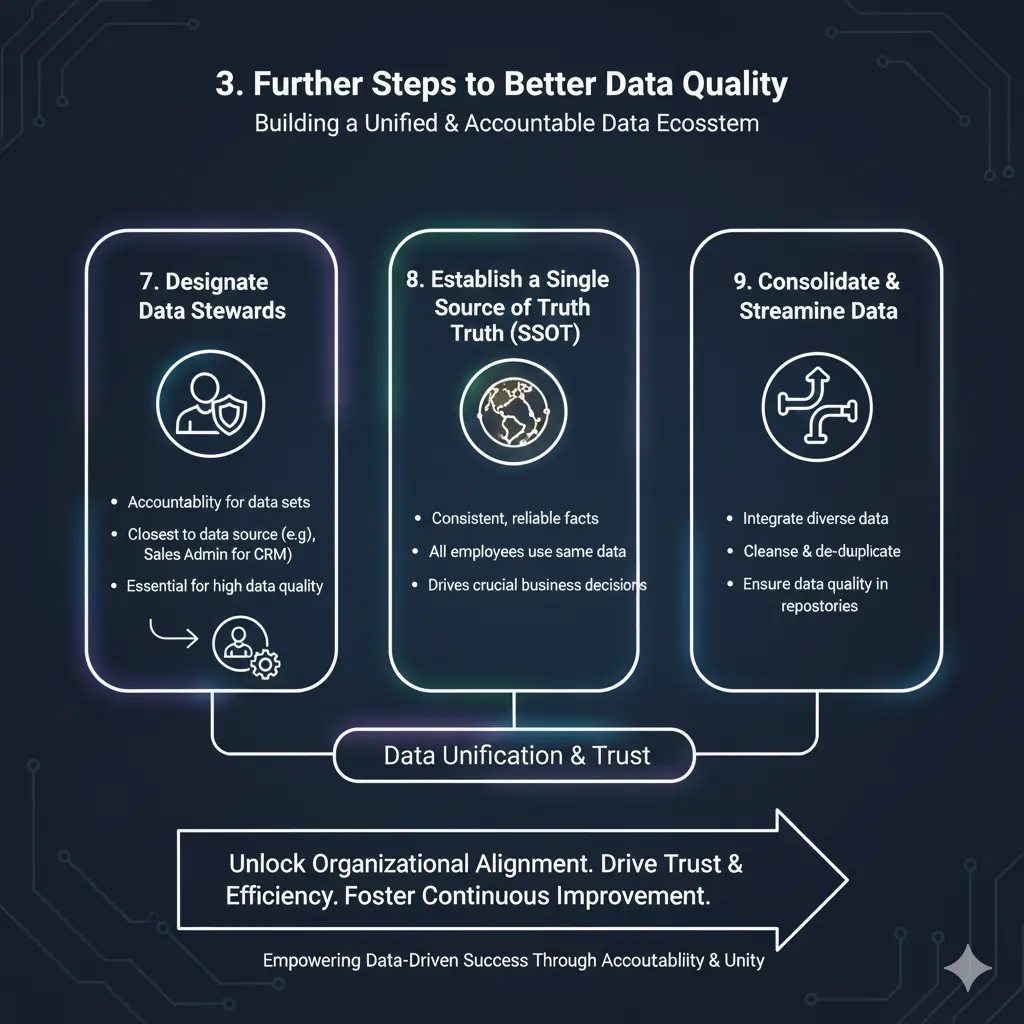
7. Designate A Data Steward For Each Department.
Data stewards are in charge of preserving the accuracy and reliability of particular data sets.
They must ensure that the data quality requirements established by the data governance team are met by their data sets. This important function is essential to guarantee high data quality.
Data stewards can be found within IT because historically, IT staff have been in charge of managing data.
Organizations have discovered, nevertheless, that the data steward who is closest to the source of the data is more effective.
For instance, a sales administrator or CRM manager may be more familiar with a client database than an IT professional, leading to more precise data of higher quality.
8. Establish A Lone Source Of Truth
A concept known as a single source of truth (SSOT) is used to guarantee that every employee in an organization bases business choices on the same reliable and accurate facts.
Since data drives many crucial business decisions, all business divisions must settle on a single source of precise, high-quality data.
9. Consolidate And Streamline Data Streams
Data from many different sources can be accessed more easily thanks to cloud computing.
The problem of integrating diverse data in various formats from many data streams, sometimes with duplicate and low-quality data, into a single data repository comes with that capability.
Data must be cleaned up and de-duplicated to find and fix corrupt, erroneous, unnecessary, or duplicate data. However, companies can better guarantee data quality once this process is implemented.
10. Make The Most Of Cloud Computing
Global decision-makers use data from various sources and locations, both on and off the corporate network.
The complexity and latency involved in providing consistent data from numerous sources to business analysts throughout the world increase if your data quality technologies are housed in one or two company data centers.
By placing your data quality tools in the cloud, you may increase user adoption and improve data quality procedures by bringing them closer to your data sources and users.
Conclusion
So how can you begin the process of enhancing data quality? Utilizing a cloud-native suite of apps with an emphasis on data integration and integrity, such as The Brisk, is the quickest, simplest, and most efficient way to get data you can trust.
It addresses all facets of the data value chain, including some of the most difficult ones. At the speed of business, users can gather data from many systems, control it to ensure its usage, transform it into new formats, enhance its quality, and communicate it with internal and external stakeholders.




No Comments