Table of Contents
We are all well aware of the fact that we live in a data-driven era, and this era is continuously growing and growing. Technology is expanding its influence in every industry, which produces enormous amounts of data that can provide valuable details about the industry. Over the past ten years, this has caused a spike in the data sector.
If you are running a business, it doesn’t matter whether it’s small or big, but you need to take care of the correct data to make the right decisions that will help your firm succeed. Consequently, having data analytics in business is crucial.
For continued growth and development, data analytics aids organizations and sectors in making sense of the enormous volumes of information.
The decision to invest in data analytics solutions will determine a company’s future success or failure. If you are interested in data analytics, read further to get to know about it.
Data Analytics
Because of the growth of technology, many new terms are being added to the industry. One such term is Data analytics.
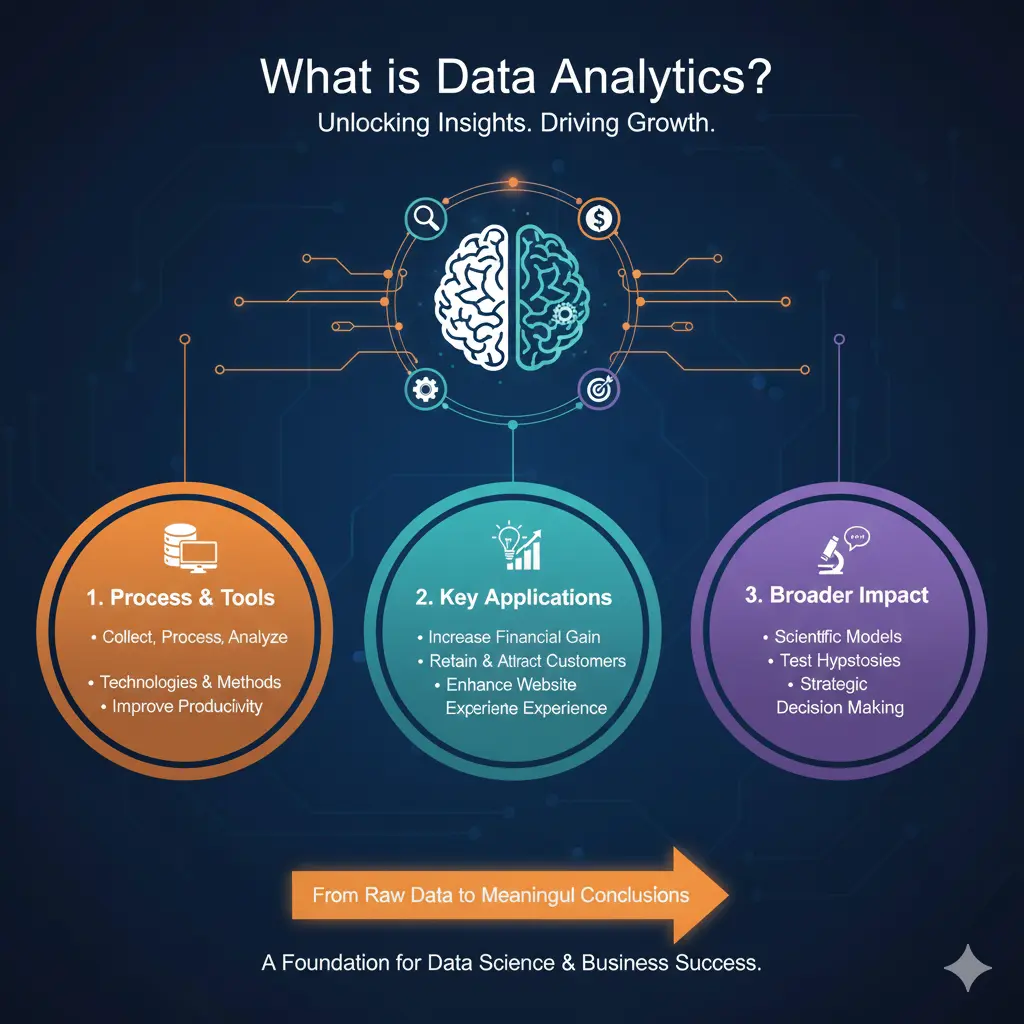
Data analytics is an important branch of data science that simply refers to all the procedures and equipment needed to analyze a collection of data and draw significant conclusions from it.
It includes the tools, technologies, processes, and methods that an organization employs to use data to increase its productivity and boost financial gain.
The term analytics covers a wider range of techniques and methods for data analysis. Even researchers and data scientists use data analytics to support or deny scientific models, ideas, or hypotheses.
If you are thinking of gaining a data analytics certification, you need to join a full course in data science.
Types of Data Analytics
Data analyst is a broad term. From online analytical processing (OLAP), reporting, and basic business intelligence, to more advanced analytics, data analytics covers it all.
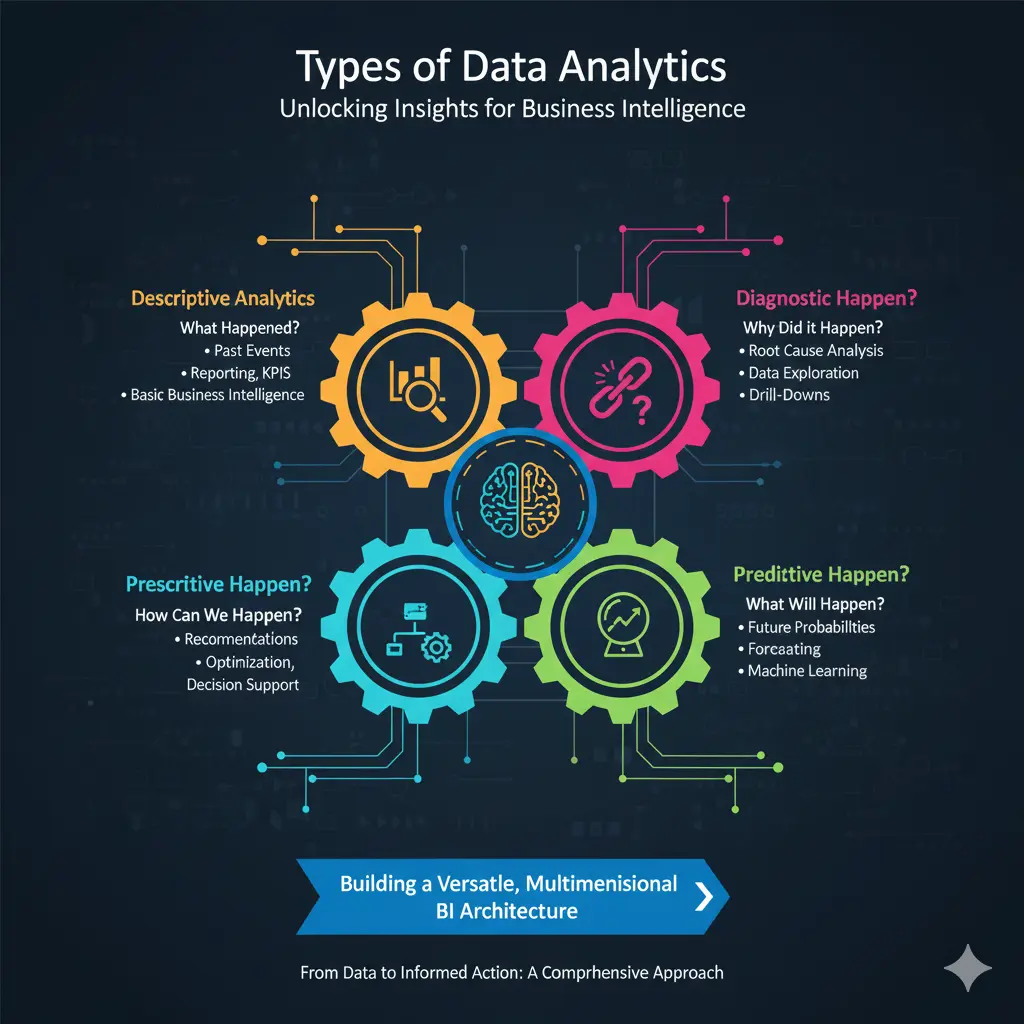
It is essential to plan and construct a business intelligence (BI) or database system architecture that offers a versatile, multidimensional analytical platform that is designed for quick ingestion and thorough analysis of massive, varied data sets.
There are four data analytics types:
- Prescriptive data analytics
- Descriptive data analytics
- Predictive data analytics
- Diagnostic data analytics
Prescriptive Data Analytics
In order to create a prediction, prescriptive analytics dynamically combine machine learning, big data, business rules, and mathematical science. They then provide a choice alternative to benefit from the prediction.
Prescriptive analytics went far beyond forecasting outcomes by additionally recommending actions that will benefit from the forecasts and outlining the implications of every decision alternative for the decision maker.
In addition to predicting what will occur and when, they also consider why it will happen. Additionally, these analytics can recommend alternatives on how to catch a project in the future or lessen a future risk, and they can also explain the consequences of each alternative.
For instance, prescriptive analytics can assist in providing answers to queries like “What if we attempt this?” and “What is the right initiative?” using developments in ML.
You may test the right factors and even recommend brand-new ones that have a better chance of producing a successful result.
It’s crucial to remember that while algorithms can offer data-driven recommendations, they cannot replace the power of human judgment.
Prescriptive analytics should be used as a tool to help inform plans and decisions. Your opinion is crucial and required to provide algorithmic output context and safety nets.
You can create your unique algorithms, employ third-party analytics solutions with built-in algorithms, or perform human analysis at your firm using prescriptive analytics.
Descriptive Data Analytics
The core of reporting is descriptive analytics. Descriptive analytics is the basic requirement for all business intelligence (BI) products and dashboards. It responds to fundamental inquiries like ” what, how often, where, how, and when.”
In order to understand how and when to tackle upcoming events, descriptive analytics examines data and analyzes prior events.
By analyzing historical data, examining past performance and evaluating outcomes to determine what caused past failures or successes.
This kind of analysis is used in almost every management report, including those for operations, marketing, finance, and sales.
Descriptive data analytics can be divided into two categories:
- Canned Reports
- Ad hoc reporting
Canned Reports
A canned report refers to a document that has already been created and provides details about a particular subject.
Ad Hoc Reporting
Ad hoc reports are usually not planned and are created by you. They are produced when a certain business concern has to be addressed. These reports help learn more specific details about a query.
Predictive Data Analytics
The most popular subset of data analytics is predictive analytics. Through predictive analytics, the data are transformed into useful knowledge. Predictive analytics examines data to predict the chance of a situation arising or the likely course of an occurrence.
In order to anticipate future events, predictive analytics uses several statistical approaches from game theory, modeling, data mining, and machine learning. These techniques analyze both current and past data.
Although the category can be further divided into:
- Predictive modeling
- Statistical modeling
Diagnostic Data Analytics
Even though it’s less thrilling than making predictions, using past information to guide your business can be very beneficial. Analyzing data to determine causes and events, or why things happened, is known as diagnostic data analytics.
Diagnostic data analytics techniques:
- Drill down
- Data discovery
- Data mining
- Correlation
This data analytics is also divided into two categories
- Discover and alerts
- Query and drill-downs
Things to consider in a data analytics solution
There are several data analytics technologies currently available on the market if you want to create a more insight-driven organization.
In the end, the ideal solution provides cutting-edge advanced analytics that are dynamic, self-learning, predictive, and transparent.
If you want to use this solution, you must always consider a single platform with integrated data management and analytics features.
The compatibility and access problems of a legacy environment with numerous recommendation, discovery, reporting, and analysis systems are avoided by such a solution.
Everything is connected and incorporated, making sourcing simpler and accelerating the delivery of business value.



No Comments