Table of Contents
Sometimes, customers are driven by an ad to take action that results in a sale at your offline shop or over the phone, rather than purchasing on your website.
You may import offline conversions and find out to know what happens in the real world when a potential customer sees your ad and decides to click on it or give you a call.
You can gain a complete picture of the keywords and targeting factors (such as location or time of day) that lead to the most efficient conversions by importing offline conversion tracking.
With this information, you can fine-tune your strategies and boost the success of your initiatives.
Importance of Measuring Multichannel Impact
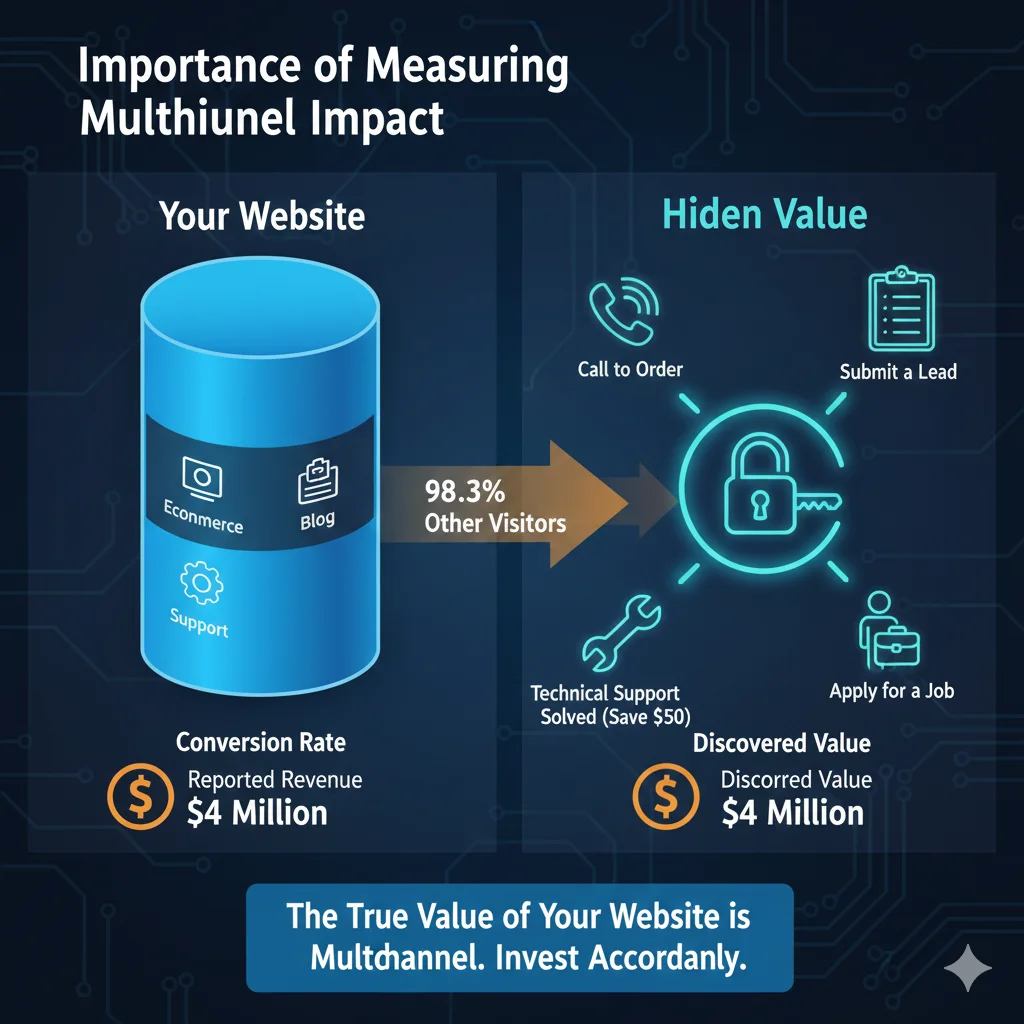
You have a wonderful site, and it’s been chugging away happily at a conversion rate of 1.7% (the industry average, according to shop.org), resulting in $1 million in reported revenue for us.
If your website is generating a lot of money for you, that’s terrific! But what’s happening to the other 98.3% of visitors who aren’t making a purchase?
Your website probably provides some value to the other 98.3%.
Those who prefer to do their research online before making purchases in person will benefit from your eCommerce site. People who wish to find out more can do so and then place an order by calling your phone number.
Any potential customer can be referred to you by submitting a lead. Some customers may find the answer to their technical support query online rather than calling (thus saving you the $50 it would have cost to answer the phone).
In addition, you can encourage someone to apply for a job with your company by teaching them about it.
Nonetheless, your website serves various purposes; it is up to you to evaluate the site’s overall effectiveness.
You can expect to find that your site gave $4 million in value to 98.3 % of visitors once you’ve done the calculations.
That’s why it’s crucial to employ multichannel analytics.
You have a hard time securing funding for the hiring of Analysts and Marketers. You’ve been trying to secure money for a new CMS, and your head’s been banging to do it.
Moreover, you’ve been pulling out your hair attempting to raise money for internet campaigns over and over again. Have you ever considered that your starting point (the “$1 million effect”) could be wrong?
Investing in the time and energy to track offline results will reveal whether or not your online channel is truly worth the investment for your business.
Tips to Track Offline Conversions of Your Online Channel
You may already be having trouble tracking the success of your offline conversions if you advertise in print publications or newspapers, run a television commercial, distribute printed brochures or pamphlets, etc.
Here are the tips to track offline conversions of your online channel:
- Keep Tabs on Your Website’s In-store Finder, Directions, and Any Other Features That Directly Relate to Your Offline Location.
If you have storefronts, hopefully you don’t bury your store locator on your website. Instead, you smartly use Google Maps. It’s important to monitor how often consumers are using the shop locator to find your locations.
Initially, it is important to monitor the total number of Unique Visitors who access the store locator throughout a specified time frame.
Adding the store locator search criteria to your internal site search will provide you with a little more information.
Customers who utilise your store locator’s maps and directions function are more likely to visit that store again.
- Use Unique Toll-Free Numbers on the Website.
When we sign up for a home phone line, our local phone company offers us a free 1-800 number because they are so inexpensive now. Each call to that number costs approximately seven cents. It’s not a big deal at all.
Use a unique phone number that is not accessible through any other route on your website.
Now trace the calls to that 800 (or whatever) number via your phone (PBX) system, and you have an additional indicator for website-generated calls.
This is highly beneficial for a variety of website types, including e-commerce, technical assistance, and lead-generating websites.
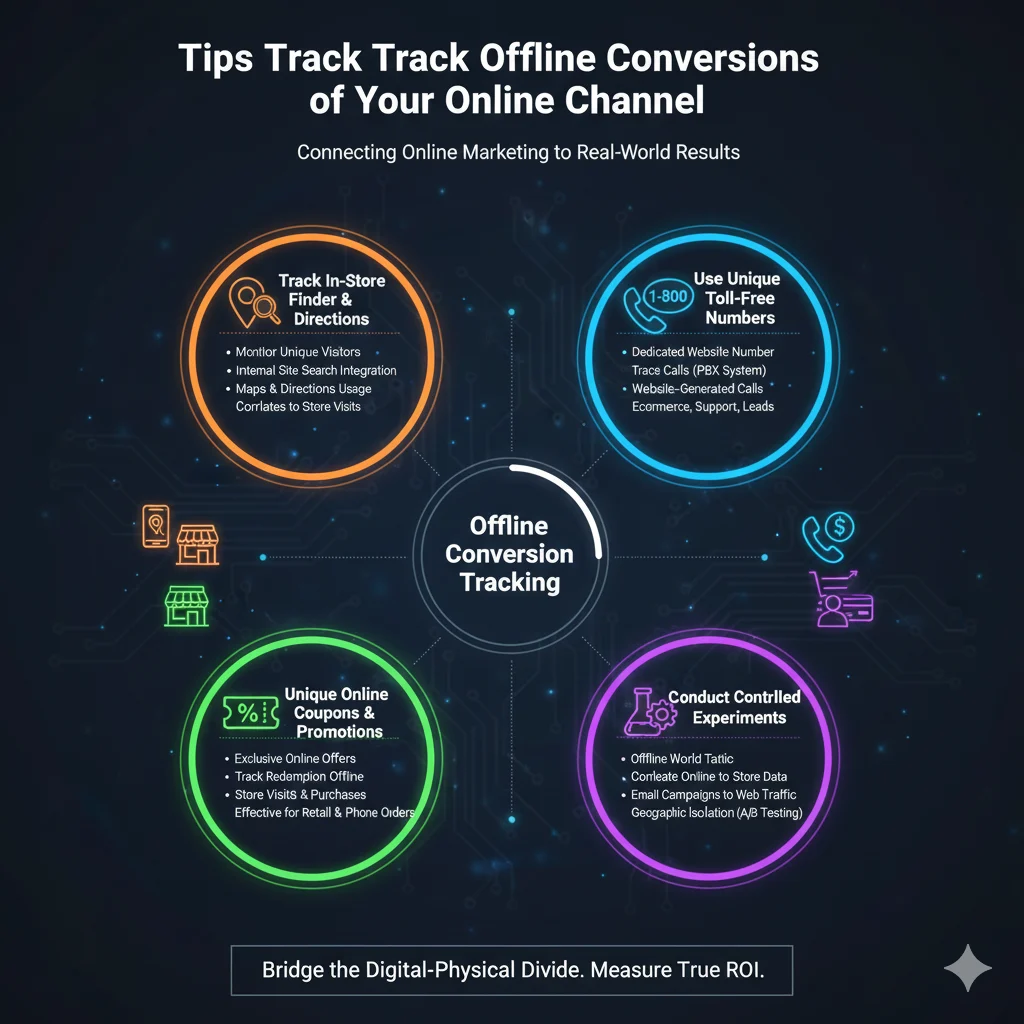
- Use Unique Coupons, Deals, and Promotions Online.
Use exclusive offers, promotions, and coupons in your internet marketing, and then track their redemption through your offline (telephone and retail) channels.
Regardless of coupon redemption rates, many firms find them to be quite beneficial for offline conversion tracking. Not all online offers must be failures; if they offer anything of value, they can be extremely effective at generating store visitors.
- Conduct Controlled Experiments
This is a tactic that our offline world has been utilising for ages, yet we in the “advanced world” appear to be completely unaware of it. Quite unfortunate, as it may be extremely cool.
Why is it that you can buy certain things in your preferred store, but when you travel and visit five other stores in different locations, you find that their selections vary slightly?
This is an illustration of a corporation doing controlled experiments to validate its ideas in the real world.
You want to determine whether your website can drive customers to your stores. Conduct an email campaign to your customers to direct them to your website for further information, and observe if this increases store visits.
The fundamental concept is to try something specific to correlate the data with offline data sources and find a signal.
By isolating it to separate states (that are geographically far from one another), you isolate “pollutants” from your data.
It is not a perfect process, it takes time, and you must be a sizable organisation to quantify the impact. However, a few things will increase your trust in the results you uncover.
Conclusion
Not all users convert to a website. Numerous website owners disregard this truth, and as a result, they are missing out on valuable conversion data.
Fortunately, web analytics allows us to communicate conversion data into the system using the tracking Protocol. Unfortunately, this is a rather manual procedure that is not always the preferred method for tracking things.
Also, you can go to the website “The Brisk” and learn more about tracking offline conversions.



No Comments