
Table of Contents
Online reviews have become a make-or-break factor for local businesses. They influence search ranking, customer trust, click-through rates, and even how much people are willing to pay. With so much riding on a business’s reputation, it’s no surprise that review manipulation and review fraud have skyrocketed in recent years.
But among all forms of review fraud, one has become particularly alarming — negative review extortion scams.
Over the past year, businesses across industries have reported being targeted by scammers who deliberately leave fake negative reviews and then demand money to remove them.
The attacks have become so widespread that last month, Google quietly launched a dedicated form for reporting extortion-based reviews — and early evidence shows that it’s working.
This article breaks down the entire picture in depth:
- What these scams really look like
- Why they’re growing so rapidly
- How they impact local search and customer behavior
- What Google’s new reporting system does
- Step-by-step details on how to use it
- Real-world success stories
- Expert insights from the local SEO community
- Preventive measures and proactive strategies
- Whether this article should be posted on LinkedIn or your website
Let’s dive into the full story.
What Are Negative Review Extortion Scams — And Why Are They Increasing?
Negative review extortion scams are a form of online blackmail where attackers weaponize your Google Business Profile (GBP) reviews to pressure you into paying them. These scams follow a predictable pattern but can vary slightly in execution.
How the Scam Typically Begins
Most businesses first notice something odd when one or more new 1-star or 2-star reviews suddenly appear out of nowhere.
These reviews share some common traits:
- They are extremely vague (e.g., “bad service” or “terrible experience”).
- They lack details that a real customer would mention.
- The reviewer profiles are often brand new or look suspicious.
- Multiple reviews can drop within minutes, suggesting automation or coordinated activity.
For a business that relies on a high average rating, even a single unfair review feels threatening — so receiving multiple fake negative reviews in a short time is genuinely alarming.
The Extortion Message That Follows
Soon after the reviews appear, the attacker contacts the business.
This is usually done through:
- Email
- WhatsApp
- SMS
- Social media DMs
The message typically says:
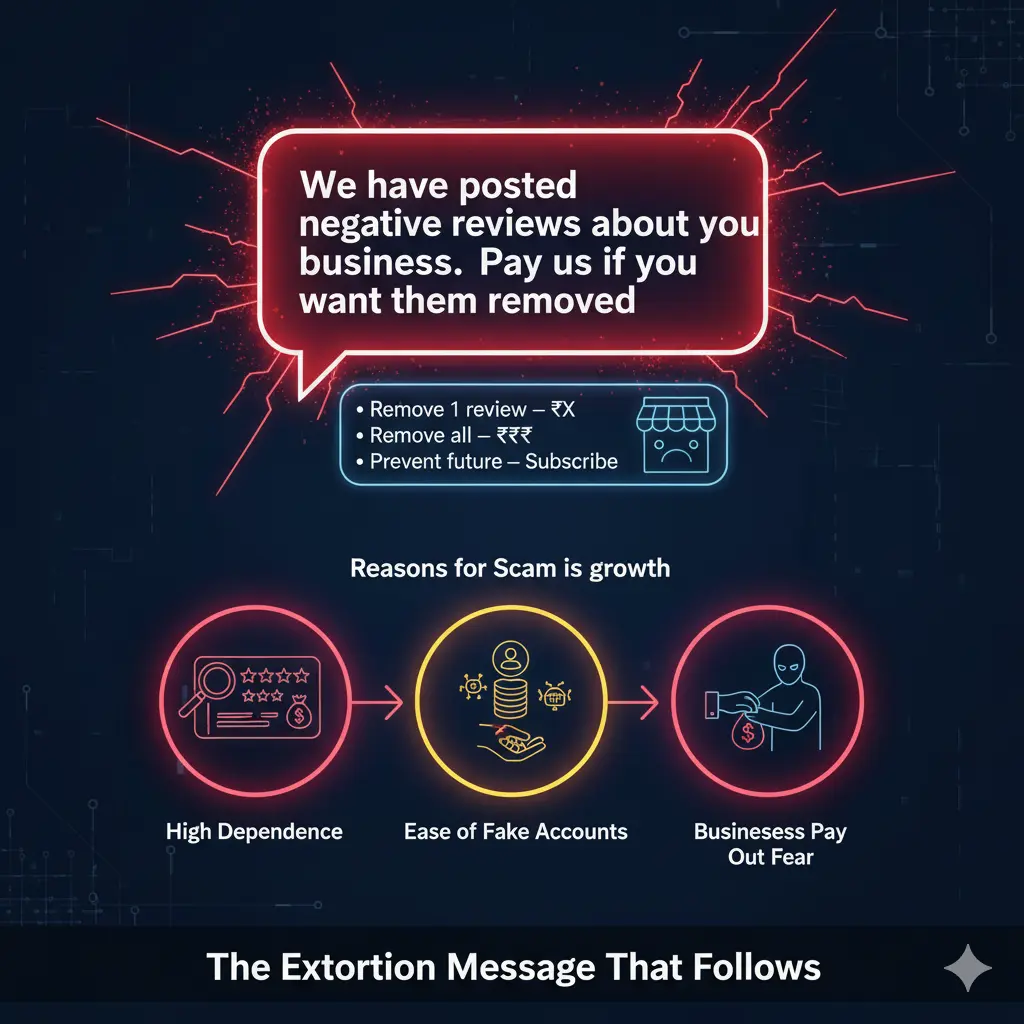
“We have posted negative reviews about your business. Pay us if you want them removed.”
Some scammers even provide a “menu” of services:
- Remove 1 review — ₹X amount
- Remove all reviews — higher amount
- Prevent future negative reviews — subscription-style payment
These messages are designed to create panic and urgency. They want you to feel like you’re losing customers every minute you don’t respond.
Why This Scam Is Growing Fast
There are three major factors fueling this rapid increase:
A. High Dependence on Local Search Results
Google Business Profiles influence real buying decisions.
According to BrightLocal, 86% of consumers read reviews before choosing a business, and over one-third avoid businesses rated below 4 stars.
Scammers know that harming your reviews harms your revenue.
B. Ease of Creating Fake Accounts
Creating fake Google accounts is easier than ever.
With VPNs, bots, and burner emails, attackers can create dozens of profiles that look legitimate enough to bypass automated detection.
C. Businesses Sometimes Pay Out of Fear
This is the biggest driver.
Scammers rely on panic.
If even a small percentage of businesses pay, the scam becomes profitable, which encourages more attackers to try it.
This is why Google’s new reporting system is a long-awaited and necessary response.
How Negative Review Extortion Affects Businesses (and Why You Should Never Ignore It)
Fake negative reviews do far more than just damage feelings — they directly impact business performance.
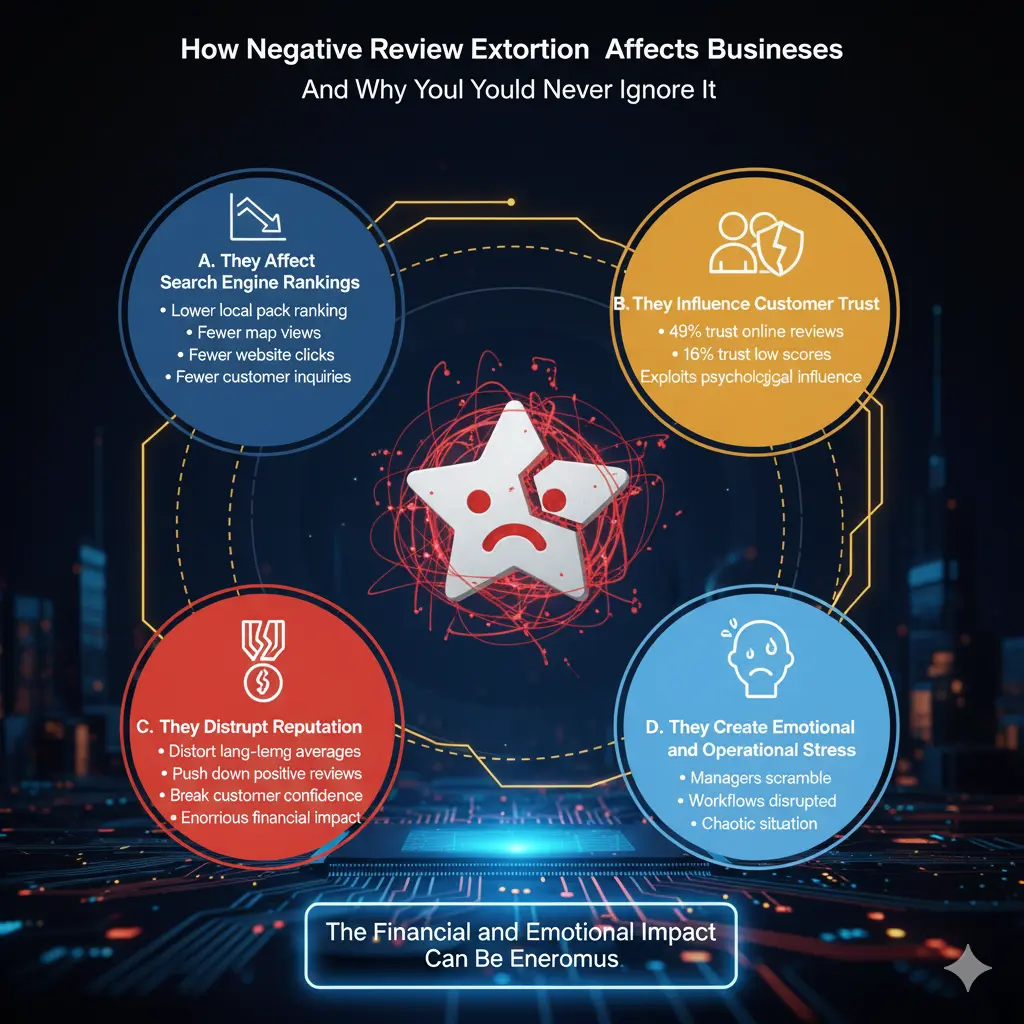
A. They Affect Search Engine Rankings
Google’s local algorithm heavily weighs:
- Review count
- Review sentiment
- Review recency
- Review diversity
A sudden cluster of negative reviews can temporarily lower your ranking in the local pack (the top 3 listings) and push your business below competitors.
This means:
- Fewer map views
- Fewer website clicks
- Fewer customer inquiries
Even if the reviews are fake, the algorithm may not know it immediately.
B. They Influence Customer Trust
People trust Google reviews almost as much as personal recommendations.
Research shows:
- 49% of people trust online reviews as much as a friend’s suggestion.
- Only 16% trust businesses with low review scores, even if reviews look suspicious.
Scammers exploit this psychological influence.
C. They Disrupt Reputation Management Systems
Businesses invest years building their online credibility.
One fraudulent extortion attack can:
- Distort long-term review averages
- Push down your positive reviews
- Trigger negative discussions
- Break customer confidence
The financial impact of losing customer trust — even temporarily — can be enormous.
D. They Create Emotional and Operational Stress
For small businesses especially:
- Owners panic
- Managers scramble
- Staff members get blamed
- Workflows get disrupted
This is why Google creating a formal solution is important — it brings clarity and structure to a chaotic situation.
Google’s New Review Extortion Reporting Form: What It Does and Why It Matters
After years of rising review fraud, Google has finally taken a focused step by launching a dedicated reporting form for extortion-based reviews.
This is separate from the general “flag review” feature and is specifically designed to address extortion cases.
What the Form Asks For
When you open the form (only accessible when logged in to your Google account), Google asks for:
A. Your Personal and Business Details
Including who is reporting the issue and which Business Profile is being targeted.
B. Description of the Extortion Attempt
You must clearly explain:
- When the attack began
- How many reviews are affected
- How the scammer contacted you
- What they demanded
- Any identifying information
C. Evidence Submission Section
This is the most important part.
Google requires proof that the attacker demanded money, goods, or services in exchange for removing the reviews.
Valid forms of evidence include:
- Screenshots of emails
- WhatsApp messages
- SMS conversations
- Social media DMs
- Voice recordings (if local laws allow recording)
- Screenshots of review profiles
The more evidence you provide, the stronger your case.
Why Google’s Form Is a Big Deal
This is the first time Google has:
- Acknowledged the severity of review extortion
- Provided a dedicated channel
- Set rules for reporting
- Started tracking extortion cases separately
- Begun prioritizing fast review removal in confirmed cases
For years, the local SEO community has been pleading for such a system.
Now it finally exists — and it’s working.
4. Google’s Official Recommendations — Explained in Detail
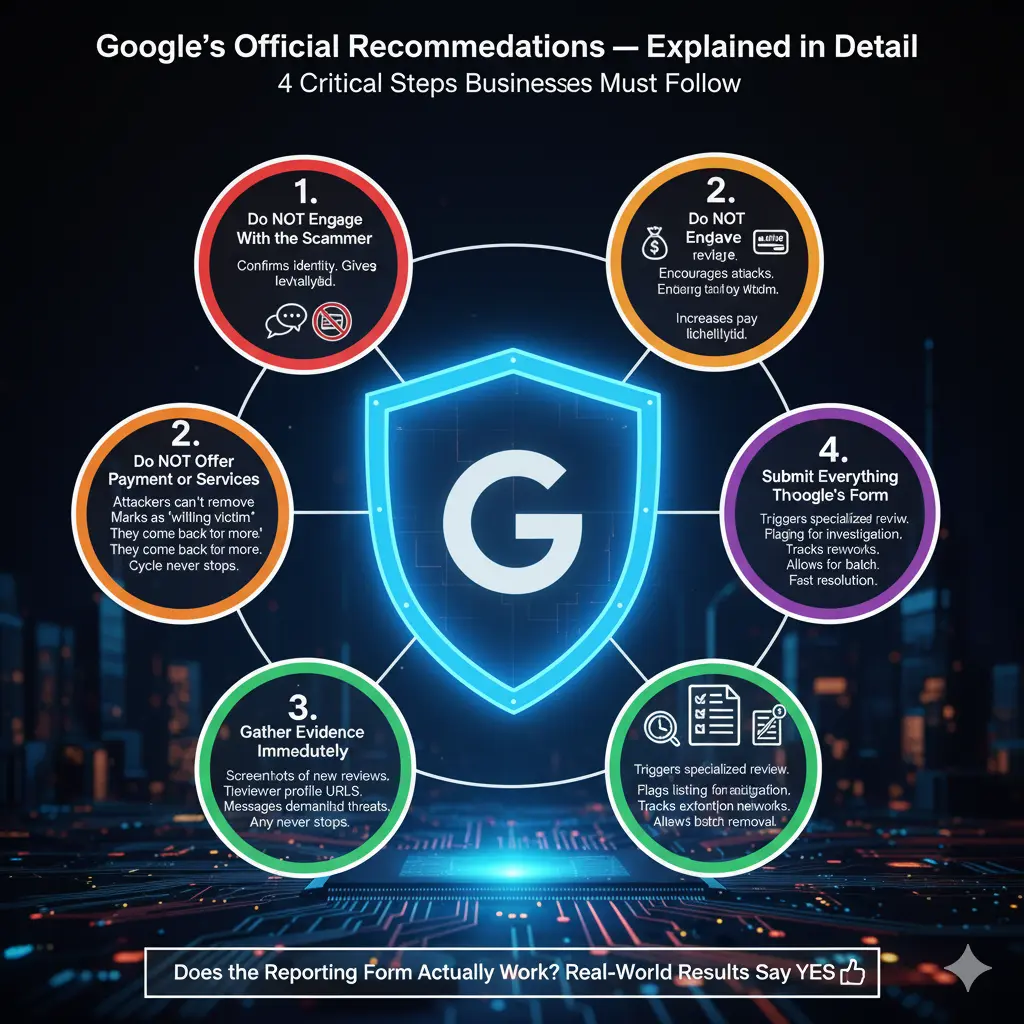
Google outlines four critical steps businesses must follow. Each is important and worth understanding deeply.
1. Do NOT Engage With the Scammer
It feels counterintuitive.
Your business is under attack, and instinct says:
- “I need to fix this.”
- “Let me negotiate.”
- “Maybe I can get them to stop.”
But engaging only:
- Confirms your identity
- Confirms that you care
- Gives them leverage
- Encourages more attacks
- Increases the likelihood you might pay
Once you reply, the scammer knows you’re vulnerable.
2. Do NOT Offer Payment or Services
Payment NEVER solves the problem.
This is because:
- Attackers can’t remove reviews — only Google can.
- Paying once marks you as a “willing victim.”
- Scammers often come back asking for more.
- They may escalate after a successful payment.
It’s a cycle that never stops.
3. Gather Evidence Immediately
Evidence is your strongest weapon.
You must document EVERYTHING:
- Screenshots of new reviews
- Timestamps of when they were posted
- Reviewer profile URLs
- Messages demanding payment
- Attempts to contact your business
- Any additional threats
The faster you gather evidence, the easier it is for Google to verify the pattern.
4. Submit Everything Through Google’s Form
This is essential.
Flagging an individual review is not enough.
You must submit the full report through the extortion form.
Doing so:
- Triggers a specialized review
- Flags your listing for investigation
- Helps Google track extortion networks
- Allows for batch removal
- Increases your chances of fast resolution
This approach is far more effective than general reporting.
5. Does the Reporting Form Actually Work? Real-World Results Say YES
Since the release of this new reporting system, local SEOs have been watching closely to see whether Google acts on these reports.
And the initial results are surprisingly positive.
Success Story #1: All Fake Reviews Removed Within 24 Hours
One business owner reported:
- 11 fake 1-star reviews
- All from new profiles
- All used to pressure them for payment
After submitting the form:
“Every fake review was removed in under 24 hours. The scammer has not contacted us again.”
This is one of the fastest documented resolutions.
Success Story #2: Reviews Removed in a Few Days
Another local SEO shared:
“I submitted the form and the extortion reviews vanished within a few days. Google didn’t delete the fake profiles but removed their reviews.”
Even without deleting profiles, removing the reviews solves the immediate problem.
Success Story #3: Insights from a Victim Who Used the Form Successfully
One experienced SEO shared extremely valuable tips after a successful attempt:
Tip 1: Do Not Reply to Fake Reviews
Why?
Replying notifies the scammer.
Once they see you’ve replied, they know:
- You care
- You’re emotionally stressed
- You’re worried about the damage
- You might pay
The attacker becomes more aggressive.
Tip 2: You May Need to Engage Just Enough to Get Evidence
This is tricky but sometimes necessary.
Google requires proof that the attacker demanded payment.
But you won’t have that unless the scammer explicitly says it.
So in some cases:
- You may respond initially
- You let them reveal their intent
- You collect the “smoking gun” screenshot
- Then you cut off communication
This gives Google everything it needs to proceed.
The SEO described it best:
“It’s a messed-up system, but once you get the evidence, the form actually works.”
6. Why It’s Critical for Businesses to Take Review Extortion Seriously
Fake reviews aren’t just annoying — they influence real customer actions.
Customers Read Reviews Before Spending
Studies show:
- 98% of people read reviews for local businesses
- 69% believe review responses reflect the business values
- 52% won’t consider a business with recent poor reviews
Negative Reviews Reduce Sales
Even one 1-star review can reduce conversions.
Ten fake reviews can destroy a month’s revenue.
The Reputation Damage Lingers
Even after reviews are removed:
- Some customers may have already seen them
- Your ratings may take time to recover
- Competitors may temporarily outrank you
- Your credibility may temporarily decline
This is why businesses need a strong review monitoring process.
7. Best Practices to Protect Your Business Moving Forward
You cannot always prevent attacks — but you CAN minimize their impact.
A. Monitor Your Reviews Daily
Set up alerts and use tools like:
- Google Business Profile notifications
- BrightLocal
- Local Viking
- ReviewTrackers
- Podium
- Swell
Quick detection = quicker removal.
B. Train Your Staff
Your receptionists, managers, and social media team must know:
- How scams look
- What not to do
- How to document evidence
- When to contact Google
This prevents emotional, rushed reactions.
C. Build a Strong Review Buffer
The stronger your review profile:
- The less impact fake reviews have
- The more obvious fraud looks
- The harder it is for scammers to damage your rating
A business with 1,200 positive reviews is harder to damage than one with 25.
D. Educate Your Customers
Customers can help you identify suspicious patterns early.
Consider:
- Posting signs
- Sending emails
- Making announcements during interactions
Transparency builds trust.
E. Report Suspicious Behavior Immediately
Do NOT wait.
Fake reviews spread quickly.
Use:
- Google’s extortion form
- Standard review flag tools
- Support forums if needed
Speed matters.
8. Is This Article Better for LinkedIn or Your Website?
If Your Goal Is SEO, Ranking, and AI Search Visibility →
Publish on your website.
Why:
- Long-form content ranks better
- Google indexes it
- AI search models prefer structured articles
- You can optimize meta tags, schema, and keywords
- You can build backlinks to it
- It improves domain authority
This article has strong SEO potential.
If Your Goal Is Engagement and Awareness →
Post a shorter version on LinkedIn and link back to your website.
LinkedIn is great for:
- Reaching business owners
- Building authority
- Starting a discussion
- Sharing insights with peers
The Best Strategy:
- Publish the detailed article on your website.
- Create a short, high-impact summary for LinkedIn.
- Link back to your website for full post.
This gives you:
- Search visibility
- Social engagement
- Traffic to your website
- Better chances of Google indexing
- Increased credibility
Conclusion:
Negative review extortion isn’t just an inconvenience — it’s a direct threat to a business’s credibility, sales, and long-term growth. In an era where 93% of customers read online reviews before choosing a business, even a handful of fake 1-star ratings can derail months of brand-building and marketing.
Google’s new reporting form may not be perfect, but early results show it is fast, responsive, and effective. For the first time, businesses and local SEO professionals have a structured, official pathway to fight back — no more being powerless against anonymous attackers.
But the real win here isn’t just the removal of fraudulent reviews.
It’s the shift in power:
- Scammers are losing leverage.
- Business owners finally have protection.
- Local customers are getting cleaner, more trustworthy review ecosystems.
Going forward, staying proactive about reputation management is no longer optional. Business owners must regularly monitor reviews, educate their teams about scam patterns, and report suspicious activity promptly.
Protect your business reputation today.
Get a free review-audit from TheBriskDigital.
#GoogleBusinessProfile #ReviewExtortion #FakeReviews #LocalSEO #ReputationManagement #DigitalMarketing #GoogleReviews #BusinessSecurity #SEO2025 #OnlineReputationProtection #TheBriskDigital



No Comments