Table of Contents
Instagram in 2025 is not what it used to be.
It’s no longer just a platform—it’s an algorithmic battlefield where brands compete for milliseconds of human attention.
What separates a scroll-past from a thumb-stopping ad today isn’t just budget—it’s creative intelligence.
Welcome to the era of Creative Ops—where art meets analytics, storytelling meets strategy, and design is no longer ornamental but operational.
This playbook isn’t a list of design rules. It’s a creative operating system for D2C marketers, creative strategists, and performance designers who want to build Instagram ads that don’t just look good—they sell.
Let’s decode how to win the Instagram ad game in 2025.
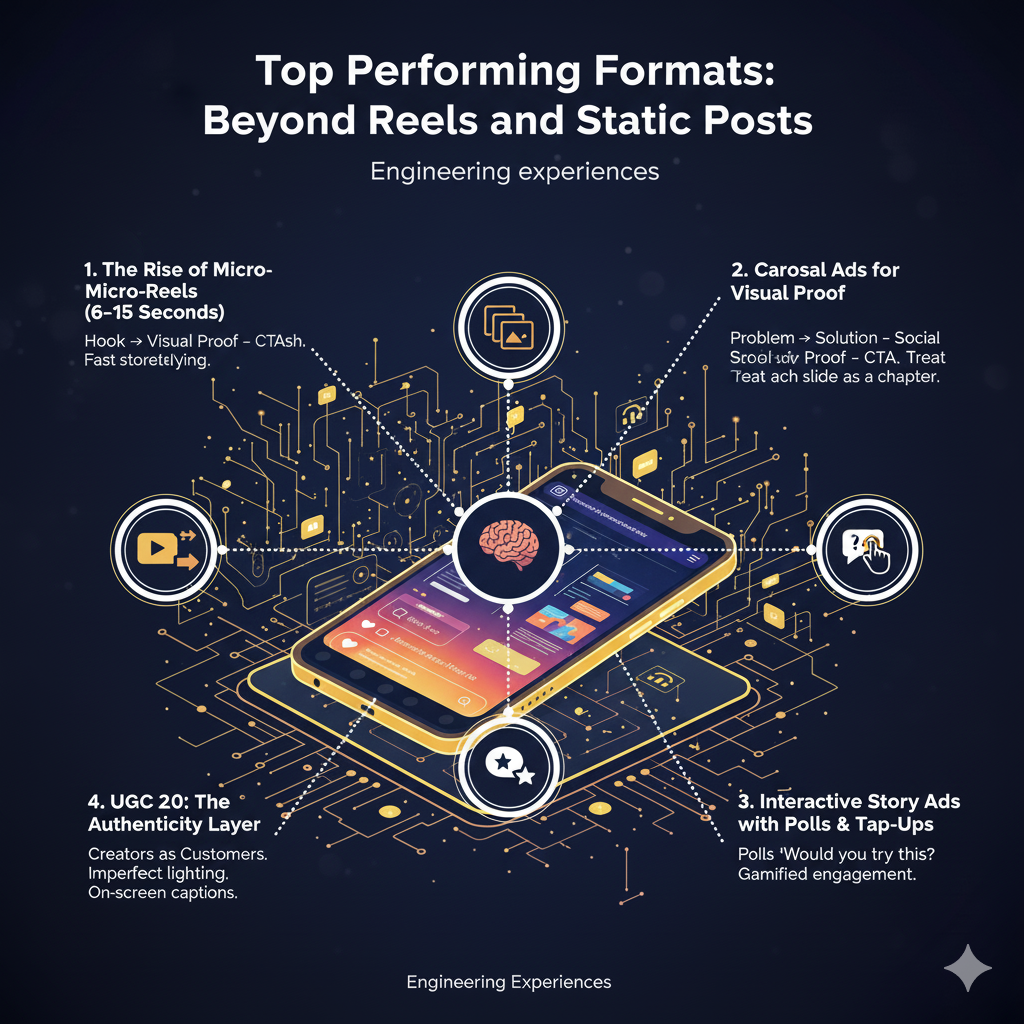
Top Performing Formats: Beyond Reels and Static Posts
Instagram in 2025 is driven by immersive formats that prioritize attention over aesthetics. The best D2C brands aren’t just choosing formats—they’re engineering experiences.
1. The Rise of Micro-Reels (6–15 Seconds)
Forget long-form. The new sweet spot for engagement lies in micro-storytelling—ads that convey a full emotion arc in under 10 seconds.
- Winning Example: Skincare D2C brands opening with “Watch this pore disappear” hooks.
- Creative Tip: Structure your ad as Hook → Visual Proof → CTA Flash.
- Why it Works: Fast storytelling aligns with the average attention span of 1.7 seconds per content swipe.
2. Carousel Ads for Visual Proof and Social Credibility
Still one of the highest-performing ad types for D2C, especially in skincare, nutrition, and apparel.
- Slide 1: Problem Visual (“Acne scars that won’t fade?”)
- Slide 2: Solution Visual (Product or routine shown in use)
- Slide 3: Social Proof (Before-after or customer screenshot)
- Slide 4: CTA (Simple, not salesy — “Tap to see results”)
- Pro Tip: Treat each slide as a chapter. Not every frame should sell—some should build belief.
3. Interactive Story Ads with Polls & Tap-Ups
The smartest advertisers are blurring the line between content and commerce.
- Add polls like “Would you try this?” before the CTA.
- Use “Swipe-Up + Save Offer” combinations for D2C retargeting.
- Use gamified engagement like “Tap to reveal your hair score.”
4. UGC 2.0: The Authenticity Layer
2025 is the year authenticity was productized.
- Creators as Customers: Real people, not influencers, are driving higher CTRs.
- Visual Cue: Imperfect lighting, real testimonials, unscripted dialogue.
- Execution Tip: Always include on-screen captions. 80% of viewers watch without sound.
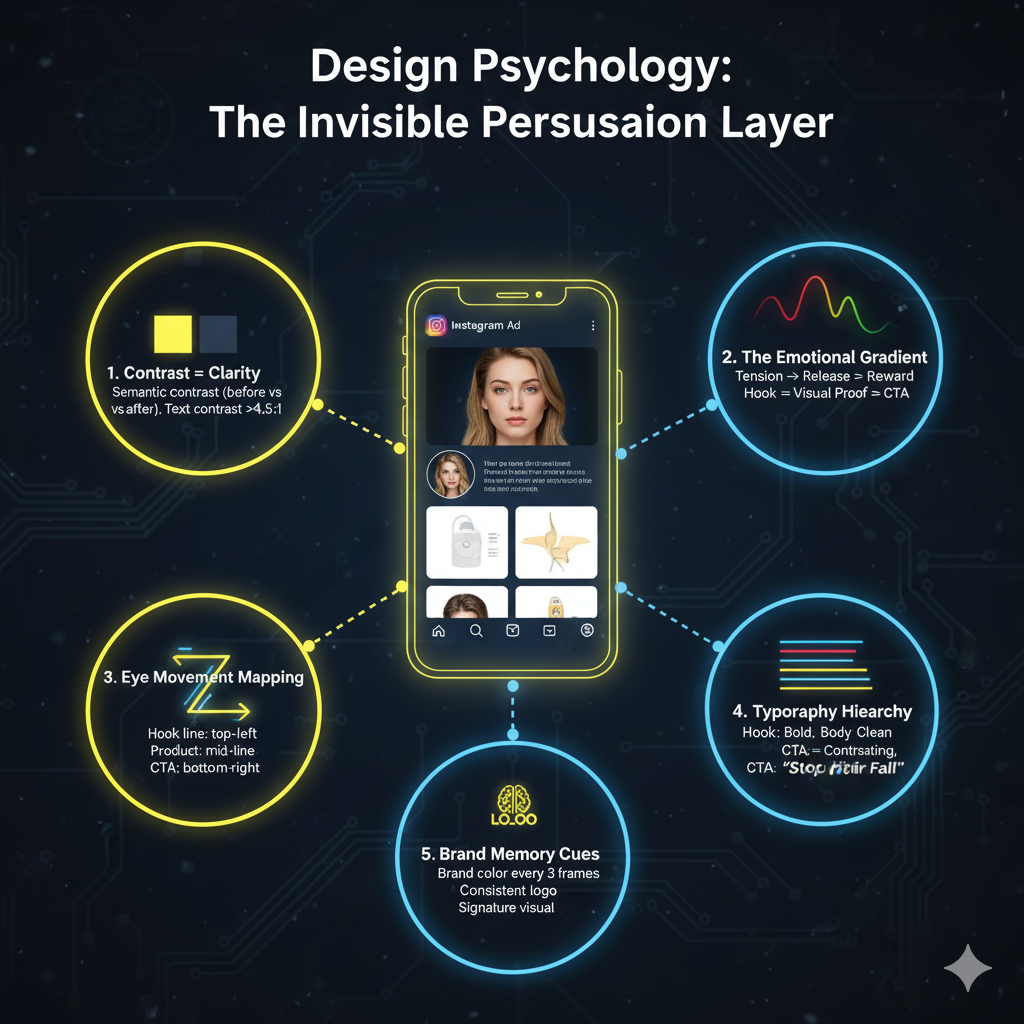
Design Psychology: The Invisible Persuasion Layer
The difference between a good ad and a great one lies not in pixels—but in psychology. Let’s break down the mental levers that drive conversion through design.
1. Contrast = Clarity
Humans process contrast before they read.
- Use color contrast (bright CTA buttons, skin-tone neutral backgrounds).
- Apply semantic contrast—show before vs after, problem vs solution.
- Keep text contrast >4.5:1 for readability on all devices.
2. The Emotional Gradient
Every high-performing ad has one emotional flow: tension → release → reward.
- Create tension: Visualize a problem (e.g., hair fall strands on a pillow).
- Release: Show relief or transformation.
- Reward: Emotional CTA (e.g., “Finally confident again.”)
3. Eye Movement Mapping
Our eyes follow a predictable “Z pattern” on screens. Smart designers use it to their advantage.
- Place the hook line top-left.
- Visual proof or product at the mid-line.
- CTA button or logo at bottom-right.
4. Typography Hierarchy
Typography is the unsung hero of D2C design.
- Hook: Bold sans-serif (emotion + curiosity).
- Body Copy: Clean, minimal, no jargon.
- CTA: Contrasting color, one verb, one promise.
Example: “Stop Hair Fall” works better than “Buy Now.”
5. Brand Memory Cues
Repetition builds retention.
- Use brand color every 3 frames.
- Keep logo placement consistent (top right or bottom left).
- Create a signature visual—like Mamaearth’s white-green box or The Ordinary’s clean label aesthetic.
Test Matrix: How Top D2C Brands Scale Creatives
Designing the ad is only 50% of the battle. The other 50% is creative testing—the structured chaos that turns creative hunches into data-driven clarity.
1. The 4×4 Creative Testing Grid
| Variant Type | Variable | Example | Metric to Track |
| Hook Test | Opening Line | “Hair fall got worse?” vs “Your hairline deserves better” | CTR |
| Visual Test | Product Shot | White background vs lifestyle | Scroll Stop Rate |
| Format Test | Carousel vs Reel | Same script, different format | Engagement Rate |
| CTA Test | Copy Variation | “Learn More” vs “Book Free Consult” | Conversion Rate |
Run each test with a minimum 3-day window and 20% daily budget allocation.
2. The Creative Lifecycle Framework
- Phase 1: Ideation → Based on audience insight and trends.
- Phase 2: Test → Validate hook and design variants.
- Phase 3: Scale → Promote the top 20% performing creatives.
- Phase 4: Refresh → Replace underperformers every 10–14 days.
3. The 3 Golden Metrics for Creative Success
- Scroll Stop Rate (SSR) – Measures thumb-stopping power. Target >25%.
- Hook Retention Rate (HRR) – How many stay till the offer. Target >40%.
- Cost per Creative Learn (CPCL) – How much you spend to validate one ad hypothesis.
4. Creative Debrief Ritual
Before scaling, run a Creative Debrief every Monday:
- Review top 5 ads by CTR and CPR.
- Identify what emotion, color, or copy pattern repeats.
- Document learnings → Feed into next ideation sprint.
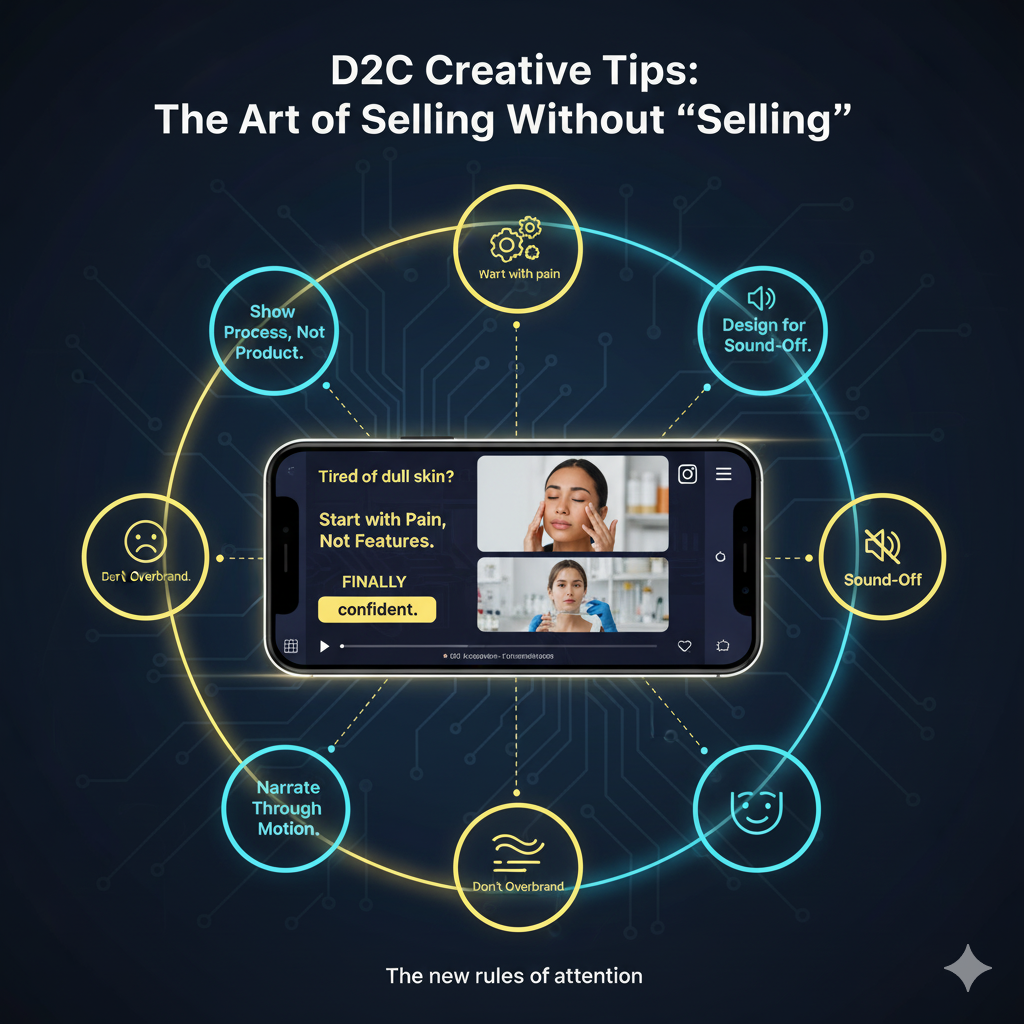
D2C Creative Tips: The Art of Selling Without “Selling”
- Show process, not product. People believe what they see being made.
- Start with pain, not features. “Tired of dull skin?” hits harder than “Now with Vitamin C.”
- Design for sound-off. 70% of users never turn on audio.
- Don’t overbrand. The first frame should hook, not introduce your brand.
- Narrate through motion. Motion creates curiosity; curiosity drives dwell time.
- Human over model. Faces outperform stock visuals by 35–40%.
Final Thoughts: Creativity as a System
In 2025, winning on Instagram isn’t about luck—it’s about systems thinking in creativity.
It’s about making your creative process as optimized as your media buying strategy.
You don’t need the biggest budget. You need discipline in experimentation, empathy in storytelling, and clarity in design.
Because great ads aren’t designed to impress—
They’re designed to convert curiosity into conviction.



No Comments