
Table of Contents
Overview
Let’s investigate the abilities a business analyst genuinely needs to succeed at work. First off, a business analyst is a person who examines how a department or functional unit operates to create an all-encompassing systems solution to the issue. Except on weekends, they rarely breathe fire or repair flat tires.
Technology
Be a part of technology. It’s time to leave if you despise computers but enjoy trawling for catfish.
There are particular technical computer abilities and certifications that you must be familiar with, depending on the precise title of your work.
Examples:
- Microsoft Office
- Microsoft Visio
- Software Design Tools
- SQL Queries
- Business Process Models
Research
When starting a new endeavour, you must conduct extensive research across the entire Internet, as if you had lost one of your lucky socks and couldn’t stop until the entire home had been flipped upside down.
The first step in developing a complete solution to the issue facing your business is research. It is the process of acquiring the facts and figures required to create a solution.
You must be able to obtain the precise information and regularly examine it using your technological and IT skills.
Everyone participating in the project must have detailed criteria that are of the highest caliber, so if they have any queries, your thorough study must be able to address them.

Data Review and Statistical Analysis
It’s great to collect data and statistics about any issues facing your business, but the crucial step is to analyze the data and statistics.
Understanding gap analysis, risk assessment, financial planning, and statistical analysis are prerequisites for data analysis.
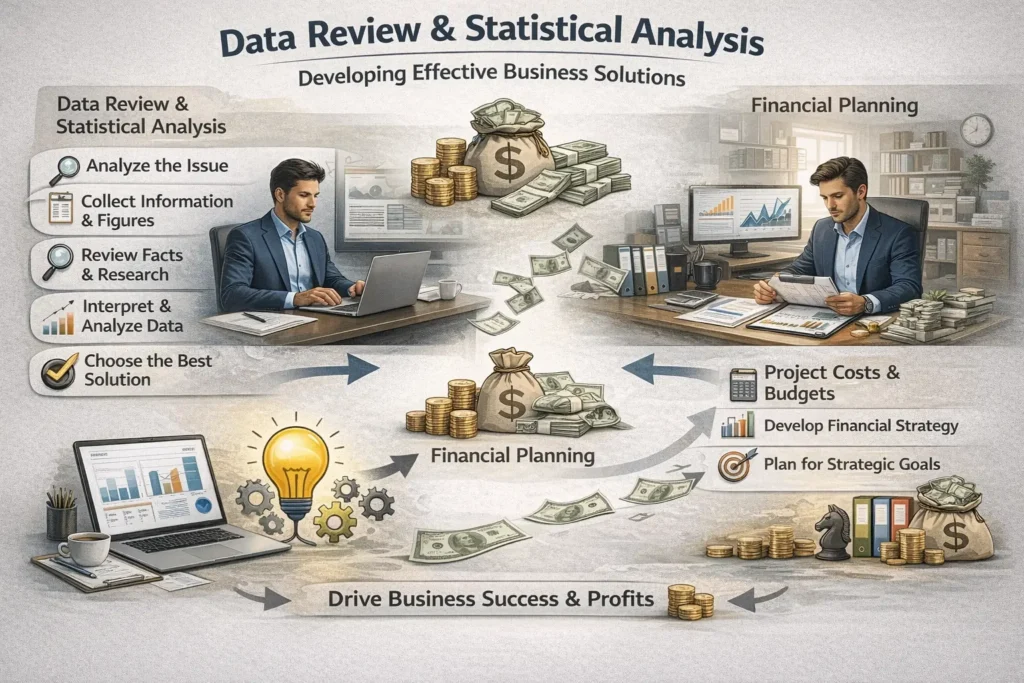
Make sense of the statistics you’ve obtained by analyzing them. Finding an effective company solution usually goes like this:
- Analyze the issue
- Collect information and figures
- Review the facts and research
- Data interpretation and analysis
- Choose the best option for your business
It is essential to have confidence when creating and reviewing data and information models. You may also plan out the financial aspects of your business solution with the aid of the data you collect.
Financial Planning
Planning your finances comes next. Using the data and information you’ve gathered, you must determine exactly how much everything will cost.
The process of figuring out how a corporation will be able to afford to meet its strategic goals and objectives is known as financial planning.
Typically, a financial plan is developed very far after the vision and goals have been established. This follows data analysis and study.
When developing a successful company solution, this is crucial.
The objective is to make your business and your client’s money. Your financial plan’s accuracy could result in financial losses for the business and/or the client. You won’t gain many friends if you do that.
Documentation/Organization: Record Everything
Maintain your organization and keep a complete record of every step.
Your job will be easier if you are organized and your documentation is clear and succinct. You’ll be able to communicate your project’s steps to others with ease.
The simplest way to make sure that everyone knows your strategy is to demonstrate exactly what is taking place. Show them your recordings and evidence from the time you started looking into the company’s issue.
Every single stage of your process, from research to the final product, should be clear to a wide range of people.
You can better explain technical concepts to non-technical personnel by organizing your material. Everyone must comprehend your strategy.
Solving Issues
While developing your company solutions, you will experience sporadic and frequent modifications. In the job, flexibility and adaptability are essential.
You should:
- Fully comprehend the issue facing the problems
- Define the parameters
- Discover all the possible answers
- Quick thinking and problem-solving
Business analysts must establish a shared knowledge of the issue, identify potential solutions, and establish the project’s scope.
Additionally, you’ll need to help coworkers resolve technical problems, particularly when such problems call for negotiations between various commercial or technical stakeholders.
Be a ruthless problem-solver and a great problem-solver.
Making Decisions
The business is depending on you to come up with the best or most advantageous answer to their challenge. They don’t want the second-best solution just because you missed some information or hurried through a step in the process of finding a solution.
Before guiding the business toward a resolution or a course of action, you must:
- Analyse a range of options
- Pose revealing queries
- Attack the issue from all directions
- Find all potential answers
- Choose the best course of action
They are depending on you to make well-considered judgments that completely address their issues.
Manage Talents
You start a project when you decide to do something, choose a plan of action, or believe you have a solution to a problem. You are in charge of the project; it is yours.
You have to:
- Plan
- Toss tasks among coworkers
- Budget projections
- Continue to focus on everyone
- Complete each stage according to the schedule
- Throughout the procedure, give appropriate instructions to other employees
You need to be able to communicate, take care of other people, and make sure your project is being carried out exactly how you want it to be.
Be a technical leader and a coach for other employees. Both the project and the solution are yours.
Additionally, you should be equipped to manage tasks of various sizes.
Communication
Business analysts often work with clients, managers, users, developers, and other employees.
A project’s effectiveness hinges on how well you convey specifics like
- Project specifications
- Monetary reports
- Requested modifications
- Testing outcomes
A business analyst needs to be able to communicate effectively with others in the workplace, both orally and in writing. They also need to have an exceptional knack for doing so.
Negotiation Skills of a Business Analyst
A business analyst serves as a bridge between various types of people.
The personalities, viewpoints, and skill sets of clients, developers, users, management, and IT all differ.
You must be able to effectively communicate with each of these characters and simultaneously win their approval.
While establishing cooperative ties with various types of people, you must keep your professional contacts.
You will need to persuade individuals to see things differently to do this. To get everyone to agree on how to put your answer into practice, you will need to persuade them to think about other options.
It takes a lot of negotiation and mind-changing to come to a profitable conclusion for the business and a workable solution for the client.
Bottomline
A successful business analyst possesses a diverse range of abilities. You need to be an expert communicator and socializer in addition to being a technology guru. The Brisk is ever ready to spread awareness regarding such things so that you do not put yourself in trouble.




No Comments